







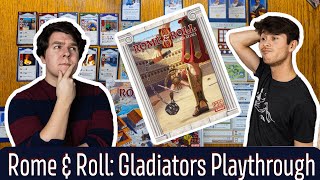


Rome & Roll Deep Dive
What the Community Thinks About Rome & Roll
Rome & Roll is a roll-and-write game for one to four players in which you try to win over the right hand of the current king of Rome, Nero. Players draft dice, spend the resources those dice provide, and then build, conquer, trade, and tax their way to the most victory points. The reviewers in these discussions agree that it is an ambitious design for its genre, but they disagree sharply about whether the ambition pays off.
Kovray is the most enthusiastic voice. Ilya and Tyler report that they have played the game repeatedly and enjoyed it, calling the base game really great and saying the expansion balances the experience in useful ways. They also present the expansion material as a prototype and point viewers to the Kickstarter page for updates on rule changes.
The Dice Tower takes a cooler view. Tom Vassel calls Rome & Roll a fairly complex game and questions why it is a roll-and-write at all, suggesting it would have worked better as a straight Euro, pointing to the number of pieces and the amount of material as the problem.
Board of It is the harshest critic. In its quick-fire roll-and-write review, the channel says the game tried to create a heavier and more interactive roll-and-write but did not stick the landing. The channel's July look-back revisits the title and describes it as confusing on first play.
Core Mechanics That Define Rome & Roll
Dice Drafting and Action Selection
Each turn begins with a pool of six dice that is rolled and then drafted. Kovray walks through the order of the draft: the first player takes one die, the next takes two, and the final player takes the remaining one, with the order reversing as more players join. Every die then determines which actions the player may take, so the draft works as both an economic choice and a sequencing puzzle. Kovray notes that more dice enter the pool when more players sit down, and a special black die is rolled separately to move the neutral Foreman token and to place gladiators.
Board of It describes the same rhythm: players roll dice, draft them, and then use the symbols to take actions. The reviewers say the symbology on those dice is crowded, which makes the draft harder to read than it should be.
Conquest, Iron, and Combat Strength
Conquest is the main route to territorial control. Kovray explains that conquering sends a player's units to settlements in different territories, and the outcome is settled by a battle in which warriors, legions, and auxiliaries add to a player's strength. Iron can be converted into auxiliaries, which add to combat strength, or into power during a battle. The Vulcan god favor doubles the iron-to-auxiliary conversion when conquering, and Kovray chose to use it on a conquest turn. A player who conquers also earns glory and places a gladiator, so conquest feeds several other systems at once.
Trade and road building round out the economy. Kovray describes trading resources for points and expanding by building roads, and notes that connecting cities for the first time earns an extra reward.
The Rome & Roll Experience
Turn Flow and Building Chains
In play, Kovray's turns frequently chain together. Building next to an opponent's building also triggers that opponent's adjacent ability, so placement can help a rival. Building a structure can also activate the production ability of its neighbors, and the couple notes that a building constructed this turn cannot activate its own production ability. That rule was added because the Arena can build a Ludus immediately, which would otherwise create awkward timing. Players also face a per-turn limit on gladiator placement, which Kovray describes as a rule for the turn rather than the round.
Pacing can be uneven. Kovray admits that the turns ran longer than expected and that they sometimes forgot to claim points they were owed. Board of It describes the gameplay as clunky and not smooth, with turns that do not flow together easily.
Advisors, Gods, and Final Tallies
Each character has personal advisors that reward specific play patterns. Public advisors are shared: any player may bribe one by paying the resource shown at the bottom of the card and then score the points it describes. Kovray gives the example of a public advisor that pays two points for each senator a player controls. Gods such as Mars and Vulcan are acquired as favors and add bonuses to actions such as raising legions. The game ends when a victory condition has been completed five times or when the Nero cards run out. Final scoring tallies coins, building points, glory, advisor points, and end-game awards tied to the Ludus and to adjacent buildings. In the playthrough's final tally, the advisor track produced a large share of the points.
What Makes Rome & Roll Stand Out
Asymmetric Characters and the Rudiarius Expansion
Kovray praises the player boards for their asymmetry. Each character starts with different advisors and a different route to victory, and the board lists how final scoring works, which Kovray likes because it shows players where points come from. The expansion's Rudiarius is the couple's favorite. Kovray describes the character as a retired gladiator whose special advisors help with using iron, and says that theme and mechanics fit together well. Kovray also values the neutral Foreman, arguing that it is especially good in two-player games and may be even better with more players.
The Colosseum Tic-Tac-Toe Board
The expansion's Colosseum is the most distinctive addition. Kovray describes it as a game of tic-tac-toe played with circles and crosses, where gladiators earned from gladiatorial buildings are placed to claim the board. The couple calls the integration really clever and asks viewers to suggest other games that use a tic-tac-toe mechanism in the same way.
Potential Drawbacks
Crowded Symbology and Unclear Systems
Board of It makes symbology its central complaint. The reviewers say the symbols on the dice are crowded and confusing, and that none of the systems link together especially well. They also found the decision space not particularly interesting, saying none of the powers unlocked through advisors was interesting to them. The July look-back adds that the symbols did not help the learning curve, and one host admits that tiredness may have made understanding the rules harder on the first play. The gameplay itself is described as clunky, with one reviewer saying that trying to do anything felt like shifting a wardrobe around. Tom Vassel's objection to the number of pieces points in a similar direction.
The advisor track also causes trouble. One advisor carries a fifth circle that sits apart from the row of circles, and Board of It says that placement led to missed points in the games it played, because players can easily overlook it.
Physical Components and Board Legibility
Board of It's sharpest complaints concern the physical product. The reviewers say the main board is so poorly designed that, combined with the odd colour choices of the dry-erase markers, it is almost impossible to see the buildings drawn on it. That is a serious problem because buildings drive the gameplay. The board is also busy enough that drawing a building's shape is difficult, and the chunky pens smudge and leave marks that are hard to read. The artwork has drawn comparisons to a 90s CD-ROM educational game about the Romans, and the July look-back says it looks like something a player would have used at school.
If You Enjoy Rome & Roll
- Hadrian's Wall: Board of It recommends it as the heavier roll-and-write to try instead, noting that it made the channel's best-of-the-year lists.
- Railroad Ink and Lost Cities Roll and Write: the quick-fire review recommends these as the easiest entry points into the genre, which suits players who want to test whether roll-and-writes appeal to them before tackling Rome & Roll.
- Metro X and Cartographers: Board of It reviews these as well-respected entries in the genre, with Metro X offering a more complex route-planning challenge for players who want more decision space.
- A straight Euro: Tom Vassel suggests that the design would have worked better as a traditional Euro.
What Reviewers Are Saying
"The symbology on the dice is crowded and confusing. None of the systems link together particularly well, and the decision space just isn't particularly interesting."
— Board of It
"There's just so many pieces, so much stuff. Just make it a straight up Euro game. I think I would have liked it better then."
— Tom Vassel, The Dice Tower
"Because I missed out on a lot of points even scoring some of the roads and that kind of piece because I wasn't getting the stone early on."
— Kovray