



Rush & Bash Deep Dive
What the Community Thinks About Rush & Bash
Rush & Bash is a card-driven racing game set in the Vudu/GodZ universe, and reviewers consistently frame it as a tabletop take on the appeal of Mario Kart. Players build a track from modular tiles, fire missiles, drop bombs, and ram rivals into boulders while racing to the finish line first. The overall verdict is favorable but measured. Enthusiasm centers on the chaos and on how a single turn can reshape the standings, while criticism focuses on presentation and on how much strategy sits beneath the zany surface.
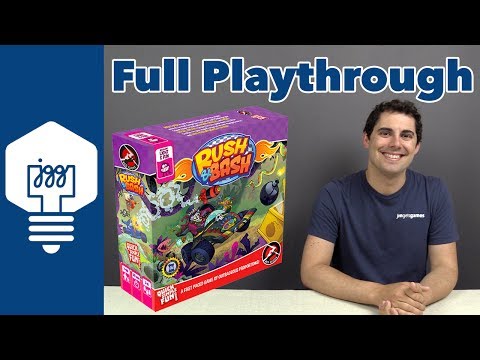
The Getting Games channel ran a full four-player playthrough and treated the game as more tactical than its appearance suggests. In a monthly vlog, the same channel previewed the game as one that "looks light but could be a lot of fun," and the playthrough showed how the choice of card, and how far to move, carries real weight. The Dice Tower took a briefer and more skeptical view in a segment on lower-ranked games. Tom Vasel called the game "okay," said it looks a little dated, and placed it among light racers that borrow the Mario Kart formula.
Core Mechanics That Define Rush & Bash
Combat: Damage Based
Every car carries a damage track, and combat plays out as a war of attrition rather than a single decisive hit. A missile fired from a car travels forward in its current lane until it strikes a checkpoint, a car, a bomb, or a boulder. A car struck in a collision takes damage and is flung forward, and a car that accumulates enough damage is spun off the road and returned to the last checkpoint. Repair actions restore lost health, bombs damage every car adjacent to them when they explode, and a car in the lead with low health becomes a target for missiles from behind. In the playthrough, two cars ran over a steam vent while a yellow car sat on a red space, forcing a track die roll that knocked it off the road. Positioning mattered as much as raw speed.
Card-Driven Movement with Rush and Sprint Hands
Each turn, a player selects one of the three cards in hand, executes its optional top ability, and then applies its acceleration value along with any steering. Players then draw back up to three cards, and the deck they draw from depends on their current place in the standings. Leaders draw Sprint cards with modest acceleration, while trailing cars draw Rush cards with higher values, so falling behind is partly offset by a stronger hand. Boost tiles add movement by flipping the top Sprint card at the end of a turn, and each time a car enters a new tile, the track die determines where boulders are placed. The reviewer at Getting Games described the central tension as knowing when to go fast and when to hold back. The gap between second and third place can look small on the board, yet it can mean the difference between drawing a Sprint card and a Rush card.
The Rush & Bash Experience
Racing
The game feels like a genuine race, with positions changing hands and finish-line tension building as the field closes. The playthrough showed lead changes several times, and cars often traded places within a single round. Once a car crosses the line, it can no longer trigger special actions and simply holds its spot for the final standings. When positions are close, the game supplies a physical ruler that is laid across the binoculars on the board to settle who is ahead, which reinforces the sense that every space of track counts.
Chaotic
Rush & Bash is intentionally unruly. Bombs left in the road explode and damage everything nearby, and missile cards can clear a boulder, open a path, or punish a leader from behind. Star power abilities can swing an entire race. One car's Grog Cannon blast hit every car ahead of it for two damage regardless of lane, while a hard club ability forced adjacent rivals to discard their hands. Reviewers described the game as zany, and the playthrough reflected that: a single move could knock a leader off the track and send the whole standings sliding. The appeal lies in watching the chain reactions unfold rather than in precise calculation.
What Makes Rush & Bash Stand Out
Tiles That Reshape Every Race
Players assemble the course from a large pool of racing tiles, each carrying its own effect, and reviewers praised the variety of layouts. The Getting Games playthrough built a course with a volcano and a bridge that passes over the main track. Steam vents and lightning bolts trigger hazards as cars cross them, and the bridge merges every lane into a single file, leaving cars on it exposed to missiles and rear-end collisions. Other tiles bring rockfalls or let cars fall off a bridge as new players climb on. The reviewer noted that these map variations give the game a lot of variety while the core rules stay simple.
Star Power as a Shared Ladder
Each car builds a star meter that unlocks escalating abilities, and the decision of when to spend it is central to play. Early levels grant repairs or steering moves, while higher levels offer extra actions, cannon blasts, or the Propeller Rockets, which let a car move eight spaces without changing lanes and pass through obstacles and other cars without affecting them. The Getting Games reviewer chose to bank stars for a larger play, and admitted missing that a rival had fully charged an ability that would hit everyone ahead of it. That tension between saving and spending gives each car its own arc through the race.
Potential Drawbacks
Dated Presentation and Modest Production
Tom Vasel of The Dice Tower said the game "looks a little dated" and described Red Glove, the publisher associated with it, as making many titles that lack high production quality even when they put a lot of fun into them. Vasel summed up the game as "very light." Players who expect polished components, refined art, or a premium feel may find the presentation underwhelming, even though the core chaos of the game is what draws most people in.
Luck and the Track Die
Luck plays a significant role in the outcome. The track die decides where boulders appear and how hazards on red tiles affect cars, and a single roll can turn a comfortable position into a stalled one. The Getting Games host noted that a car was knocked off the track after a roll of four on the first of two dice rolls, and the same host later conceded that a more cautious approach might have served them better in the middle of the race. The game rewards careful reading of the standings, but it can still punish a turn that a player expected to be safe.
If You Enjoy Rush & Bash
Reviewers consistently place Rush & Bash in the same family as Mario Kart, the video game that the board game is frequently compared to for its missiles, hazards, and drive to reach the finish first. Players who enjoy Rush & Bash's damage-based racing and its track full of hazards will find similar satisfaction in Mario Kart, where item play and bold moves can matter as much as raw speed. For groups that want the same chaotic energy in a racing format, Mario Kart offers a familiar reference point for how a racer can keep every player in contention until the final lap.
What Reviewers Are Saying
"Thinking about how far you want to go forward with the numbers is key because you sometimes don't want to be in second place. The difference between second and third place can be almost negligible on the board, but it's a really big difference with you being able to grab those Rush cards versus the Sprint cards."
— Getting Games
"Red Glove makes a lot of these games that don't have super high quality, but they try to put as much fun into them and they can pull that off. This one's very light."
— Tom Vasel, The Dice Tower
"It essentially looks like Mario Kart the board game of just racing around this track with a bunch of zany things happening, shooting missiles at each other and trying to get to the Finish Line first. It looks light but it could be a lot of fun as well."
— Getting Games