/pic1048414.jpg)
Note that there are two editions of Saga.
Saga 1st edition was released in 2011.
Saga 2nd edition was released in 2018.
For more information about the second edition of Saga (aka Saga II or Saga v2), you can Click Here.
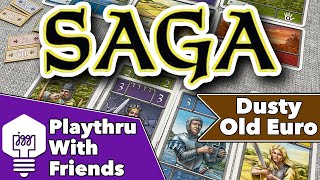
Gripping Beast's Dark Ages miniatures skirmish. Each side has between 25 to 73 miniatures, organised into groups of 4-12 figures. Miniatures are classed as Hearthguard, Warriors, or Levy, and an army comprises of 4 or 6 points of units (1 point = 4 Hearthguard, 8 Warriors, or 12 Levy figures).
Each faction - Anglo-Danish, Viking, Welsh, Norman - has its own battleboard of command options, which are selected depending on the roll of your Saga Dice. Saga Dice have special icons and give your command choices for the turn.
Combat and shooting are simple and based on six-sided dice rolls, the real challenge is to use the options from your battleboard as effectively as possible. The core game comes with a battleboard for the four main factions, with future battleboard releases intended to cover other armies/factions.

Saga - Playthrough With Friends

- continues to be a fan favorite
- people are still picking it up
Mechanics (from transcript analysis)
Video topics + discussion points
Quotes (from this video)
- it cost me two things actions and resources
- the print is that small cuz it does not need to be
- the thing that I thought was cute with one piece is the same thing here is at the beginning of the game you take seven cards off the top of your deck and that's your life and when you take damage you take one of the life cards and discard it but there may be a trigger on it which does something like maybe puts it to your hand I thought that was kind of unique
- Evolution 2.0 that's right Evolution one of my favorite games
- this game is for those of you that enjoy Evolution but want to play with people who have never played
- I'm loving the concept I'm loving the idea of the um individual modules and the various biomes that they're picking
- you can make the deck so the the game so that okay there's not a lot of player interaction not of a lot of attacking or could be there could be a lot of attacking
- we were completely mesmerized by these things cuz they are very cool
- they are actually very helpful for even people of advanced age because it's 4 through 99
- the fact that it's a magnetic setting where you put an overlay in the box and you are sticking these pieces to it just blew us away
- teaching people how to use chopsticks
- this is the miniature game for board gamers
- 45 minutes okay now I'm paying a lot more attention
- this is a skirmish game
- an army is only like 15 Miniatures I could put those together real quick and paint those real quick
- we did another draft event tonight oh my gosh 64 people sign up for the event
- my leaders were all of the villain the dark side that I had
- don't judge a book by its cover
- she made it look easy and I played that leader the night before and I felt like I was an idiot
- you know what am I dealing with here and she just I was like wow
References (from this video)

- Classy aesthetic, fits upscale surroundings
- Strategic board manipulation
- Encourages visualizing lines and space
- Easy to learn and visualize
- Good for couples
- Movement can be tricky (have to go to the end or another piece)
- Can create too much space if not careful
- Aligning pieces
- Ringo
Mechanics (from transcript analysis)
- Area Control (Implicit) — Putting it over here to give yourself more room to move. But having room to move isn't always a good thing. You want to shorten your lines.
- board manipulation — The second thing you do each turn is change the shape of the board. Remove a disc from the edge and put it somewhere else.
- Line movement — Every turn, you move one of your pieces in a straight line in any direction.
- Set Collection (Implicit) — You win by getting all three of your pieces together touching each other.
Video topics + discussion points
Quotes (from this video)
- And Dice Pool Party plays two to eight players and will work for the whole family.
- It's such a silly little game, but it's such a fresh challenge.
- Her favorite is Suspectto, which is a beautifully simple deduction game.
- It feels like it's teaching her things that most other games for toddlers aren't.
- The other game, Troopo, is a great introduction to pushing your luck.
- It's the classic push your luck dilemma, but distilled down to a format that kids can understand, and it works perfectly.
References (from this video)
- hot-potato style gameplay with back-and-forth invasions
- card-driven combat with territory control
Mechanics (from transcript analysis)
- card play with troop color sets — play cards to build sets with troop colors to invade castles
- castle conquest and hand management — invade castles, take over, and regain troops; maintain income each turn
Video topics + discussion points
Quotes (from this video)
- it's a relatively lightweight card game
- looks very pleasant
- i would love to try at some point
- aesthetically pleasing vibe
- i'm genuinely curious to learn more about this
References (from this video)

- mentioned as a classic older euro
- recalled fondly
Mechanics (from transcript analysis)
Video topics + discussion points
Quotes (from this video)
- this is easily my game of the month and right now it's one of the best games I've played in the last year to uh maybe a couple of years
- Randomness uh chaos nightmare essentially
- it's a historical simulation
- the tiebreaker is the number of Windows you have in your Mansions
- the rulebook literally says get comfy you know Brew yourself a cup of coffee it's going to take you a little while to read through this rulebook
- I was not expecting to like this game so much in general
References (from this video)

- gameplay mechanics are expected to be similar to My City
- cannot start another legacy game while currently in the middle of other campaigns
- My City
Mechanics (from transcript analysis)
- hex grid — more hex's going down on the board there is going to be some changes to this one but the core function of the game should be very similar
- legacy — Started the legacy version of sagr.
Video topics + discussion points
Quotes (from this video)
- we have officially played all of the games that we have brought back from Gen Con
- this is going to be a hot and heavy video we're going to go through every game we brought home why we brought them home and what our initial impressions of them
- 10 Penny Parks should be on your on your radar like it's one that you might want to consider it does something different it's Unique it's got a cool theme
- this is four science from gray fox games this is a real time uh stacking and building game trying to solve a science experiment
- three ring circus by games you know I forgot about it still think trick draw T it for me I this would be number two though is okay that it can take number two for you
- it is a tableau you have your three rows of cards and you have to sequence your numbers and the colors in the order that you want them to
- we finished playing all of my city played through the entire campaign
- we started the Legacy version of sagr and as any of you know this is a legacy game so we don't want to start another Legacy game while we're in the middle of a few other titles a few other campaigns
References (from this video)
- beautiful components and elegant drafting
- clear, compact, accessible abstract game
- great variability with window and tool-card combinations
- dice drafting and window crafting with color/number requirements
- Abstract space of stained-glass windows and color-number constraints
- abstract puzzle-like experience
Mechanics (from transcript analysis)
- Dice Drafting — Players draft dice from a common pool into their personal window tableau.
- end-game scoring via patterns — End-game points depend on achieving specific color/number patterns on the windows.
- tile/window customization — Multiple interchangeable windows encourage varied setups and scoring opportunities.
- tool cards — Tool cards modify dice placement and allow strategic mitigation of restrictions.
- window drafting / placement — Drawn dice must be placed into a personal window with color and numeric restrictions.
Video topics + discussion points
Quotes (from this video)
- heat pedal to the metal yes this is it
- this game is abstract it is a fantastic abstract game but also has dice
- Cascadia yeah Cascadia
- my number one is a bag building Press Your Luck
- Quacks of quedlinburg this game this game gets me
References (from this video)
- Snappy turns and quick rounds
- Accessible, lightweight euro design
- Castle abilities add variety and strategic tension
- Two-player play is compact and approachable
- End-game timing can be tense and rewarding
- Potential for variety with different decks and castle abilities
- Can feel chaotic and highly memory-dependent (fame remembering can punish forgetfulness)
- At 2 players, only a single attacking force can be formed at a time, limiting depth
- End-game scoring can hinge on kept track of points, which can be error-prone
- Some players may find it overly zero-sum or repetitive with two players
- Rule memory (e.g., when you gain/lose fame or scores) can cause frustration
- feudal conquest with light fantasy elements
- Medieval kingdoms contending for castles across a shared map
- light, emergent narrative driven by card play and position
- Saga (2-player variant)
- Dusty Euros (category of older Euro games)
Mechanics (from transcript analysis)
- Attacking Force formation — On your turn you place a card to start or extend an attacking force; the card color determines the target kingdom.
- Castle abilities — Each castle provides ongoing or one-time effects (defense bonus, returning a card to hand, or special abilities when conquered).
- Conquest by overpowering defense — If the attacking force is stronger than the defending force, you conquer the kingdom and its castle card shifts to defending status.
- End-game scoring — Ends when a player plays their last card; scoring accounts for conquered kingdoms, Fame, and penalties for unused cards in hand.
- Fame economy and enlistment — Players gain Fame each turn from their castles; Fame can be spent to enlist knights or to influence future placements.
- Hand Management — Each player starts with a hand of 12 cards; when kingdoms are conquered, defending cards go to the attackers' side and may return to hands, creating cyclical value from won/returned cards.
- Shadowlands / one-time abilities — A faction or card with a one-time ability (e.g., adding a card to a defending force) that can be used once per game.
Video topics + discussion points
Quotes (from this video)
- Snappy turns
- I'm so good at this game
- it's like chess
- it's nonsense if you're not actually taking your points
- this is a 19 year old game
- we're beginners
- this game is nonsense if you're not actually taking your points
References (from this video)
- historical skirmish warfare
- historical/skirmish
- Infinity
- Wrath of Kings
- Dark Age
Mechanics (from transcript analysis)
Video topics + discussion points
Quotes (from this video)
- I like to play a lot of demos when I go to conventions just because of what I'm doing here on the channel.
- Be it Adepticon or Gen Con, so be it.
References (from this video)

- Historically flavored and accessible scale
- Solid gateway to larger games in the same universe
- Historical/legendary mix may not appeal to all fantasy players
- Historical/fantasy mix with mythic elements
- Viking-era skirmish warfare
- Historically flavored with some fantasy twists
- Ragnarök
Mechanics (from transcript analysis)
- Dark-age skirmish combat with fatigue and support rules — Base-to-base contact, unit cohesion, and board-based tactical play
Video topics + discussion points
Quotes (from this video)
- Gaslands is a very cool game and it's like 20 bucks
- it's going to be probably more accessible to more people certainly
- I really like the kind of bidding system about how you who goes first
- you can't take Kill Team rules for most models too which is cool
- it's almost like X-wing Star Wars X-wing
- Gaslands is a very cool game and it's like 20 bucks and you go to town
- Kill Team is the way to go... it's the next logical step
- it's not about swapping a lot of weapons as much anymore