/pic5562971.png)
/pic3283110.png)

Santorini New York puts players in the work boots of builders constructing a grand city at the start of the 20th century. During the game, you will move your workers around Manhattan, raising buildings and skyscrapers. To prove your skill, climb atop the tallest building and look down over the city you have built. Only clever tactical moves and cards will bring you victory.
In this 2-5 player abstract strategy game, you'll control 2 workers while all building New York City. Each turn consists of a move and a build, but special Role Cards impact how you play your turn. Each player will have 5 Role Cards, choosing one to play at the beginning of each turn. Once used, it is discarded, which continues until each player only has 1 Role Card left. 4 more are dealt to each player to provide more options.
The first player to move to the third level wins the game, however they must have the Statue of Liberty when they do in order to win. Each Role Card has a number printed on it, showing it's initiative order. Role cards are simultaneously revealed each round, and the player with the lowest number goes first. The player with the highest number takes the Statue of Liberty, and is the only player who can win on that turn, creating an intense and dynamic 'all vs 1' environment every turn.
The game comes with 14 Role Card sets, but only 4 are used each game, providing a large amount of replayability. The game also comes with 6 custom sculpts of the world-record breaking skyscrapers at the turn of the century.
-description from publisher
Part of the Santorini family — see Santorini for the combined view.
/pic5562971.png)

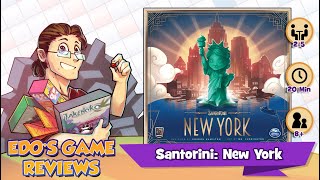
- high production values and deluxe components
- strong variability through a card-driven power deck
- scales well from two players up to five (and with variants potentially more)
- short, punchy rounds that support quick, tense decisions
- accessible entry for abstract-strategy fans while offering strategic depth
- edition differences (Kickstarter vs mass-market) can affect inserts and component feel
- not as deeply strategic as heavier euro games; more tactical and dynamic than purely strategic
- outcomes can be influenced by card draws, introducing luck into the flow
- thematic alignment with New York may be less immediately intuitive for some players used to a Greek-myth flavor
- Mythic gods reimagined within an urban, modern cityscape
- New York City, USA
- god-powers drive asymmetric play; dynamic interactions shape the board state
- Santorini
Mechanics (from transcript analysis)
- cap mechanism — buildings can be capped to block occupancy and movement, increasing strategic tension
- deck of powers — players draft four god-power cards at setup and form a deck that determines abilities and initiative
- dual workers per player — each player controls two workers on a grid, moving and building to gain height and position
- initiative by card numbers — the lowest-numbered card goes first; the highest-numbered card bearer holds the Statue of Liberty and can win the round
- multi-ability builds — certain powers require building in two different spaces or performing extra actions, adding complexity
- special buildings and rooftop — some powers force special constructions (e.g., rooftop) that open alternate victory routes
- Statue of Liberty win condition — only the player with the statue can win on their turn, creating a leader-target dynamic that others try to stop
- variable character powers — each power grants a unique move/build interaction, producing diverse turn-to-turn dynamics
Video topics + discussion points
Quotes (from this video)
- The production value is fantastic and the two-player abstract game with awesome art and personality and theme.
- Could we come up with a new theme for Santorini and could we do it in a way that it could play more than two people and really feel good?
- This is a really nice system... dynamic tactics.
- It's not as deeply strategic it's not as deeply tactical... but it has what I like called dynamic tactics.
- If you've never played Santorini New York and you're not really into two-player head-to-head games I would recommend Santorini New York first.
- Santorini shines more with more players in a way, but certainly works with two.
References (from this video)

- Better with more players than original
- Solid upgrade concept
- Not as strong at two players
- Abstract strategy
- New York version of Santorini
- Two-player emphasis
Mechanics (from transcript analysis)
- abstract strategy / tiling — Two-player or multi-player strategy with building towers.
Video topics + discussion points
Quotes (from this video)
- Shark Park, a memory kind of game.
- they're essentially just more complex versions of the last.
- it feels like it's a bigger game that was streamlined and streamline is often very good, but this one I felt almost a little streamlined too much.
- This one's almost there. And I know a lot of people love the Talisera.