

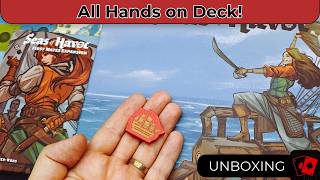





Seas of Havoc Deep Dive
What the Community Thinks About Seas of Havoc
Reviewers who have actually sat down with Seas of Havoc tend to remember it as a good time first and a tactical puzzle second. The loudest praise comes from The Dice Tower, where Tom Vasel called Seas of Havoc a favorite pirate game and singled out its deck-building as the reason it stands apart from the rest of the genre. Ryan and Bethany from Ryan and Bethany Board Game Reviews placed it in their top 100 of all time, and their praise leans on the laughs and the fond memories that come from playing it with friends.
The Watch It Played segment took a similar view from a viewer-pick angle. The host relayed a viewer's description of it as a sneaky deck-building game where you blow up your friends with cannons, and said it looked really good and was a game they wanted to check out. Their enthusiasm centered on how the worker placement and card play work together during combat.
The most cautious voice comes from the Watch Review store-visit video, which previewed the game on a shelf rather than at a table. That reviewer liked the island phase on paper but found the confrontational ship battles and the pirate combat theme less appealing, and said they might enjoy the solo mode more. Because that take comes from reading the box, it is best treated as a first impression rather than a verdict on how the game plays.
Core Mechanics That Define Seas of Havoc
Seas of Havoc is built on two loops that reviewers keep returning to: a resource economy on the island and a deck of cards that drives the ship at sea. The two feed each other, which is a big part of why the game holds attention.
Resource Management on the Island
The island phase is where the game's economy lives. Players send their skiffs to worker placement spaces to gather resources, improve their decks, and repair and upgrade their ship. Watch It Played described the same structure, and the Watch Review reviewer picked up on it as the part of the game that most appealed to them, since it is where you build up your ship and crew before heading out to fight.
Because every placement on the island competes with other needs, the choices carry real trade-offs. A resource spent on repairs is a resource not spent on a stronger deck, and the right answer depends on what the next sea battle is likely to demand. That tension between preparing for the sea and surviving it is what gives the island phase its weight.
Deck-Building That Steers the Ship
The second mechanic is the one Tom Vasel spent the most time on. In Vasel's telling, the ship is the centerpiece of the board, and players move it around, collect treasure, and fire on other pirates, all through a deck of cards. Your hand determines how your ship maneuvers, navigates obstacles, searches shipwrecks, and fires cannons, and the multi-use cards let you choose between several options as a battle unfolds. Because the cards you draw change over the course of a game, the same ship can feel very different in round one than it does in round six.
Vasel drew a direct line to Clank! here. Clank! uses deck-building to delve into dungeons, and Seas of Havoc uses it to move and fight on the high seas. That comparison explains why the game feels familiar to deck-builders while still doing something new with the genre.
The Seas of Havoc Experience
Swashbuckling Silliness
Many reviewers describe the game as silly in the best way. Tom Vasel called it silly fun, and Ryan and Bethany remembered their sessions as genuinely hilarious. Vasel described the theme as swashbuckling fun that is mostly silliness, and the game leans into that tone without taking itself too seriously. That makes it an easy recommendation for groups who want a loud, playful evening around the table.
Strategic Satisfaction in the Combat Phase
Beneath the humor, reviewers say the game rewards careful thinking. Vasel described it as strategic and interesting in the same breath as calling it fun, and Watch It Played pointed to the way the cards let you maneuver better and shoot in different ways than the worker placement alone would allow. The result is a sense that the combat phase is a series of small, satisfying decisions rather than a single big roll of the dice. For players who enjoy planning several moves ahead, that is where the game's appeal sits.
What Makes Seas of Havoc Stand Out
A Captain and Ship Pairing With Special Abilities
Vasel highlighted how each player builds their setup. You pick a pirate and a pirate ship and combine them, and the pairing gives you a special ability and a slightly different starting deck. Because each captain plays differently, the choice at the start of the game shapes how you will approach the sea battles that follow. Reviewers see this as a quick way to make each player feel distinct without adding much rules overhead.
Pacing That Respects the Evening
Vasel also praised the length, saying the game has a very good time length and does not overstay its welcome, which is a relief in a genre where combat-heavy games can drag. Ryan and Bethany's memories of the game point in the same direction, describing a session where traveling, attacking, and collecting kept moving. For groups who want a substantial game that still fits into a single evening, that balance is a major selling point.
Potential Drawbacks
Confrontation Is Central, and Not Everyone Wants It
The clearest concern in these videos is tone. The Watch Review reviewer found the game looked very confrontational, with sea battles and pirates fighting each other at the center of the experience, and said that the adversarial style had not appealed to them in the past. Players who prefer cooperative games or who dislike direct conflict with their friends may find this focus wears thin. The game is at its best for people who enjoy the back-and-forth of battle.
Playful Tone Can Undercut the Tactics
The same reviewers who praise the strategic layer also describe the overall feel as mostly silliness. Tom Vasel calls the combat satisfying and strategic in one breath, then turns around and frames the theme as swashbuckling fun that leans more on silliness than seriousness. Players looking for a tightly tuned tactical game may find that the lighthearted pirate theme pulls against the depth the cards are trying to deliver, so the game sits awkwardly between a cutthroat strategy title and a party romp.
If You Enjoy Seas of Havoc
If Seas of Havoc clicked for you, Clank! is the natural next step. Both games use deck-building as the engine of an adventure, and Tom Vasel drew the comparison directly, noting that Clank! uses deck-building to delve into dungeons while Seas of Havoc uses it to maneuver ships and shoot at rival pirates. Both put you on a risky quest for treasure, so the pleasure of shaping your deck to chase loot carries over from one to the other. Vasel's comparison is the clearest signal in these videos that the two will appeal to the same kind of player.
What Reviewers Are Saying
"I've always liked deck-building games and this game uses deck-building for something really fun. Just like Clank! used deck-building to go and delve into dungeons, Seas of Havoc uses deck-building to maneuver your ship, go around, and shoot at other pirates."
— The Dice Tower
"This game is just absolutely hilarious. I just have a really fond memory of, I don't know, three years ago or something, playing this with Ryan's dad, and it was just really hilarious, like you're going out getting stuff and then you're attacking, you're traveling and then you're attacking, and I don't know, I just had so much fun with this."
— Ryan and Bethany Board Game Reviews
"I was really interested in this because you got your worker placement stuff, when you're doing worker placement stuff but the cards that you're getting allow to maneuver way better and shoot in different ways and out battle your opponents during the fighting bit, and that amalgamation of actions really does make me happy."
— Watch It Played