/pic8037477.jpg)


It’s 1929. You are Captain Sofi Odessa and her crew lost at sea in a strange world. Aboard the steamship Manticore, you must work together to survive by exploring mysterious islands, battling creatures, and meeting the world’s inhabitants. Along the way, seek out the totems of the gods. Wake the gods and perhaps you’ll be able to return home.
Sleeping Gods: Primeval Peril is a short standalone campaign for one or two players, but will include a variant for playing with 3-4, set in the world of Sleeping Gods and using the same rules.
Primeval Peril is set on a dangerous river that winds through lush jungle. It includes new characters and stories so that nothing from the Sleeping Gods base game is spoiled.
It was first offered as a free print-and-play to all backers of the Sleeping Gods Kickstarter.
This first retail edition is revised and expanded with new stories and quests, streamlined gameplay, and an atlas with new maps.
Part of the Sleeping Gods family — see Sleeping Gods for the combined view.
/pic8037477.jpg)



- Ambitious world-building, strong production
- Engaging map and encounters
- Character development and story could be stronger
- Mythic exploration, quest, and survival
- 1920s jungle river adventure setting
- Chapter-driven narrative with storybook encounters
Mechanics (from transcript analysis)
- Exploration map with encounters — Navigate a river map with numbered encounters.
- Narrative Choice — Flip through a storybook and choose options.
- Resource Management — Collect resources and manage health/dice for checks.
- Storybook / chapter progression — Flip through a storybook and choose options.
Video topics + discussion points
Quotes (from this video)
- Creature Comforts I've now played it solo and multiplayer I love it that much
- this is a good lighter weight family game
- I would keep it in my library
- the story is good the character development they're fairly flat
- this is a worker placement dice drafting game where you have two dice
References (from this video)
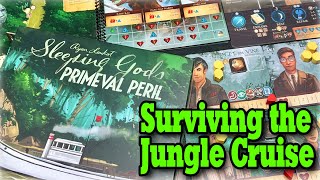
- Great price for the content provided.
- Smaller, condensed, more concise experience compared to the original Sleeping Gods.
- The setting of being confined to a river effectively dictates the scope of the adventure.
- Good use of the map book for exploration and integrated combat pages.
- Well-written, concise narrative passages.
- Interesting deck building element for combat cards.
- Combat continues to be interesting and challenging.
- Health is a resource that is managed through give and take.
- Various useful resource tokens (food, torches, maps, coins, rope).
- The event deck adds unpredictable challenges.
- Branching paths lead to replayability and exploration of different stories.
- Score chasing mode encourages improvement.
- Boat actions control the game flow and turn structure.
- Conveys a strong sense of adventure and survival.
- Feels like managing one crew that works together, not individual characters.
- Easy to manage the party/crew.
- Not as expansive or epic as the original Sleeping Gods.
- Players will bypass things and need multiple games to explore everything.
- An adventure game that reminds the host of the Jungle Cruise.
- On a river
- Sleeping Gods
- Distant Skies
- Warhammer Quest: The Adventure Card Game
- Elder Sign
Mechanics (from transcript analysis)
- boat actions — Players control the boat, taking actions like traveling, exploring narrative events or special spaces, repairing the ship (requiring a crafting test), or taking a rest action.
- Boat Health — If the boat's health reaches zero, a moon symbol is marked off, contributing to an in-game failure condition.
- branching paths — The river has branching paths that lead to branching story segments, meaning not all content can be explored in a single playthrough due to a time limit.
- Combat Puzzle — In combat, players assign combat cards to characters to participate in a puzzle-like system where damage must cover monster health spaces, allowing for splash damage.
- Deck Building (Combat Cards) — Players have a minimum of 12 combat cards in their deck (weapons, gear) and can discover and swap them to improve their combat capabilities.
- End of Round Attacks — Enemies inflict status conditions like poison, weakness, fright, madness, or venom if they are still alive after player turns.
- Enemy Power Icons — Enemies have power icons that add damage tokens when they retaliate, making it beneficial to cover these icons quickly.
- Event deck — An event deck introduces random occurrences, usually negative, that players must overcome.
- Integrated Combat Pages — Combat encounters are printed on the opposite page of the area where they are found, eliminating the need for separate combat cards.
- Keywords — Players can earn new keywords (e.g., 'cursed statue') which have ongoing effects when encountered later in the game.
- Map Book Exploration — Players use a map book with pictures of the river, featuring spaces with interactable elements and corresponding passages in a storybook.
- Narrative Adventure — An open-world narrative adventure game where players guide characters through a dangerous jungle, making story choices and battling creatures.
- Quest cards — Quest cards from a numbered adventure deck track goals, with a single deck containing quests, items, and combat items.
- Resource Management — Players manage character health and stamina, with stamina depletion preventing actions and health loss being a primary risk.
- Resource tokens — Various tokens representing food, torches, treasure maps, coins, and rope can be spent for different effects like healing, skill checks, or finding treasure.
- Rest actions — Limited to six per game, rest actions regenerate stamina and health for characters.
- Score Chasing — A mode where players tally a score at the end of the game to track performance and aim for improvement in subsequent plays.
- Skill Tests — Characters perform skill tests (strength, perception, savvy, cunning, crafting) by combining character skills with dice rolls, with items providing bonuses.
Video topics + discussion points
Quotes (from this video)
- I think that is just a fantastic price for something like this
- this is basically a smaller stripped down more concise condensed version of sleeping gods and pral apparel
- when I got back I I was feeling a little nostalgic for Disneyland and so I thought it would be a perfect time to bring out preval Peril because this really is kind of an adventure game that reminds me of the Jungle Cruise
- all of your combat encounters are printed on the opposite page of the area in which you might find these creatures
- don't worry don't uh fret about about your characters taking damage that's just something that will happen in this game because that is a major resource that you are trying to track
- I can't I can't stress this enough but in this game health is a resource you will be losing it and you will be gaining it it's a give and take it's a tug of war
- it's fun balancing out that Resource Management that kind of survival horror aspect of sleeping Gods along with the different Adventures the different quests the different types of combat encounters you can get into and the different narrative encounters
- I do not feel like I am managing five or nine individual characters I feel like I am managing it one crew it feels like a crew that works together as a single character and it's very easy to manage
- overall I am just generally very happy with this game when I want a shorter more condensed version of sleeping Gods this is what I'll turn to
References (from this video)
- Strong storytelling with well-written stories and memorable characters.
- Accessible two-hour solo experience with meaningful choices.
- Not ideal for players seeking long, sprawling campaigns.
- Some players may want more replayability beyond the shared adventures.
- Story-driven exploration with branching paths and individual character journeys.
- Fantasy/supernatural island exploration with a choose-your-own-style adventure structure.
- Choose-your-own style with modular adventure components and episodic storytelling.
Mechanics (from transcript analysis)
- choose-your-own style branching paths — Player decisions steer narrative outcomes with varying consequences.
- Narrative Choice — Player decisions steer narrative outcomes with varying consequences.
- rest mechanics to avoid failure — Resting prevents incapacitation and shortens looming danger in combat encounters.
- two-hour compact campaign — Shorter boxed campaign designed for accessible but meaningful play sessions.
Video topics + discussion points
Quotes (from this video)
- It's basically Space Invaders, the board game.
- Deduction and survival. The way that the deduction works in this game is fantastic.
- The best thing easily about this game is the stories that it tells. It's really well written. I love all of the characters.
- The explosive dice mechanic is just so sick.
- Playing solo board games has completely changed the way that I look at board gaming.
References (from this video)
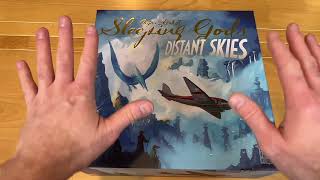
- offers a streamlined entry into the Sleeping Gods universe for 1-2 players
- tight, engaging play sessions that still feel like a proper Sleeping Gods adventure
- strong narrative flavor with varied hazards and encounters
- less room for sprawling exploration compared to the main game
- some players may prefer the breadth of the base title or Distant Skies
- adventure-driven exploration with escalating hazards and a tighter playtime window
- Another installment in the Sleeping Gods universe, delivering a shorter, more focused experience that still threads into the same world of distant exploration.
- campaign-style scenarios with a compact, more approachable setup
- Sleeping Gods (base game)
Mechanics (from transcript analysis)
- combat deck evolution in a shorter frame — A compact combat deck system with new cards that support shorter, more contained conflicts.
- Combat: Deck/Hand — A compact combat deck system with new cards that support shorter, more contained conflicts.
- expanded hazard and curse system — New hazard tiles and curses alter outcomes and challenge players with status effects and tricky decisions.
- quest deck and loot progression — A distinct quest card set that drives shorter campaigns while still offering meaningful rewards.
- river journey and map variety — A river-based travel mechanic that introduces fresh locations and hazards within a more compact play session.
- save and replayability within a compact campaign — Even in a shorter module, players can replay with different routes and outcomes to experience new content.
Video topics + discussion points
Quotes (from this video)
- this is a super fun adventure game
- there are six different endings
- this one is going to be a lot shorter, about two hours
- we're going to be back with distant skies and primeval peril