/pic1339353.png)
In Sleuth, a classic deduction game from master designer Sid Sackson originally released as part of the 3M Gamette Series, players are searching for a hidden gem, one of 36 gem cards hidden before the start of the game. The remainder of this gem deck – with each card showing 1-3 diamonds, pearls or opals in one of four colors – is distributed evenly among the players, with any remaining cards laid face up. Thus, you and everyone else starts with some information about what's not missing.
A second deck contains 54 search cards, each showing one or two elements, such as diamonds, pairs, blue opals, red pearls, or an element of your choice. Each player receives four face-up search cards; on a turn, you choose one of those cards and ask an opponent how many gem cards they have of the type shown. If you ask for, say, pairs, the player must tell you how many pairs they hold but not which specific pairs; if you ask for something more specific, say, red diamonds, the player reveals to everyone how many such cards she holds while you get to look at them in secret.
Players track information on a score pad. You can guess the hidden gem at any time, or on your turn you can ask any one question regardless of which search cards you have, then immediately make a guess by marking your sheet and checking the hidden gem card. If you're wrong, you keep playing but can only answer questions; if you're correct, you win.
The simplicity of the rules and the cards belies the complexity of the game. In some cases you see cards, while in others you hear only the number of cards that an opponent holds, making it tough to deduce. Any notation system you devise must be both flexible and reliable, recording negative information as well as positive in order to tick off the possibilities one by one...
Reimplements:
The Case of the Elusive Assassin, with the core mechanisms of that game being used in Sleuth, minus the game board, movement and player proximity.

47 New Board Games - UKGE 2025 Haul

- Hoped to elevate the original game with more life
- Original had limited replayability
- Santa Maria
Mechanics (from transcript analysis)
- Dice Drafting — The host mentions the original game, Santa Maria, is a great little dice drafter.
Video topics + discussion points
Quotes (from this video)
- I just got back from the UK Games Expo. I had a great time as always and I just wanted to make a quick video talking about all of the games that I acquired during the expo.
- The brig and buy was was great, but it was very chaotic and long long cues and longer than we've had before.
- So, definitely um was at capacity. Yeah, the brig and buy was was great, but it was very chaotic and long long cues and longer than we've had before.
- So, I definitely recommend going at least once if you have the faintest bit of interest.
- But for everybody else, I'll see you next time on Chairman of the Board. Bye-bye.
References (from this video)

- Difficult and complex deduction
- A strong entry from Sid Sackson
- Deduction
Mechanics (from transcript analysis)
- Deduction — Players deduce the location of gems based on information gathered during play.
Video topics + discussion points
Quotes (from this video)
- It's all about the narration, the story, the the you know, and that's I still get caught up in this map.
- It was called Remote Possibilities.
- Scotland Yard, it just it's one of those games that's way ahead of its time.
- Sid Sackson was Way ahead of his time.
- This game almost just This started a genre, but then didn't.
- Cosmic Encounter is the or one of the original asymmetric games.
- Also introduced the traitor mechanism, which was a really cool concept that again didn't really become a thing till years later.
References (from this video)
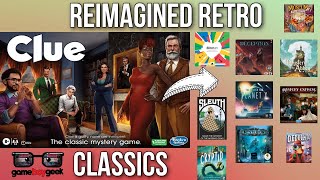
- streamlined from Clue’s original mechanics
- very strong pure deduction experience
- some randomness was removed but still present via cards
- crime investigation and logic
- A murder mystery with a streamlined deduction system
- pure deduction with minimal randomness
- Clue
Mechanics (from transcript analysis)
- Deduction — Logic puzzle where players deduce the murderer based on given questions.
- questioning constraints — Asks predetermined questions and deduces through a constrained set of possibilities.
Video topics + discussion points
Quotes (from this video)
- Clue even inspired an entire genre of games called social deduction.
- This is an absolute masterpiece.
- Sleuth... best straight logic pure deduction games out there.
- An art interpretation game, similar to say Dixit.
References (from this video)

- Classic deduction lineage; strong social interaction
- Scales from 3-7 players (per video)
- Speaker has limited hands-on experience; still early in evaluation
- Detective work
- Deduction; missing gem puzzle
- thinky, puzzle-driven
Mechanics (from transcript analysis)
- information reveal — information is revealed to all players as questions are asked
- preset questions — players use preset questions to elicit information
Video topics + discussion points
Quotes (from this video)
- "Caesar sees Rome in 20 minutes"
- "this is like the spiritual successor or at least a sister game or a partner game to paulo maurice blitzkrieg"
- "I believe you're investing in these companies these companies can merge with each other so it's just all about making profit"
- "Detective Club and the expansion"