


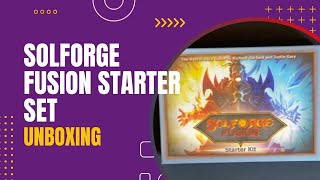


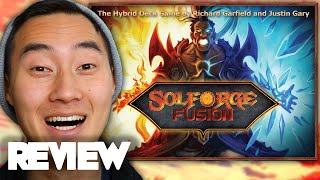

SolForge Fusion Deep Dive
What the Community Thinks About SolForge Fusion
SolForge Fusion divides reviewers in a fascinating way. Those who embrace its innovative leveling system find themselves floored by the experience, recalling the giddiness of discovering card games in childhood. Shelfside's reviewer described it as capturing "that magic of being an eight-year-old again and just discovering a new card game that you want to commit a ton of time to." Yet the community also voices real frustrations: the absence of a physical rulebook, fiddly components, and no built-in life tracking make the game feel rushed to market. The leveling system, though, keeps reviewers coming back. It is the mechanic that redefines what a card duel can be, shifting how players think about every single card play from turn one.
Core Mechanics That Define SolForge Fusion
Card Leveling System
The standout mechanic is the card-leveling system. Every time you play a level 1 or level 2 card, you immediately replace it with the next level version, which goes into your discard pile. When your deck cycles (which happens every three turns), that upgraded card shuffles back in. A level 1 card might generate a resource; its level 2 version generates that resource plus something better; by level 3, it transforms completely. One reviewer highlighted a dragon egg that does nothing when played at level 1, becomes functional at level 2, and at level 3 deals five damage to all opponent creatures when played. This progression makes every card a puzzle: do you rush to level 3 for raw power, or keep a level 2 version in your deck for consistency? The system rewards long-term thinking while punishing greedy plays, creating a unique tension no other card duel captures.
Forge Board Abilities and Deck Cycling
SolForge pairs the leveling system with Forge boards, each offering a unique ability that levels up alongside the cards. Every three turns (one deck cycle), your Forge board levels up and unlocks a new ability. You only play two cards per turn, discarding the rest and reshuffling your deck three times per game. This tight economy makes every card choice meaningful. Reviewers noted that you cannot simply flood the board with creatures on early turns; you must carefully orchestrate which cards to level and when to activate your Forge board's abilities. Two different Forge boards come in each starter kit, letting you choose which asymmetric power you want before each game. The Forge board system also determines turn order and placement restrictions, adding a layer of positioning strategy as you decide whether to play offensively in the front row or defensively in the back.
The SolForge Fusion Experience
Nostalgia and Childlike Wonder
Multiple reviewers described SolForge Fusion in terms of emotional resonance rather than mechanics alone. One reviewer, who spent years chasing a replacement for the Yu-Gi-Oh experience after moving on from competitive play, found SolForge the closest match. Shelfside's 2022 top experiences list placed SolForge Fusion at number two after just one play, describing the feeling as pure enchantment. The game does not punish you for drawing weak cards late (since you only play two cards per turn anyway), and it does not overwhelm with fussy combat resolution. Instead, reviewers felt what one called "such little friction to see cool ability here, big monster here, or area of effect spell here." The simplicity underneath the innovation let players focus on enjoying big moments and fun interactions rather than parsing rules.
Tactical Richness and Card-Game Mastery
Beneath the nostalgic surface lies genuine tactical depth. Reviewers emphasized that the game is "easy to learn but hard to master." As players progress, they begin tracking opponent leveling patterns, memorizing their deck's contents, and anticipating what upgraded threats might arrive in the next deck cycle. One reviewer noted that watching when an opponent shuffles their discard pile "really wants to keep in mind that this level 2 dinosaur with a way to boost itself to 15 attack is probably one of the upcoming turns." The Forge board decision of whether to use its ability early for tempo or save it for a late-game swing adds another layer of play. Skilled players start making nuanced decisions about which cards to level up first, recognizing that rushing a level 3 might be worse than balancing your deck across multiple progressions.
What Makes SolForge Fusion Stand Out
Innovative Card Progression System
The leveling mechanic is distinctive in tabletop card gaming. It shares DNA with Magic: The Gathering (both designed by Richard Garfield), but the physical card progression creates decision trees no mana-based system can replicate. You are not just deciding what to cast; you are deciding whether to advance a card that will be stronger later or take a different action entirely. Reviewers praised the system for letting "seemingly useless level 1 monsters" transform into "huge level 3 things," rewarding strategic foresight. The progression also justifies the odd rulebook quirk of level 3 cards being permanently removed from the game when they die, which on first read seems punitive but actually ensures that leveling matters and late-game threats stay threatening.
Superb Card Readability and Art Clarity
In an era of bloated card games (reviewers specifically cited Yu-Gi-Oh's overwhelming text walls), SolForge Fusion stands out for clarity. Each card's attack, health, level, and ability are easy to scan. Key terms are bolded; symbols are generous and intuitive. The level progression is marked with a clear border on the card, and the stats preview for level 2 and 3 versions appears in the corner so you know what you are leveling into. One reviewer noted that "card descriptions are so easy to read, none of this old school Yu-Gi-Oh stuff I had to deal with in the past." This attention to usability makes the game accessible to newcomers while remaining deep for veteran players.
Potential Drawbacks
Missing Physical Rulebook and Minimal Online Rules
The most glaring issue reviewers cite is the complete absence of a printed rulebook. The game ships with only a small reference card explaining keywords, leaving players to hunt online for rules. One reviewer called this "incredibly rushed" and noted that the online rules are "too minimalistic," especially for non-Magic players. Key concepts like deck cycles and the banished area are not clearly explained, and the turn structure does not appear on the included reference sheet. Reviewers had to have a laptop at the table during their first game just to understand how turns worked. For a game where every action matters, this omission feels like an unforced error that dims what should be an excellent first experience.
Fiddly Components and No Integrated Life Tracking
Beyond the rulebook, the non-card components are disappointing. The mats are paper, not neoprene, and stick up at the corners, making cards sit poorly. The tiny disc markers to track Forge board ability use are so small they resemble garbage from a hole puncher and blend into the table; multiple reviewers described losing these markers. There is no integrated way to track the 50-point life totals, forcing players to use phone calculators or provide their own dice. The thin square health tokens included block card art and are hard to manipulate. One reviewer summarized the situation bluntly: "Components that aren't cards just suck in this game." Players will need to homebrew solutions using multiple colors of dice or similar workarounds, adding friction to an otherwise elegant game system. Shelfside noted the disconnect between the pristine digital version (where life totals update automatically) and the physical mess, making TTS feel like the more polished experience.
If You Enjoy SolForge Fusion
Magic: The Gathering shares SolForge Fusion's designer and some design DNA, but Magic can feel bloated by comparison. SolForge strips away mana management and tapping, keeping the focus on creatures and combat. Yu-Gi-Oh players seeking to recapture the tactical pleasure of older card games (before power creep took over) will recognize something of that magic here, though SolForge is simpler and shorter. Ashes Reborn and KeyForge, both notable for novel deck-building constraints, share SolForge Fusion's spirit of trying something different within the card game space. If you loved the pre-built deck innovation of KeyForge but wanted more player agency in how cards progress, or if you enjoy Magic but find yourself craving a tighter, faster experience with clear readability, SolForge Fusion is your next obsession.
What Reviewers Are Saying
"During all this time I've been chasing the next card game. I've tried Magic the Gathering, I've tried some Vanguard, I've tried some Android Net Runner, and then of course I've played fairly recently Ash's Reborn. I do like, or really like, all these games, with Ash's Reborn being the clear favorite."
— Shelfside
"This one playthrough I had with it was so fun and we're talking about board game experience of 2022. It recaptured that magic of being an eight-year-old again and then being at a friend's house and just discovering a new card game that you want to commit a ton of time to."
— Shelfside
"The innovative leveling up system is the standout mechanic here. Upgrading your cards by constantly replacing them in your deck makes you view this Mage Dueler in a completely new way. It's like your deck building as you play. This adds a whole another layer to simply just playing one card a turn."
— Shelfside