




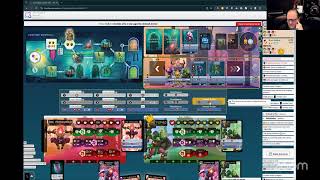




Soul Raiders Deep Dive
What the Community Thinks About Soul Raiders
Soul Raiders divides the table between those enchanted by its ambitious design and those frustrated by its unclear rules and punishing difficulty. Reviewers recognize the game as a genuinely unique experience: a narrative-driven cooperative adventure that refuses to be categorized as a typical dungeon crawl or tactical skirmish. The passion from its designer Marc André (of Splendor fame) and its beautiful production are praised across the board. Yet some players hit hard against the learning curve and what they perceive as a punishing design that can end a character quickly and with little warning.
Core Mechanics That Define Soul Raiders
Exploration Deck Building
Each player starts with a shared deck structure they can upgrade throughout play. The elegance of the system lies in its flexibility: cards can be combined in many ways, stacked to create larger numbers, or used individually depending on the challenge at hand. As players lose health (called Vitality), they draw fewer cards each round, forcing harder choices and increasing tension organically. This creates the roguelike aspect reviewers mention: sometimes you must wait for a better hand before attempting a harder task, and sometimes you must make do with what you have and accept the risk. The deck itself becomes the engine driving decision-making, evolving as players acquire new cards from the shared market.
Simultaneous Cooperative Exploration
Unlike turn-based games, Soul Raiders operates with all players acting at once without a formal turn order. This simultaneous play creates genuine coordination challenges: one player can venture into a distant area while another stays behind, but their choices affect a shared threat meter and a common health pool. When a player raises the threat level through their actions, everyone faces stronger monsters. This interconnected danger system encourages communication and consequence-aware decision-making. Characters have different starting strengths that specialize them in particular skills, meaning the party's composition matters as much as individual resourcefulness.
The Soul Raiders Experience
Narrative Branching, Not Storytelling
Soul Raiders feels closer to a point-and-click adventure game than a battle simulator. The game is structured around exploration of a setting with multiple paths forward, and any path can lead to completing the chapter's objectives. Reviewers describe it as a "Seventh Continent light" experience: you arrive in a place, and you could go several different directions. Many of those directions will remain unseen on your first playthrough. This creates the foundation for high replayability, the designers intend for players to return and explore the roads not taken, seeing new events, encounters, and stories unfold.
Failure as Progression
The game embraces a counterintuitive design principle: failure does not mean starting over. If players cannot complete all objectives in a chapter, they still progress to the next one, but with consequences and unique setbacks that persist throughout the story. This philosophy keeps players engaged and invested in the narrative arc rather than punishing them into frustration. Combined with the roguelike card draw mechanic, it creates a game where smart choices and resource management matter, but bad luck or a tough decision doesn't end the experience.
What Makes Soul Raiders Stand Out
A Fantasy Adventure That Doesn't Feel Like One
Marc André's design sidesteps the standard dungeon-crawl tropes entirely. There are no minis being plopped on a grid for tactical positioning. There is exploration, but it feels like reading a map and making meaningful choices about where to go, not just moving tokens. The game creates a genuine sense of a narrative journey unfolding cooperatively, where each player's decisions ripple outward. Reviewers appreciate that the accessibility of the system (easy to learn, not overwhelming) allows the thematic experience to shine through without grinding gears of complexity.
Production Quality and Ambition
The physical presentation left reviewers speechless. The game comes in a custom book-shaped box with magnetic flaps, and the inside is organized into numbered chapter envelopes and card boxes with lids. Every component has a textured, premium feel. The artwork throughout is gorgeous, with detailed isometric or point-and-click adventure-style scene art that creates atmosphere. Reviewers note that the level of care in production is extraordinary, this is a fully realized vision from creators who understood the world they were building and invested in bringing it to life.
Potential Drawbacks
Unclear Rules and Learning Curve
For a game that emphasizes accessibility, some reviewers struggled to parse the rulebook on first reading. The procedural nature of the rules and card mechanics can feel unintuitive until seen in action. One reviewer noted that watching a playthrough video clarified what the rulebook's examples only hinted at. While the system is elegant in design, it requires engagement during the first play, and players used to more conventional game structures may need patience to acclimate.
Reading and Exploration May Not Translate to Video
Reviewers noted that Soul Raiders, by its nature, involves a lot of reading scenario text and exploring locations. This creates a rich experience at the table, but recording playthroughs for an audience may not produce the most exciting viewing. The game rewards deep engagement with its story and setting, which translates well to direct play but less so to spectating from a distance.
If You Enjoy Soul Raiders
Players drawn to Soul Raiders will find similar satisfaction in The 7th Continent, which shares the exploration and consequence-based narrative design. For those who enjoy cooperative storytelling with high replayability and branching paths, Descent: Legends of the Dark offers a similar commitment to character development within a narrative framework. If you love the simultaneous action and coordination puzzle elements, Andromeda's Edge provides cooperative play without turn order. For players seeking that point-and-click adventure feeling translated to tabletop, games like Lands of Galzir capture the exploration and choice-driven gameplay without Soul Raiders' martial focus.
What Reviewers Are Saying
"It takes that experience of sort of a fantasy adventure and makes it incredibly accessible and sort of the simplicity is a very elegant system with the way you're playing your cards."
— Watch Review
"The deck builder is great as you can use your cards in many ways to kind of combine with each other but you might need to at times wait for a better hand of cards so that you can go for a harder task."
— Board Game Brody, Meeple Mountain
"You just start off and you're like we could go in four different directions and then you might never even see what happens on the other three directions which which is what's going to encourage you to kind of go back and play it again."
— Watch Review