




Sovereign Skies Deep Dive
What the Community Thinks About Sovereign Skies
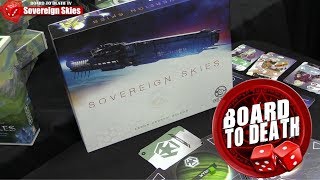
Reviewers who have played Sovereign Skies tend to describe it as a tight, quick euro built around a rondelle, and most of the praise centers on how much each decision matters. John Gets Games is the most detailed voice in the discussion. Its host called the game streamlined, found it easy to teach and easy to play, and came away wanting a few more rounds rather than fewer. Board to Death TV covered the game in a Gen Con interview with its publisher, Deep Water Games, where the pitch was a roughly 45-minute strategic euro in which almost every action feeds several strategies at once.
Where reviewers agree is on the movement system and the scarcity of resources. Where they diverge is on pacing. BoardGameGeek lists a 30 to 60 minute playtime, and the John Gets Games two-player session ran about 40 to 45 minutes, which felt sudden to the players at the table. The host of The Dice Tower, Tom Vasel, mentions the game only briefly in a shelf tour, calling it a small space card hand management game, a label that undersells its rondelle at the center. The John Gets Games host summed up the response well: eager to introduce the game to friends, but not yet rushing out to buy a personal copy.
Core Mechanics That Define Sovereign Skies
Rondelle Movement With Paid Direction Changes
Sovereign Skies places a rondelle, a circular track of action spaces, at the center of the table, but reviewers highlight that it is modular. Each player has a single ship token on the track, and moving forward one space is free. Every additional space costs energy. The distinctive tweak is direction: in John Gets Games' comparison with Navigator, classic rondelles let you move only clockwise, while Sovereign Skies lets a ship travel either way, with a reversal costing two energy. The designer is Aaron Andrew Wilson, according to the John Gets Games preview, and the game is published by Deep Water Games.
The reversal rule matters because in most rondelle games a bypassed action waits for a full lap. Here a player can spend energy to turn back and reach a spot they just passed, so the track rewards planning ahead but still lets players change their minds.
Planet Actions, Energy Economy and Area Control
Each time a ship lands on a planet, its owner chooses one, two, or three actions. Taking one action gains energy, taking two is neutral, and taking three costs energy. The options on each planet include dropping a ship, drawing a card from that planet's stack, and a planet-specific action, such as discarding cards to pick up senators or swapping drop ships for a base. Influence over the planets is the scoring engine. The first player to activate a spot and discard the matching card claims a control token worth three points, and an opponent who later takes control of that planet and discards a card of the same color can take the token back. Energy also flows to whoever controls a planet another player lands on, which is why the economy keeps moving.
The Sovereign Skies Experience
Scarce Resources and Constant Trade-Offs
Board to Death TV describes the game as one in which every choice leaks into the others. Energy is always the limiting factor, so spending a little extra to move farther or to take a third action is always a gamble. John Gets Games framed each turn the same way, asking whether to spend a little extra energy for an edge or hold it back. That tension is the feeling the game aims for: a tight budget that makes a single landing feel like an important decision.
Brisk Competition That Ends Without Warning
Reviewers describe the play as a short sprint with real back-and-forth. The game ends when a set number of control tokens have left the board, and the current round finishes before the scoring. In the John Gets Games session, neither player took a token from the other, because the host realized partway through the game that ending it would be better than attacking the opponent's planets. Both players were surprised by how fast the game finished, but the feeling was closer to a sudden stop than to a bad design.
What Makes Sovereign Skies Stand Out
Easy to Teach, Quick to Play
The most consistent praise is about accessibility. John Gets Games called the game very quick to teach and quick to play, with plenty of competition packed into a short session. Reviewers also appreciate that the iconography is readable enough for new players to pick up the rules without a long walkthrough. The streamlined nature of the game makes it a strong choice for a table that wants a euro with real decisions but without a long learning curve.
A Modular Rondelle That Changes Every Game
Because the board is modular and shuffled each time, the order of the action spaces changes from one game to the next. John Gets Games pointed out that this sets the game apart from fixed rondelles such as Navigator, where the same wheel appears every time. Combined with the freedom to reverse direction, the layout turns the track into a navigation puzzle rather than a memorized route, and players must reassess their options whenever the setup changes.
Potential Drawbacks
A Game That Can End Before Players Are Ready
The most common concern is length. The John Gets Games host noted that the designer or publisher had said the game was designed to be quick, and that a session of about 40 to 45 minutes met the advertised playtime. Still, the host wanted more rounds, and the ending trigger depends on how many tokens are removed from the board, so it can arrive earlier than players expect. Players who prefer a longer, more contested game may find the end too abrupt, especially if the planned token swings never happen.
Energy That Flows Freely in Two-Player Games
John Gets Games also questioned whether the economy stays tense at two players. In a two-player game there are six planets, and each player tends to control three, so landings on an opponent's planet frequently generate energy. The host often found that taking three actions was affordable, which reduced the sense of scarcity that defines the game. The host suspected that a larger player count would change the balance, since players would control fewer planets on average. That criticism was tentative after a single play, but it is the main reason reviewers want to see how the game plays with more people.
If You Enjoy Sovereign Skies
John Gets Games compared Sovereign Skies directly with Navigator, which uses a classic pay-more rondelle that moves only clockwise. Players who like the energy spending and planet actions of Sovereign Skies should find Navigator familiar, while the reversal rule in Sovereign Skies is the main difference to notice. For a different take on the same genre, Nova Luna uses a circular track where taking tokens gradually shrinks the options until the board refills, giving the same pleasure of watching a shared track narrow over the course of play.
What Reviewers Are Saying
"The cool thing about it is that every single action that you're faced with is going to influence multiple different strategies that you can take."
— Board to Death TV
"It was so easy to teach and had so many cool things going on like some elegant competition back and forth."
— John Gets Games
"In Navigator you can only go clockwise around that wheel and in fact most of the rondelle games that fit that classic definition go clockwise, but Sovereign Skies throws a little bit of a wrench into that, where you can go clockwise or you could spend a decent amount of resources to turn around and then go in the other direction."
— John Gets Games