


Space-Off Deep Dive
What the Community Thinks About Space-Off
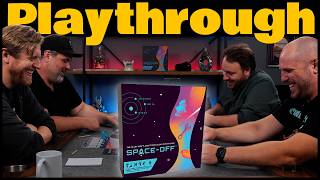
Space-Off arrives with a comic premise that reviewers pick up on immediately. Two stranded crews of astronauts must reclaim their landing craft from local aliens who are holding its pieces for ransom, and the only way to win them back is a tournament of silly tasks. The Brothers Murph, in a playthrough sponsored by Rule 1 Games, set the tone from the first minute, with Nick and Mike introducing the game as a very silly affair for four to 10 players that mixes physical challenges, hide-and-seek, and word puzzles with curse cards that keep piling on top of everything else. Their playthrough stays loud and physical from start to finish, and the hosts spend as much time laughing at their own mistakes as they do playing the game.
The Dice Tower takes a more reserved look. In an unboxing video, Tom Vasel had the game only as a box, and was openly unsure what to make of it from the packaging alone, pointing to a tagline about tossing, tricking, daring, sketching, and solving that did not tell Vasel much about what play is actually like. That unboxing is a first impression rather than a verdict, but it captures the fact that Space-Off makes its case at the table, not on the shelf. Watch It Played offers a warmer memory. In a live show, the host recalled a Space-Off playthrough with their son Luke that was a lot of fun, down to the sound effects the pair made up along the way. When a viewer asked for a rematch, the host said there were no current plans, but the request itself suggests the game has an audience that wants to revisit it.
Core Mechanics That Define Space-Off
Tug-of-War Lander Scoring
The scoring engine keeps the chaos pointed somewhere. The lander pieces sit between the two teams, and completing a trial pulls a piece one space toward the winning side. The Brothers Murph explain that the goal is to control enough pieces at the same time to take the lead. If neither team wins outright after several rounds, the last lander piece is drawn and the endgame shifts to a series of grand trials, where each success earns a cube and the first team to collect three cubes gets off the planet. Reviewers describe this as a tug-of-war in the most literal sense: every trial pulls the rope a little further, and the rope rarely stays still for long. Because the win condition is spread across the whole game rather than settled in a single event, a team that falls behind early still has a route back into contention.
Team-Based Mini-Game Tournament
Each round moves through a fixed sequence of phases. The active team first draws a curse card, then rolls a die to decide which kind of trial it will face. Witch trials are puzzles and creative challenges, tough trials are physical tasks that get everybody moving, and gotcha trials are secretive, requiring players to trick their rivals into completing a goal. The gotcha example given in the description is a player claiming a rival's shoes are untied so the rival looks down. The Brothers Murph tried several trial types in a single session. A tough trial asked two players to walk three steps with a cube balanced on each foot, a hide-and-seek challenge had one rival hide a card in five seconds while the other team searched for it within 30, and grand trials pitted both teams against each other in head-to-head contests. The format keeps the whole table engaged even when only a few players are on the clock.
The Space-Off Experience
Physical Comedy and Team Shouting
The Brothers Murph describe a game where the table is rarely still. Players hide cubes under their arms, stand against walls, throw cubes at a rival tower, and take part in a group noise challenge that quickly dissolves into laughter. A player balancing cubes on each foot is a funny sight, but it also builds the tension that makes the best moments land. The video is full of shouting, announcements of who is in trouble, and players reacting to their own failed attempts in real time. Watch It Played's host echoes that energy when recalling their own session, where made-up sound effects were part of the fun, which suggests the game rewards players who commit to the bit.
Rules Interpretation and Table Debate
Much of the humor comes from the rules themselves. The Brothers Murph repeatedly stop to reread card text, debate whether a trial applies to one player or to the whole team, and decide how strictly to enforce the wording. At one point they ask whether a trial applies to both teams or just one of them, and the answer shapes how they approach the rest of the challenge. Tie results, fewest-throw comparisons, and the question of whether team members are working together or competing all produce friendly arguments. Reviewers seem to enjoy these moments as much as the mini-games, because they show how players interpret rules under pressure, and the table quickly learns to negotiate its own house rules when the card text leaves room for doubt.
What Makes Space-Off Stand Out
Mini-Games That Blend Wit, Dexterity, and Bluffing
Reviewers highlight the variety of the trial deck. A single session moves from a spelling contest to a balancing act to a bluffing challenge, and the switch keeps the game from settling into one rhythm. The Brothers Murph point to a dexterity trial in which a player catches thrown cards with one hand, and to a tower-building trial that they compare to reverse Jenga, where whoever knocks the tower over loses. They also joke about struggling with Rhino Hero, which makes the stacking comparisons easy to follow. Anyone who has enjoyed a stacking or dexterity game will recognize the tension, and the rest of the mini-games add a social layer of deception that pure stacking games do not offer.
Built for Late-Night Groups
The Brothers Murph lean into the setting, filming the game late in the evening with the stakes framed as a ridiculous tournament that demands full commitment. The curse cards are a key part of that appeal. Each curse limits what a player can do for several turns, and breaking one of those restrictions means the team fails on the spot, which means the table has to keep track of who is cursed and what they are allowed to do. Watch It Played's host describes the earlier playthrough as a memorable session, and a viewer's request for a rematch suggests the game is at its best when a group is willing to get loud, silly, and a little competitive together.
Potential Drawbacks
Physical Strain and Stamina
The physical trials are the game's signature, but reviewers are candid that they can be hard on the body. The Brothers Murph describe cubes pinned under the arms digging into their ribs, shoulders that were still sore after the session, and a noise challenge that left one player laughing too hard to continue. A curse that forces a player to keep cubes in place while moving around the room is funny to watch, but it is also tiring to play. Groups with players who have limited mobility, or who prefer quieter games, will need to adjust the trials or sit out the most demanding ones.
Rules Clarity and Adjudication
Because so much of the game depends on reading card text quickly, rules ambiguity can slow the table down. The Brothers Murph stop several times to reread cards, and they discuss whether a trial applies to one player or the whole team before settling on an interpretation. Tie results also produced confusion, with a grand trial that ended in a tie leaving both teams without a tug. Players who like clean, mechanical rules may find the freewheeling interpretation frustrating, while players who enjoy arguing about the rules will find it part of the fun.
If You Enjoy Space-Off
Space-Off suits groups who enjoy loud, physical party games and do not mind a little rules debate. Players who like performance-driven party games will recognize the mix of acting, word play, and team pressure. Players who like stacking and dexterity challenges such as Jenga or Rhino Hero should also feel at home with the tougher trials. The best fit is a group of four to 10 players who are comfortable being silly in front of each other, enjoy a bit of physical comedy, and want a game where bluffing and shouting are part of the strategy.
What Reviewers Are Saying
"This is a very silly party game for four to 10 players where we're going to be getting up, doing physical challenges, playing hide and seek, writing words backwards, all sorts of crazy stuff, all while having curse cards that will limit our abilities to do all the other tasks we're doing."
— The Brothers Murph
"Doing this is legitimately difficult, y'all."
— The Brothers Murph
"That was a lot of fun to do. We had wonderful collaborations there in that, and it was a lot of fun to do."
— Watch It Played