



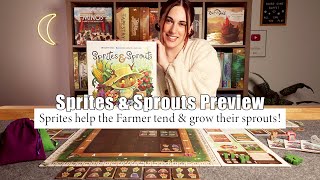
Sprites & Sprouts Deep Dive
What the Community Thinks About Sprites & Sprouts
Sprites & Sprouts is a cozy, puzzle-driven worker placement game published by Open Owl Studios and designed by Manny Vega, the designer behind Flamecraft. Players take on the role of sprites who help a farmer plant, tend, and harvest crops on a shared garden board, competing for victory points through daily harvests and personal challenge cards. Reviewers present the game as a blend of gentle charm and sharp deduction, set in the whimsical Mythwind universe. Every preview available for the game stresses that it is still a prototype, so the components and rules described are subject to change before release.
Reviewers generally place the game in a comfortable middle ground. CVY highlights how quick and easy it is to teach, and how replayable it becomes because of its deduction board. Foster the Mele describes it as a game for players aged 10 and up that delivers a magical thinky experience without being overwhelming, while still offering enough crunch for experienced gamers.
Core Mechanics That Define Sprites & Sprouts
Worker Placement With the Magic Action
Worker placement is the structural backbone of the game. Each sprite begins on the magic space, and reviewers explain that a sprite must move to a different action space on every turn, so the same action can never be repeated back to back. The four available actions are plant, tend, prep, and magic. After taking a basic action, a player places one of their four worker tokens on the garden board, either on an unoccupied crop tile or on a border space around the grid. Only one worker can occupy a given spot, which means positioning becomes a contest for the squares that will matter at harvest.
The magic action is the more interesting wrinkle. According to The Board Game Garden, a player who uses magic places their worker on the action itself rather than on the garden, which lets them perform an enhanced version of plant, tend, or prep. The cost is that the basic version of that action is blocked for the rest of the day, so the choice is one of timing as much as power. The enhanced prep option even lets a player draw a skill tile and move one of their sprites already on the board.
Hidden Harvest Deduction
The second defining mechanic is the hidden harvest. At the start of each day, a farmer card sets the tone for the round, and a harvest forecast challenge card is drawn and placed face down. That card determines which plot of the 4x4 garden will be scored at sunset, and players must work out the location before the reveal. Information arrives through the prep action, where a player draws two challenge cards, keeps one secretly, and reveals the other, which the table then marks with cubes to rule out that plot. CVY argues that this deduction element is the key twist that sets the game apart from other tile placement games, because scoring is tied to a location that everyone must infer from partial evidence.
The Sprites & Sprouts Experience
Cozy Charm and Whimsical Presentation
Charm is the first thing reviewers mention. Foster the Mele calls the game very, very cute, and CVY jokes that the crops have faces so they cannot bring themselves to eat them. The farm setting, the five distinct sprite characters, and the connection to Mythwind give the game a warm and inviting tone. The Board Game Garden frames the premise as a whimsical world in which sprites help a farmer with the crops, garden, and harvest, which makes the sometimes intricate scoring feel approachable.
Puzzle Satisfaction and Calculated Risk
The puzzle side of the game delivers a strong sense of reward. Challenge cards ask players to build specific patterns with their sprouts, including boxes, diagonals, fields, scatters, and trails, and Foster the Mele observes that the puzzle really shines on these cards. Reviewers also describe the thrill of reading the harvest correctly. CVY says that guessing the right location early, with limited information, feels very good, and that a well-planned read leaves a player feeling quite intelligent. That tension between careful deduction and educated guessing is what gives many of the game's moments their memorable character.
What Makes Sprites & Sprouts Stand Out
A Hidden Harvest That Rewards Careful Reading
Reviewers repeatedly point to the way challenge cards double as information. A card held in hand is hidden from the table, but once it is scored or revealed, it narrows the harvest possibilities for everyone. Scoring rewards the player whose workers and tended crops sit in the harvested row or column, so every placement carries a bet about where the farmer will harvest. CVY notes that this deduction board is a major reason the game is so replayable, since each day plays out with new uncertainty.
Skill Progression and Catch-Up Drafting
The skill system is the second standout. Players draw skill tiles from a bag and place them beneath the plant, tend, and prep actions, with a maximum of two skills per action. Those skills can add abilities such as moving a crop anywhere on the garden when tending it. The Board Game Garden explains that at the end of each day, skill tokens are drafted starting with the player who is behind on the scoreboard, which it calls a fun catch-up mechanism. CVY says that because of these skills the game scales up as it is played, letting sprites do more and more mischief across the farm.
Potential Drawbacks
Prototype Components and Rules
Reviewers consistently stress that the preview copies are prototypes. The Board Game Garden notes that the components on display are prototype and subject to change, and Foster the Mele adds that the rules as well are provisional and that the video is not an official how to play. Anyone considering a purchase should treat the rules and layouts described in these previews as a snapshot of work in progress rather than the final product.
Deduction That Can Tip Into Guesswork
The hidden harvest is also the source of the game's main frustration. CVY acknowledges that a gamble on an early guess can pay off, but warns that sometimes the choice is really just a guess. A player who invests heavily in one row because they are convinced the harvest will land there can see that investment wiped out when the forecast card reveals a different location. Reviewers also describe the daily clearing of the harvested row and column, which removes crop tiles and sends workers home, as a mechanism that forces players to rethink their garden plans constantly.
If You Enjoy Sprites & Sprouts
Reviewers point to two titles that share the game's creative lineage. Flamecraft is the best-known earlier work of Manny Vega, the designer of Sprites & Sprouts. The Board Game Garden calls it Manny Vega's very well-known game, and players who enjoy this designer's approach to cozy, strategic play will find a familiar sensibility in both titles. Mythwind is the more direct connection. Sprites were introduced in Mythwind, an asymmetric cooperative game from Open Owl Studios in which each player controls a different character. CVY points out that Sprites & Sprouts takes place in the same universe, so fans of Mythwind will recognize familiar faces and can expand a world they already love.
What Reviewers Are Saying
"Deciding to take the enhanced action, whether that is the plant, tend, or prep enhanced action, you are getting more from it. But you are then giving up your ability to do that basic action for the rest of the day. It's this give and take of what you want to do and when you want to do it."
— The Board Game Garden
"You can take that gamble early on and maybe it does pay off. It feels really good when that happens, and sometimes it is really just a guess that can get you farther ahead than everybody else."
— CVY
"If you love cozy games with clever puzzles, Sprites and Sprouts is made for you. It's perfect for fans of pattern building and gentle competition, and shared board dynamics where every choice reshapes the game for everyone else."
— Foster the Mele