/pic265704.jpg)
Publisher blurb
Including a total of 180 plastic figures and dozens of unit types, Starcraft: The Board Game features an innovative modular board of varying sizes, which guarantees a new experience each and every game. An exciting card driven combat system allows players to modify and upgrade their faction with a wealth of powerful technologies. Players can unleash a Zergling rush, use powerful Protoss shields to halt an enemy invasion, or even send cloaked Ghosts out to guide nuclear missiles to their target.
Description
In StarCraft: The Board Game, players battle for galactic domination on a dynamic board of interconnected planets. Planetary setup is already part of the game - every player gets two planets to place, and will place their starting base on one of them. Planets are connected with direct and "Z-Axis" connections that are placed during setup, but can sometimes later be modified during the game, and movement is only possible within planets and through those connections (by means of purpose-built transports).
Each player controls a faction out of six, that belongs to one race out of three - Humans, Zerg, and Protoss. Each faction has a unique special victory condition, but all factions can also win through victory points that are gained by controlling special areas on some of the planets. Players build units and base upgrades with the resources they gather from the planetary areas that they control, and gain access to additional unit types through those upgrades.
Each turn is subdivided into first a planning phase, then an execution phase, and finally a regrouping phase (used for cleanup). In the planning phase, players take turns playing a number of order tokens into stacks on each planet, with orders placed later obstructing the ones that were placed before them. This allows players to set up combos of their own, but also to obstruct plans of other players. In the execution phase then, players take turns again, and when a player's turn comes up he can choose one of his order tokens on top of any stack and execute that one - if all of their orders are obstructed, they skip their action and draw an event card instead. The execution phase isn't over until all players executed all of their orders. Possible orders are Build (used for building both units and buildings), Mobilize (used for moving units and attacking enemies) and Research (see below), and orders can always be Standard Orders or Special Orders, with the special orders having prerequisites but stronger effects.
Players can also research new technologies and thus improve their combat deck in a precursor to more recent deck building mechanisms. Each player is given a combat deck unique for their race at the start of the game, and when they research new technologies then matching cards are added to that deck. This allows the players to customize what cards they will draw; when the last card of the deck is drawn, the deck is reshuffled. Most cards remain in the combat deck once researched, though some researched technologies add effects that are always in play, while some particularly strong combat cards are discarded after one use.
"Reimplements"
StarCraft (video game)

- Scale (number of models) is not the host's preferred style.
- Host lacks nostalgia for the video game IP.
- null
- null
- null
Mechanics (from transcript analysis)
- Army Game — Referenced by the host as a style of game with a large number of models.
Video topics + discussion points
Quotes (from this video)
- I
- I was never super into the video game, frankly. So, I'm not I don't have the nostalgia for it.
- I'm also not really into army games, so like the scale of it, not the physical scale of the models, but how many models there are is also not really my thing.
- I always love making lore for my miniatures in Trench Crusade. It's just so interesting making backstory for each of them.
- I love the new GW Cog fort model, but is anyone going to make a squadron and buy four of them at $210 a piece?
- The white ones are definitely the type that don't take rattle can.
- Shatterpoint biggest problem wasn't really the game. I think it was the feeling of the neglect.
- That walking building sure is cool. Assume I can buy it and it's not totally sold out already.
- Metal minis, that's a tough one. I'm not good at those.
- Sets one and two are grim dark, but three and four lean into the Wim dark. Oh, I like the word whim dark. That's fun.
- I'm going to be working on these guys, which are um the naval raiders from uh Trench Crusade.
- It's such a fun world to build inside.
- I'm probably going to paint these guys up and then when the plastics come out, I'll probably just redo them.
References (from this video)
- strong thematic tie-in to a beloved franchise
- older design may show its age compared to newer mega-games
- asymmetric factions and base-building
- futuristic military sci-fi
- operational strategy with sci-fi flavor
- Forbidden Stars
- Twilight Imperium
Mechanics (from transcript analysis)
- Faction Asymmetry — different factions have distinct abilities and win conditions
- territory and resource control — players compete for map sectors and resources
Video topics + discussion points
Quotes (from this video)
- I had an amazing time but that's a game that you're super engaged with the players and the game for three to four hours so the time kind of flew
- the time kind of flew
- it's funny you say that because I have a built-in clock even if a game is long if there's some element that eventually will wind down and the game will end I love that
- Scheduling in advance is really the way to go
- I rarely actually rarely get to play a three plus hour game
References (from this video)

- vast strategic conflicts, asymmetric factions
- StarCraft universe, sci-fi warfare
- epic, scale-driven wargame feeling
Mechanics (from transcript analysis)
- area-control — Players compete for map zones to gain resources and leverage.
- asymmetric factions — Different factions have unique abilities and victory conditions.
Video topics + discussion points
Quotes (from this video)
- I'm really nervous my hands are sweaty
- it's always fun to play a game with Bons
- my banana costume is amazing
- we're going bananas
- three out of five in this round
- we've got five out of ten points so far
- Gen Con I'll be working for Floodgate part-time so if you want to see me stop by The Floodgate booth and say hi
- you stream both video and board games
- stop watching and go play a game bye
References (from this video)

- Beloved IP with deep strategic potential
- Sought-after for sci-fi wargamers
- Rare/expensive; not widely available
- Terran vs. Zerg vs. Protoss style conflict
- Sci-fi universe (StarCraft lore)
- Forbidden Stars
- Kingdom Death Monster
Mechanics (from transcript analysis)
- Area control and asymmetric factions — Multiple factions with distinct abilities vie for map control.
- Resource management and build-up — Strategic deployment and economy management over turns.
Video topics + discussion points
Quotes (from this video)
- Rick dawn of Kiev this has been on my Grail list actually for a very long time
- damn Friedman fries
- I want all the fastest losses of racing game
- forbidden stars is one I'm really really excited to add to the collection
- Balloon Cup to the collection I want the OG Balloon Cup
- Monster Slaughter ... it's your turn to hunt down and slay those insufferable teenagers
References (from this video)
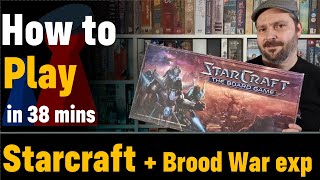
- Complex strategic gameplay
- Faithful to video game source material
- Unique faction mechanics
- Detailed combat system
- Complex rules
- Hard to find/expensive
- Long play time
- Sci-fi strategic warfare
- Interstellar space conflict
- Asymmetric faction warfare
Mechanics (from transcript analysis)
- Area Control — Players expand and control planetary areas
- Card-driven combat — Combat resolved through strategic card play
- Resource Management — Managing minerals, vespene gas, and workers
Video topics + discussion points
Quotes (from this video)
- The galaxy is dominated by three unique and powerful races
- Will you be able to trigger your special victory condition?
References (from this video)
- miniatures and thematic feel
- tension from hidden order token technique and bluffing
- asymmetric factions with unique objectives
- epic space-meets-tabletop vibe with memorable moments
- large/lengthy rulebook (~45 pages)
- long playtime (2-3 hours per typical game; 3-4 hours with more players)
- possible attacker advantage and dice randomness depending on situation
- out of print and expensive on secondary markets
- Faction-based space empire conquest with base-building and strategic combat
- Interstellar space with planets to explore and factions (Protoss, Terran, Zerg)
- Array
- Forbidden Stars
Mechanics (from transcript analysis)
Video topics + discussion points
Quotes (from this video)
- this is an area control game where you gain control of planets through exploration and combat
- the action selection and resolution
- there are these brain games that are going on during this entire phase of putting down the orders
- i honestly felt i was not going to be able to understand how to play this game
- smirk as you put one of your older tokens on top of somebody else
- i love playing protoss and there's nothing better than building a carrier
References (from this video)
- Thematic pull from a popular IP
- Epic scale and player engagement when it lands
- Spectacular components and multiplayer feel
- Long play sessions
- Asymmetric setups and rule quirks can frustrate newcomers
Mechanics (from transcript analysis)
Video topics + discussion points
Quotes (from this video)
- my taste in games over the past 20 years has changed
- the length of time a game can last has changed
- it's not the theme so much as the mechanics that keep me coming back
- I like the idea of changing history in games like Cuba Libre or Watergate
- Ark Nova is the example where the theme meshed with mechanics
- I want to have fun and my window of fun is kind of narrow to what I see on the shelf