


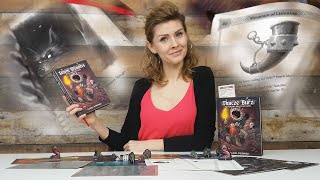

Storm Weavers Deep Dive
What the Community Thinks About Storm Weavers
Storm Weavers is a one-player gamebook that layers tactical combat on top of a classic choose-your-own-adventure structure, and the reviewers who have covered it reach noticeably different conclusions. Jana of ON TABLE Board Games presents it as a warm recommendation for players who want a solo role-playing adventure with a board-based fight system. Drive Thru Games approaches it from the opposite direction, having expected a story-driven hybrid and finding the execution disappointing.
Both reviewers agree on the core format. Each paragraph of the book ends with a choice or a skill check, decisions steer the story, and certain encounters pull out a separate map board for combat. Where they part ways is on whether that combination produces a satisfying experience. Jana sees a book that guides the player like a game master, while Drive Thru Games found the storytelling thin and the combat more of a checklist than a source of tension. Storm Weavers has a Polish crowdfunding history that Jana highlights, and the reviewers' differing reactions suggest that its appeal depends heavily on how much a player values a linear, text-led adventure.
Core Mechanics That Define Storm Weavers
Skill Tests Built on Dice and Attributes
The game's resolution system is familiar to anyone who has played a traditional role-playing game. Jana walks through character creation, in which the player distributes points among attributes such as agility and wisdom, and then explains how a check works in practice. The dwarf protagonist, Timin, has a dexterity value of seven after the base points and the player's own allocation are added, so a roll of 2d6 succeeds on a result of seven or less. Jana notes that the book also includes a coin test as a second kind of check. Because success depends on attributes that the player has deliberately developed, the reviewer points out that investing in those attributes is worthwhile throughout the adventure.
Tactical Combat on Map Boards
The combat layer is the feature that most distinguishes Storm Weavers from a standard gamebook. When the dwarf faces more than one enemy, the reader uses the map boards that come with the book, places the opponents and the hero on the grid, and considers position carefully. Jana describes the result as a real strategic element, since being surrounded changes the fight and attacking with momentum adds strength to the blow. Both sides roll their tests, the results are compared, and the difference determines the damage. Drive Thru Games describes the boards as double-sided, with hex encounter tokens and a deliberately minimalist, abstract miniature style of combat. The reviewer saw these boards as the element that was meant to add excitement to the reading, but found the result did not deliver.
The Storm Weavers Experience
A Game Master in a Book
Jana frames Storm Weavers as a solo role-playing experience in which the book takes the place of a human game master. The player learns the rules from the opening pages, then moves from paragraph to paragraph while the text describes the world and resolves events. The fate of the dwarf is left to the reader, since the decisions made at the end of each passage determine the direction the story takes. For players who enjoy imagining a character's life, that sense of authorship is the main attraction. Jana closes by suggesting that anyone looking for something like this could find the game is made for them.
A Linear Adventure That Can Feel Like a Checklist
Drive Thru Games experienced the game in a very different way. The reviewer had tried several modern gamebooks in this style without enjoying them, and hoped that the mini boards and combat would add enough texture to change that. Instead, the adventure felt like moving from one fixed point to the next, with the reviewer describing the storytelling as uninspired. The combat and dice steps were treated as separate boxes to tick off rather than moments that connected to the narrative. For this reviewer, the feeling of progress was procedural rather than dramatic, which is the central tension in how the game is received.
What Makes Storm Weavers Stand Out
Physical Components and Stretch Goals
Jana gives particular credit to the physical production of the Polish edition. The stretch goals unlocked in the Polish campaign replaced cardboard stands with colored plexiglass standees, which Jana describes as a very nice addition with a strong look on the table. The campaign also added a stretch board with a scratch-off element that reveals content beneath the surface, giving the map a sense of discovery. Jana presents these upgrades as the reason the game deserves attention from players outside Poland, where a Kickstarter campaign is now bringing the title to a wider audience.
A Help Card for Newer Players
The included help card receives consistent praise for making the game approachable. Jana explains that the rules are introduced in the first pages of the book and that the help card is especially useful for players who are less experienced with this type of game. The card explains how encounters are resolved and how the decisions at the end of a paragraph point toward the next section of the story. Because the number of rules a reader must remember can be substantial, this reference material is a practical feature that lowers the barrier to starting a first adventure.
Potential Drawbacks
Limited Replayability
The most serious criticism from Drive Thru Games concerns replay value. The reviewer had been led to expect a book with enough variety to be played multiple times, but felt the game did not deliver on that promise. A single playthrough was not especially enjoyable, and the reviewer doubted that a second playthrough would add much. For a book whose appeal rests on the choices a reader makes, a single playthrough leaves less to discover on the next attempt. Jana, by contrast, emphasizes the depth of the decisions available to the player, so prospective buyers should weigh these two perspectives against their own expectations for repeat plays.
Abstract Combat and a Heavy Rules Load
Combat is the second area where reviewers see room for improvement. Drive Thru Games found the miniature-style fights too abstract to feel like a true tactical encounter, and the combination of dice tests and map positioning did not create the excitement the reviewer was hoping for. Jana also observes that there are quite a few rules to remember, which makes the help card important but still leaves a learning curve. Players who want a board-game-like tactical contest, rather than a text adventure with supporting combat, may find the system less satisfying than the box suggests.
If You Enjoy Storm Weavers
Drive Thru Games makes a direct comparison to Legacy of Dragonholt, which the reviewer generally liked and found to offer a strong narrative structure. Storm Weavers was expected to deliver a similar experience with the added appeal of mini boards and combat, and the reviewer's disappointment is partly a reflection of that expectation. Readers who value a story that unfolds through a sequence of choices and who want a more memorable narrative arc may find Legacy of Dragonholt the more rewarding reference point. Players drawn to Storm Weavers for its solo role-playing focus and its tactical map encounters should approach it knowing that the reviewers' experiences diverged on how well those elements come together.
What Reviewers Are Saying
"So there is a strategic element. It is matter where and how you move around board, whether you are surrounded by enemies."
— ON TABLE Board Games
"very much checking a box, like okay I'm going to do this, I'm going to do this, I'm going to do this, and I've sort of satisfied all of these kind of different buzzwords or something, and it just did not work out very well."
— Drive Thru Games
"I don't think you could really play through it more than once and have fun with it, and even the one time was not really that fun to me."
— Drive Thru Games