




The Battle of Five Armies Deep Dive
What the Community Thinks About The Battle of Five Armies
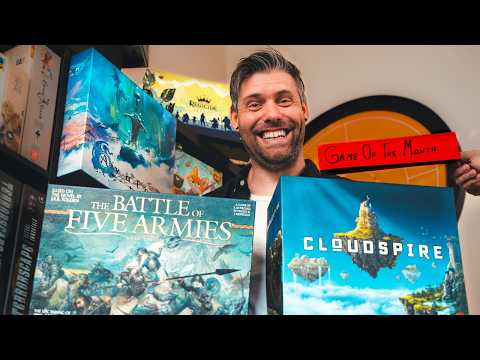
Reviewers tend to frame The Battle of Five Armies as a smaller, faster companion to War of the Ring rather than a standalone epic. Drive Thru Games describes it as the same basic system with a lighter footprint, while Board Game Hangover calls it more compact, a bit easier, and more about fighting than about the story surrounding it. Those descriptions share a central idea: the game keeps the War of the Ring feel but narrows the scope to a single battle, and most of the discussion follows from that choice.
The community is not unanimous. Board Games UnLocked, in its ranking of the worst releases of 2014, placed the game second and argued that the Free Peoples have too few reinforcements, which are hard to obtain and can only enter in certain regions, while the Shadow can sweep across the board to claim victory points. BoardGameCo presents it as a legitimate choice for players who want a War of the Ring style game in a shorter package, even though the host regards War of the Ring as the stronger game. Box of Delights, which posted an unscripted session, sits between these positions: the match swings sharply on dice and card timing, and the narrator's engagement with the tension is paired with frequent frustration at unlucky rolls.
Core Mechanics That Define The Battle of Five Armies
Dice Rolling
Dice rolling is the engine of every engagement. Drive Thru Games explains that both sides roll, but the Shadow player receives extra dice to activate forces, which gives the evil side a larger dice pool. Box of Delights shows how leadership tokens modify those rolls: a commander with leadership can reroll failed dice, so many decisions revolve around how many leadership tokens a stack can spend. Gandalf's Blast of Magic adds a dedicated dice effect, rolling five dice and scoring a hit on each result of four or higher against an army within the ruler's range. Board Game Hangover notes that the game comes from the same authors as War of the Ring, and the dice framework carries over from that design.
Card-Driven Combat
Cards supply the other half of each turn. Drive Thru Games describes the game as card driven on one side and dice driven on the other, and the session in Box of Delights shows cards changing the odds mid-fight. Great Confusion limits the dice the Free Peoples can roll in an attack, while Captain of War lets a commander remove a friendly token to clear two damage tokens from the army. Players also weigh event dice against character dice, since the same roll can either draw a card or activate a hero. Those decisions add a planning layer on top of the dice, which is the element reviewers point to when they describe the battles as more than a simple roll-off.
The Battle of Five Armies Experience
Dramatic
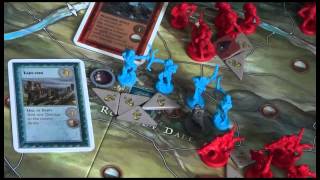
Dramatic swings are central to the game's appeal. In the Box of Delights session, a Shadow assault on the Ruins of Dale turns on a handful of dice, and the narrator reacts to each roll with a mix of dismay and delight. Several rerolls fail to deliver, and the momentum flips repeatedly. The narrator's hesitation over whether to spend a leader's token or remove a character to clear damage captures the feeling reviewers describe: each choice carries emotional weight because its consequences are immediate. The retreat from the ruins after the Free Peoples are reduced to two units shows how a single bad round can reshape the entire campaign.
Intense
Board Game Hangover frames the core experience as one of suspense created by the dice doing the deciding. The reviewer says the outcome is unpredictable, comparing it to real battles with orcs, dragons, and whatnot. Reviewers describe the fights as taking longer and having more moving parts than a typical War of the Ring clash, which keeps each engagement tense even when the board looks settled. Players who want a calm, controlled wargame will find the uncertainty draining, while players who enjoy high stakes will find the same uncertainty gripping.
What Makes The Battle of Five Armies Stand Out
A Shorter Route Into the War of the Ring System
Drive Thru Games stresses that the game plays a little quicker than War of the Ring and is less heavy overall, while remaining rules dense enough to satisfy experienced wargamers. The reviewer describes it as a possible stepping stone for players who find the three-plus hour length of War of the Ring intimidating but are still intrigued by its themes. Board Game Hangover makes a similar point, describing the game as more compact and a bit easier, which makes it a practical way to learn the shared combat system before committing to the larger game.
Heroes on the Battlefield
Board Game Hangover highlights the chance to play as Gandalf, Thorin, or Bard, and reviewers treat these characters as the source of much of the battlefield drama. Gandalf's Blast of Magic is the clearest example, letting a single card turn a bad position into a damaging strike. Drive Thru Games also praises the presentation, noting that a collector's edition with pre-painted miniatures is available. Together, the heroes and the physical components give the battle a sense of spectacle that reviewers feel the abstract War of the Ring map does not always deliver.
Potential Drawbacks
Randomness and Balance
Board Game Hangover acknowledges that the game is very random, and it presents that randomness as the reason some players will dislike it, even though the same reviewer finds the uncertainty enjoyable. Board Games UnLocked is far harsher, arguing that the Free Peoples are structurally disadvantaged because reinforcements are scarce and difficult to reach. The critic reports that every player who took the Free Peoples reached the same conclusion, that the side has little real chance of winning. Players who value balance will see this as a serious concern, while those who enjoy swingy dice outcomes may treat it as part of the appeal.
Thin Beyond the Battle
The second concern is that the game is mostly about fighting. Board Games UnLocked argues that the absence of a political track removes the thematic link that makes War of the Ring feel like an extension of Tolkien's world, leaving a design built around straight combat. Board Game Hangover, which praises this focus, acknowledges that the game is all about fighting and offers less of the story that surrounds the battle. Players who want campaign politics or strategic maneuvering beyond the battlefield may find the game too narrow.
If You Enjoy The Battle of Five Armies
Players who enjoy the dice and card combat of The Battle of Five Armies will find the fuller version in War of the Ring, which Board Game Hangover describes as bigger and grander, with more event cards and more moving parts. BoardGameCo frames The Battle of Five Armies as a War of the Ring for players who want a second, smaller take on the same system. For players who enjoy the same dice and card rhythm but want a different theme, Dune: War for Arrakis is the closest relative. BoardGameCo describes it as the same system in a different setting, and Board Game Hangover treats it as the best of the three when played in sequence, starting with this game, moving to War of the Ring, and finishing with Dune.
What Reviewers Are Saying
"It's very random. You can do what you want, but the dice will decide the destiny of your armies."
Board Game Hangover
"I don't think it's bad. It's just that this is War of the Ring for people who wanted a second War of the Ring, but still think War of the Ring is better."
BoardGameCo
"Oh my goodness, that's dreadful. Just one hit. We've hardly softened this army up at all."
Box of Delights