


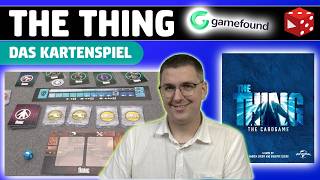





The Thing: The Boardgame Deep Dive
What the Community Thinks About The Thing: The Boardgame
Reviewers treat The Thing: The Boardgame as a hidden-role game that lives or dies on its table talk. It is praised for capturing the paranoia of the film, while reviewers are more divided on the rules and the length. TableTop Wolf ranked it among the most anticipated games of its year and summed up the appeal in one line: "it's basically a game of Among Us". Board Game Coffee's giveaway episode was openly positive, and its host said "I actually like this one" even after a finish that came down to a single turn. Reviewers who were less keen pointed to the workload of the teach rather than the theme. The general view is that the game rewards groups who enjoy deception, and that smaller tables play it more smoothly than full ones.
Core Mechanics That Define The Thing: The Boardgame
Room Actions and Hidden Sabotage
Each round, surviving players place action cards into rooms. The cards are use, repair, or sabotage. The leader collects the cards, shuffles them, flips them one at a time, and assigns each to a player in a room, so the group cannot fully control what resolves. Sabotage is the Thing's main weapon, and a few bad cards can drain the boiler, the generator, or the helicopter's fuel. Reviewers noted that the random-card drawer adds bluffing, because a player can claim a card they did not actually play.
Encounters, Blood Tests, and Accusations
When two players share a room, each presents two tokens, and the receiving player draws one. A Thing token infects the person who picks it, which changes their goal from escaping to spreading the infection. Accusations push a suspect up the suspicion track. Once a player reaches the top, they must reveal their character card face up. Weapons such as the flamethrower or the wire can also test someone directly. The No Rolls Barred session showed how a single test can make the rest of the table feel safer or more exposed.
The Thing: The Boardgame Experience
Suspicion That Lingers
The defining feeling is social suspicion that does not switch off. Players in the No Rolls Barred session spent long stretches arguing about who had touched whom, who had shared a room, and whose card choices looked odd. Infection spreads through shared rooms and shared tokens, so every encounter leaves a trail to reason about, and reviewers said the tension carries into quiet turns when a friend might no longer be human.
Dread of the Base Itself
The base is a second antagonist. The weather, the boiler, the generator, and the food supply all drain each round, and the helicopter is always a few turns away. The No Rolls Barred group described a steady sense of running out of time, where one bad result could cost fuel the group needed. Dogs add a more physical dread. In the same session a player pointed out that the dog bag held "seven good tokens in here and only two bad ones", yet the group still found the dogs frightening.
What Makes The Thing: The Boardgame Stand Out
A Theme Faithful to the Film
Reviewers consistently praised how closely the board game mirrors the movie's structure. Players collect supplies, guard the base, and work toward a helicopter that may or may not carry them off the ice. Rooms have distinct functions, and the helicopter escape reads as a dramatic finale rather than a bookkeeping step. The No Rolls Barred group noted that players who had seen the film picked up the setup quickly.
Production Quality
Rolling Dice and Taking Names described the game as "beautifully produced" and said it was one they would revisit once the rules were familiar. The same episode identified the publisher as Pendragon Game Studio and named Andrea Crespi as a designer, with the North American edition distributed by Aries Games. TableTop Wolf also noted that the Kickstarter edition adds miniatures, which the retail release does not include.
Potential Drawbacks
Rules Overhead
The most common complaint is the time spent learning the game. Reviewers described weapons, tests, and room effects as a lot to absorb before the first round. Rolling Dice and Taking Names said "you've got to slog through a lot of rules for such a simple game", and suggested that the game becomes more enjoyable once the rules are familiar. The teach itself was described as involved, since every room needs explaining before play can start.
Length at Full Player Count
The game lists one to eight players and a 60 to 90 minute run time. Rolling Dice and Taking Names reported that an eight-player game ran well past that window, and the reviewer felt five or six players would be a better fit. TableTop Wolf noted that the base game ships with eight characters, while the full roster of twelve is what makes solo play possible.
If You Enjoy The Thing: The Boardgame
If the social deduction and the dread of a closing base appeal to you, Infection at Outpost 31 is the closest companion, since it shares the film's setting and the same hidden-infection core. Reviewers who like deduction and crisis management often point to Battlestar Galactica and Dead of Winter, both of which pair a failing base with traitor reveals. The Rolling Dice and Taking Names host said they would rather play Dead of Winter first, since it feels similar but may run smoother. For a lighter take on accusations, Among Us is the comparison TableTop Wolf reached for. Nemesis rounds out the list for players who want a sci-fi horror setting with a strong hidden-threat hook.
What Reviewers Are Saying
"It's basically a game of Among Us."
— TableTop Wolf
"There are seven good tokens in here and only two bad ones."
— No Rolls Barred
"You've got to slog through a lot of rules for such a simple game."
— Rolling Dice and Taking Names