



The Walking Dead: No Sanctuary Deep Dive
What the Community Thinks About The Walking Dead: No Sanctuary
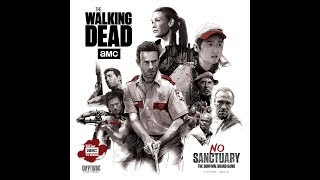
Opinions on The Walking Dead: No Sanctuary split less over what the game is than over whether its central tension is a feature or a flaw. It is a fully cooperative board game with highly detailed miniatures, built around survivors who have to work together even though their goals do not always line up. On Rolling Dice & Taking Names, the designers, Adam and Brady Sadler, described how Cryptozoic brought them in to push a licensed property toward a deeper strategy design. The hosts came away enthusiastic and called it a really good game.
BoardGameTeacher takes a neutral, rules-first approach, walking through setup, the five round phases, and the three ways a group can lose without offering a verdict of its own. That leaves 3 Minute Board Games as the clearly negative voice. In a list of games that reviewer got rid of, The Walking Dead: No Sanctuary is described as a game that seems to have a really cool concept until you actually play it. The disagreement is less about the zombies than about how the game manufactures friction between players.
Core Mechanics That Define The Walking Dead: No Sanctuary
The Leader, Approach Cards and Group Stress
Every round opens with a planning phase in which the leader draws two event cards, secretly plays one, and neglects the other, which carries its own penalty if the group cannot fulfill it. The event in play sets a color, and any survivor who plays a different color is treated as defiant. Adam and Brady Sadler explained that individual choice was one of their core design mantras, so every survivor keeps a private hand and still decides what to do regardless of what the leader says. Each defiant turn adds stress to the leader, and once the leader reaches three stress, leadership passes to the next player. BoardGameTeacher adds that the active event carries its own mini objectives, and if nobody on the team meets them, the leader takes stress as well. That turns a simple color choice into a balancing act.
Dice Pools, Stress Dice and Focus
Actions are resolved by building a dice pool. A survivor rolls dice equal to the relevant attribute, adds a stress die for each stress token, and adds one more if a walker shares the space. BoardGameTeacher explains that successes are spent to boost the action (grappling, for example, can spend a success to knock down an enemy in the same area), while exert symbols can be converted by spending focus or by discarding a survivor card. Fear results trigger the effect printed on the survivor card that was played, which the walkthrough describes as usually bad. Because each survivor's deck doubles as that character's health, exerting costs cards, and a survivor who cannot discard is defeated, which costs the whole group the game. The designers described the action system as robust, with a real economy around successes and focus tokens.
The Walking Dead: No Sanctuary Experience
Tension Inside the Group
The tension is the feeling reviewers return to most. Rolling Dice & Taking Names described the prototype as very tense, and said the leader role works because the leader has to decide how to help the group without hurting it while other players may go against them. Adam and Brady described the team as a set of plans that want to mesh but do not always work that way, which they framed as mimicking the show itself. The sense of an uneasy team holding together under pressure runs through every description, even when the reviewer reading the rules finds that same pressure frustrating.
The Walkers as a Background Threat
The walkers are present but deliberately pushed into the background. Adam described them as environmental hazards that players have to navigate, while the real threat becomes the dynamic within the group and the human factions outside. The designers said this mirrors how the TV show has morphed over its seasons. BoardGameTeacher describes the same idea from the rules side, with walkers that shamble toward the nearest human, barricades that hold them back, and objectives the group must advance to win. Walkers still matter, though. Crawling walkers, for example, cannot be shot and have to be stomped, which keeps the hazards from disappearing entirely.
What Makes The Walking Dead: No Sanctuary Stand Out
Survivors With Their Own Decks
Reviewers and designers both return to the cast. Each survivor has a unique deck, three attributes that set how many dice they roll for each action, and a special ability. Adam and Brady named favorites that show the range: Rick, who helps players roll more dice and sheds stress, and Hershel, who plays as a medic. The Governor is designed as an exclusive survivor whose buffs come at a cost, since his tokens must be spent once they are on the sheet. Lori can discard her ability token to reveal a card to the leader, which lets her soften the leadership dynamic. Because the designers say each deck plays differently, swapping survivors changes the story even when the scenario stays the same.
Modular Scenarios and Rival Groups
The designers highlighted modularity as one of the game's strongest sources of replay value. Special walkers are dealt at random rather than fixed by the scenario, so a familiar map can play differently each time, and scenario rules can change how rival groups act. Rivals are simple AI groups whose behavior follows the leader's approach, so an aggressive group draws fire from rivals while a cautious one may find rivals busy with walkers. The hosts of Rolling Dice & Taking Names also praised the 3D sculpted miniatures, calling them pretty cool for fans of the show, which fits the game's emphasis on its characters.
Potential Drawbacks
Forced Approach Matching Can Feel Arbitrary
3 Minute Board Games is the sharpest critic. The reviewer found the approach system confusing in practice: a leader calls for a cautious round, but players holding only aggressive cards cannot follow the call, which creates friction that nobody at the table chose. The objection is that cooperative tension should come from what players decide to do, not from an arbitrary shortage of matching cards. As the reviewer put it, that kind of mechanic takes the agency away from the players. The reviewer's sarcastic take on the result is a table forced to shout in a room full of zombies because loud is the only option in hand. That reviewer's verdict was that this is what sank the game.
Luck and Stress Can Overwhelm Planning
BoardGameTeacher notes that stress dice are bad and that players have little control over them, so the practical goal is to keep stress low before a dice pool is ever rolled. Combined with fear effects on the survivor cards and the threat track, a bad roll can compound quickly. The same walkthrough lays out a dense structure, with ten setup steps, five round phases, and separate event, search, and objective decks, which makes learning the game a real commitment.
If You Enjoy The Walking Dead: No Sanctuary
- The Grizzled: Rolling Dice & Taking Names pointed to The Grizzled as the closest model for the feel the designers wanted. In that game players cannot talk about their hands, and every card played tends to hurt someone else. That difficulty of cooperating is what the designers captured without using trader mechanics.
- Legendary Encounters: Aliens: The 3 Minute Board Games reviewer praised its structured chapters and said it worked well both solo and with groups. It is a useful contrast for players who want a cooperative story with clearer objectives than the leadership dynamic of No Sanctuary offers.
What Reviewers Are Saying
"The tension is very thick when you're playing. What they tried to design works. It's not about the zombies, it's about working with other people in completing your goal."
— Rolling Dice & Taking Names
"This is a wonderful player cooperative dice rolling hand management game in which you take the role of one of the characters from the hit TV show. You'll be moving that character around the board, taking actions and special abilities that are thematic to that character from the show."
— BoardGameTeacher
"It's a game that seems like it has a really cool concept until you actually play it. That sort of mechanic just takes the agency away from the players, and it's the mechanics of the game telling you that your group isn't working."
— 3 Minute Board Games