






Tiny Towns: Fortune Deep Dive
What the Community Thinks About Tiny Towns: Fortune
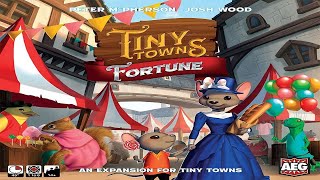
Reviewers across multiple channels agree on one transformative aspect of Tiny Towns: Fortune: it makes the base game significantly more forgiving and strategic. The first expansion to the core Tiny Towns experience, Fortune introduces a coin-based economy that fundamentally shifts how players approach resource management and town planning. Rather than feeling like a band-aid patch on a broken game, reviewers consistently describe Fortune as a thoughtful, elegant enhancement that preserves what makes Tiny Towns special while giving players meaningful new options.
The expansion is particularly praised by players who found the base game brutally tight, especially at higher player counts. Where Tiny Towns can feel unforgiving when other players call resources you don't need, Fortune introduces a layer of player agency that doesn't trivialize the core puzzle. Reviewers note that while the expansion adds complexity, it does so sparingly and remains easy to teach alongside the base game.
Core Mechanics That Define Tiny Towns: Fortune
The Coin Economy
At the heart of Fortune is a simple but elegant economic system built around coins. Each player receives a small chest that holds a maximum of four coins. Throughout the game, specific buildings and monuments can generate coins when constructed, and coins can also be earned by building two structures in a single turn. The key decision point emerges when other players call resources: any player can spend one coin to take a resource of their choice instead of being bound by what was called. Leftover coins at the end of the game convert to victory points at a one-to-one ratio, creating a constant tension between spending coins for immediate advantage and banking them for end-game scoring.
Reviewers highlight how this mechanic creates meaningful strategic depth. The economy forces players to weigh immediate resource needs against future flexibility and endgame points. Building coin-generating structures becomes a strategic decision with real tradeoffs, since pursuing those buildings might limit space for other construction. Some buildings require coin expenditure to activate, adding another layer where players must decide whether the benefit justifies the cost.
Pattern-Placement Building with Enhanced Options
Fortune introduces numerous new buildings and monuments that work within Tiny Towns' core pattern-matching system, where players arrange colored resource cubes to construct town structures. The expansion nearly doubles the variety available by adding ten new monuments and additional copies of base buildings, increasing from four of each type to six. These new buildings predominantly center around the coin economy, whether generating coins upon construction, requiring coins as payment, or offering variable bonuses based on a player's coin reserves. The variety ensures that each game offers distinct strategic puzzles and different incentive structures, preventing the card selection from feeling repetitive across plays.
The Tiny Towns: Fortune Experience
Relief from Relentless Brutality
One consistent theme across reviewers is that Fortune transforms Tiny Towns from a game of resignation into one of agency. The base game, while elegant, can leave players feeling trapped by the resource calls of others, particularly in games with three or more players. Fortune's coin system provides a relief valve. Reviewers describe the experience of having coins available as a psychological shift, even if they rarely spend them. The knowledge that you have options available makes the inevitable moments of receiving unwanted resources feel less catastrophic and more like a manageable strategic puzzle.
Satisfying Strategic Puzzle with Visible Payoff
Reviewers emphasize that Fortune feels rewarding to play because it creates solvable problems. When facing an inflexible board state, a strategic player can spend coins to create new possibilities. When recognizing an advantageous coin-generating building combination, there is tangible satisfaction in assembling it and watching the economic engine generate benefit. The expansion maintains Tiny Towns' filler-weight positioning while adding enough depth that players who want to engage strategically have clear levers to pull. The coin count is visible and trackable, making it easy to evaluate which economic decisions paid off.
What Makes Tiny Towns: Fortune Stand Out
Minimal Overhead for Maximum Payoff
A hallmark of strong expansion design is delivering impact without overwhelming the teaching load. Reviewers repeatedly note that Fortune achieves this balance. New players can jump directly into Fortune alongside the base game without struggling to learn extra systems. The rulebook is remarkably concise, and the coin chest mechanic is intuitive: gain coins through certain buildings, spend coins to override resource calls, count leftover coins at the end. Despite this simplicity, the economic interactions create surprising depth for players seeking it. This accessibility is particularly valuable for Tiny Towns, a game that already has family appeal, because it allows households to introduce the expansion without making the game less welcoming to younger or less experienced players.
Flexible Scaling for Player Count Challenges
One specific pain point the expansion addresses is player-count dependency. Tiny Towns' core challenge stems from turn order and resource calling: the more players at the table, the less often you get to call resources you actually want. At four, five, or six players, this can feel oppressive. Fortune's coin system directly mitigates this problem by giving players tools to respond when dealt an unfavorable resource call. Reviewers praise how this makes higher-player-count games feel more forgiving without removing the resource scarcity that creates tension. The expansion doesn't eliminate randomness, but it provides a safety valve that feels thematic and earned rather than arbitrary.
Potential Drawbacks
Increased Complexity at the Table
While reviewers generally praise Fortune's restraint, some note that it does push Tiny Towns incrementally toward "more game." Players comfortable with the base game as a light filler might find that tracking coins, evaluating coin-generating buildings, and optimizing expenditure adds decision weight that changes the experience. This is not a drawback for most reviewers, but for those specifically seeking a game with minimal cognitive load or strict turn efficiency, Fortune's added considerations are noticeable. The good news, as multiple reviewers point out, is that you can dial the expansion in or out: some buildings and monuments can be omitted if desired, and the core coin system remains optional for players who want maximum simplicity.
Not Essential, but Hard to Live Without
Reviewers emphasize that Fortune is not a mandatory purchase. The base game stands complete on its own, and many playgroups will find Tiny Towns satisfying without any expansion. However, reviewers who have played with Fortune consistently report that once introduced, they lose motivation to play without it. The expansion doesn't patch a broken game; instead, it opens new strategic doors while preserving accessibility. This creates a secondary challenge: if you own Fortune and want variety, the expansion quickly becomes your default, making the base game feel diminished by comparison. The decision to add Fortune is best made with an understanding that you may rarely want to play without it afterward.
If You Enjoy Tiny Towns: Fortune
Fans of Tiny Towns: Fortune should explore other games where elegant economies create meaningful decisions within tight constraints. Roll for the Galaxy offers comparable decision-making around resource management and push-your-luck tradeoffs in a different setting. For those drawn specifically to the modular building aspect of Tiny Towns, exploring other tile-placement or pattern-building games with economic layers will scratch similar itches. Within the Tiny Towns family itself, the separate Villagers expansion offers a different flavor of adding control through movable meeples rather than coins, and both expansions can be combined for those seeking maximum mitigation of the base game's randomness.
What Reviewers Are Saying
"But then the fortune expansion brings a friendly thing to it where you can, you know, utilize the coins to help you in this putting the shape, because I'm not really that good again. I enjoy it but I'm not that good in general, in a special rotation. So the fortune is a, for me it's a really good addition to try to help me. I'm like, oh shoot, I'm, I, you know, I shouldn't done that, but then there's coins that I can spend for that."
— Meeple University
"One of the best parts about this expansion is that it's so easy to introduce this to new players, even if people haven't played the base game before. There was really no reason to leave out including the expansion if you have it. It's very little extra rules overhead, and in fact it actually makes the game a little more accessible, I feel, to newer players, especially at higher player accounts."
— All You Can Board
"You have the money, to you have a risk reward: okay, I can spend it now to get the resource I really need, or I can hold on to it to try and get some points. So yeah, like, I really like it. I think it's a fun expansion."
— Board Games UnLocked