
Game Info
Year
2024
Players
20-47
Age
Playtime
300 min
Publisher
Ben Kanelos
Collection
Ratings
Creator Score
Mechanic profile
Waiting on more creator content
Vibe profile
Waiting on more creator content
Description
A semi-cooperative dark fantasy megagame where outposts gather resources and perform rituals to survive an endless eclipse
Ask a Rules Question
All mentions
Browse transcript mentions, sentiments, pros/cons, mechanics, topics, quotes, and references.
Total mentions: 1
This page: 1
Sentiment:
pos 0 ·
mix 1 ·
neu 0 ·
neg 0
Showing 1–1 of 1
Video mdJ30wUeuB4
Shelfside Analysis at 0:24 sentiment: mixed
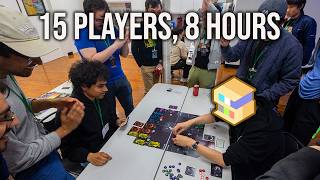
Click to watch at 0:24 · YouTube ↗
Overall sentiment (raw)
mixed
Pros
- The goal is to make an epic story.
- High player count fosters cooperation and competition.
- Real-time interaction keeps things moving.
- Physical presence and moving between tables is intuitive.
- The event can be very immersive, with players scheming even during breaks.
- Council meetings provide dramatic political intrigue.
- The game can make players think critically about real-world issues like news and wealth distribution.
- The soft power of the news felt real and was not something witnessed in other games.
- The high moments were insanely peak and memorable.
- The game has many spatial elements and a large room, which is hard for a board game to replicate.
- It's a good excuse to have many people hang out together.
- The game is not too complicated or stressful, allowing for a relaxed hangout with friends.
Cons
- A lot of preparation work is needed.
- It's not a board game in the normal sense.
- The game requires a minimum of 15 people.
- Logistics can be challenging, with players needing to travel and use caravans.
- There's an element of being alert due to factions that can steal resources.
- The game can be slow and have significant downtime, especially in mid to late game.
- One-person teams are stretched thin and vulnerable.
- Converting people to a new religion is difficult and voluntary.
- Learning the rules is tough due to asymmetric factions and lack of a central board.
- The rulebook and component design are confusing and unclear.
- The cost of the game is steep ($200).
- The room size can be too small, making trading too easy if tables are too close.
- Downtime during shadow attacks can be long, with players sitting idle.
- The game can be too slow, leading to fewer rounds being completed than planned.
- People get bored during the slow rounds and resort to phones.
- The spatial elements and large number of players are not easily replicated.
- Playing with strangers for eight hours and paying for it is not ideal for everyone.
- Some rules are different on each sheet (e.g., morale, ritual costs).
Thematic elements
- Cooperation and competition towards objectives in a large-scale simulation with role-playing elements.
- The dark ones have blotted out the sun, and every country is working together to prevent the world from becoming doomed.
Comparison games
- Battlestar Galactica
- Unfathomable
- Twilight Imperium 4
Mechanics (from transcript analysis)
- Action cards — Each faction has a hand of action cards for various effects, some playable anytime, some 'take that', and some to build an engine.
- Caravans — Pieces representing resources must be placed on a caravan sheet to be moved across the room, slowing down trading.
- Negotiation — Players work out deals and deals become more complex with elements like taxing caravans and political maneuvering in council meetings.
- Resource Management — Players need to manage food, water, and crystals for rituals, and also repair destroyed places.
- Role-playing — Players role-play as representatives from their countries, such as nobles or ambassadors, with specific faction goals.
- Secret Agents — Some members from countries are secret agents working for the dark lord to bring the light level to zero.
- Social Deduction — The ritual involves players trying to determine if any agents of the dark lord are present to sabotage it.
- Trading — Players must travel to another table and work out a deal to trade resources. Resources must be moved on a caravan sheet.
- Worker Placement — Everyone has workers to put on their faction-specific places to get resources.
Video topics + discussion points
No key topics recorded for this video.
Quotes (from this video)
- This is not a review. This is not a review. This is not a review.
- In more plainer English, it's an entire day's worth of gaming with a lot of people, generally from 30 to 100 people, all organized into teams either cooperating or competing towards objectives.
- My absolute favorite phase of the game, though, was the council meetings.
- I would say besides a good amount of jank and some good amount of downtime in rounds, especially mid rounds and later, I would say I had a great time. It was a great time.
- This is really something I can't see a board game replicating as a mega game has so many spatial elements, and the room itself is so much bigger.
- The soft power of the news felt real and not something I've witnessed in a game.
- At some point, I felt like a charity program that sometimes needed to temporarily close its doors, and I would make some random PR statement about why that was the case.
References (from this video)
No references stored for this video.
Transcript Navigation
Showing 1–1 of 1