









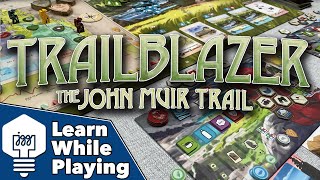
Trailblazer: The John Muir Trail Deep Dive
What the Community Thinks About Trailblazer: The John Muir Trail
Reviewers describe Trailblazer: The John Muir Trail as a hiking game built on worker placement and set collection, wrapped in a theme that most of them take seriously. The game runs for 12 days along a 10-step trail from Happy Isles toward the summit of Mount Whitney, and the requirement to reach that summit shapes almost every reviewer's account. Stella of Meeple University, in an overview playthrough, called the game competitive and noted that 12 rounds "seems quite long but not really" once players realize how little time they have to gather what their hike needs. Board Game Dad placed the game first on a list of five titles said to be better than Wingspan, and Grant Lyon of Grant's Game Rex highlighted the second edition's refined rulebook and streamlined player aids. Getting Games filmed a prototype copy and cautioned that the final art and rules might differ, which is a useful reminder that the second edition described by other channels may not match every earlier copy.
Core Mechanics That Define Trailblazer: The John Muir Trail
Worker Placement With Scarce Workers
The daytime phase is the heart of the game, and reviewers focus on how few actions each player gets. Players begin with three track tokens that act as workers, and Meeple University's overview explains that the two tokens set aside at setup unlock as players climb the elevation track, giving more actions each round. Stella of Meeple University stressed that players "have to be efficient when selecting the key actions," since a single placement can gain resources, advance the hike, and build toward scoring at once. Meeple University's April roundup described the design as a conventional Euro worker placement, but added that the timing is where it stands out: racing the hike early opens an action space that pays out better resources sooner. The hike action itself is the most demanding placement, because each player may take it only once per round and must pay for every step.
Set Collection Across Field Guides and Gear
Set collection supplies much of the scoring. Field guide cards are gathered from a market and placed face down into sets by animal, bird, or other category, with a set's value rising as it contains more distinct types. Getting Games walked through the scale, noting that a set of two unique cards is worth a point, while a set of all five icon types is worth seven. The backpack adds another layer, since gear and patches placed into it trigger bonuses at each completed row, and reusing an item that is already packed advances the elevation track instead. Watch It Played's Kenneth K described the game as "in by and large a set collection game," with players trying to hold two of each symbol so they can use those resources. Meeple University's April roundup agreed that players are collecting sets of gear in their backpacks, or repeatedly using the same piece to trigger other bonuses.
The Trailblazer: The John Muir Trail Experience
Adventure
Reviewers consistently describe the game as a journey, and the sense of moving along a real route comes through in both the rules and the commentary. Getting Games frames each turn as a stop along the trail, with players picking up natural resources, spotting wildlife, and taking in vistas as they move. Grant Lyon declared that "if you want a game about hiking, this is probably the most thematic game about hiking out there," and the trail's named landmarks, from Sunrise Lakes to Half Dome, give the sense of exploration that adventure fans look for. The personal resources of food, water, rest, and conditioning add a survival layer that keeps the journey feeling like a trip rather than an abstract race.
Gorgeous Art
Art receives strong praise, and Board Game Dad singled it out as the main reason the game earns a spot on a Wingspan-style list. The reviewer called the game "just so satisfying in its artistic and natural beauty" and said the artwork "creates very much the same impression" as playing Wingspan. Meeple University's April roundup also praised the work of Andrew Bossley, calling it a "very gorgeous game." That praise matters for a game where the board, trail cards, and field guides all carry the theme, because the visuals do much of the work of making the trail feel real.
What Makes Trailblazer: The John Muir Trail Stand Out
Timing Trade-offs on the Trail
The most-discussed design choice is the tension between racing and pacing. Meeple University's April roundup observed that the game gives players a reason to rush up the trail early, because the trail's conditions make hiking harder later and the timing of each step matters. Players must also pick the two rounds in which they will not hike, which Meeple University's rules video described as "part of the game's puzzle." That combination means every round involves a real decision about whether to move forward or invest in resources and destination cards.
A Refined Second Edition
Grant Lyon used the release of the second edition to explain what changed. The rulebook has been clarified, the player aids are streamlined to make the game easier to start, and the component balance has been adjusted based on player feedback. Lyon also framed the game as a medium-weight strategy title that runs around 120 minutes, which suggests the second edition is aimed at players who want a substantial session with fewer rules questions along the way.
Potential Drawbacks
An Unforgiving Finish Requirement
Reviewers repeatedly flag the rule that players who do not reach Mount Whitney cannot win. Meeple University's rules video said that a player who has not reached the 10th spot "is eliminated and finishes with a score of zero." Watch It Played's Kenneth K described the reaction at their own table: the group was told about the requirement only after starting, and the reviewer said the information would have been helpful at the outset. Hardship tokens add pressure as well, since Getting Games tallied them at negative four, nine, sixteen, and twenty-five points for one through four tokens. New players may find that the penalty for a misjudged hike arrives suddenly, long after the decision was made.
Length and Weight for a Medium Game
Grant Lyon rated the game at around 120 minutes and medium weight, and the length is a real commitment for a worker placement game with 12 rounds. Stella of Meeple University noted that the game "seems quite long," even though the reviewer ultimately decided it was manageable. The number of resources to track, the market of field guides, the destination decks, and the backpack layout can slow down a table that is still learning the rules. Players who want a quicker session may find the game demanding.
If You Enjoy Trailblazer: The John Muir Trail
Board Game Dad recommended Wingspan as the closest comparison, and the match rests on more than the bird and nature imagery. Both games share a natural theme and a worker placement core, and both reward players who build a collection of cards or items that expands their options over time. Board Game Dad described Trailblazer as having "a nice easy going flow" that is "complex enough to keep things interesting but not too involved to be overly heavy," which is much the same balance that makes Wingspan approachable and deep at once. Players who enjoy putting birds into a portfolio will find a similar satisfaction in packing gear into a backpack, and the rewards for finishing rows and sets will feel familiar.
What Reviewers Are Saying
"12 rounds seems quite long but not really with three to five workers that you have you need to gain all the different resources for your hike the hike itself and to gain the good point cards."
— Stella, Meeple University
"I just played Trailblazer a fun game with a lot of variability but a pretty simple rule set and we had a good time hiking the trail."
— Kenneth K, Watch It Played
"More than anything else Trailblazer the John Muir Trail is just so satisfying in its artistic and natural beauty."
— Board Game Dad