/pic4597145.jpg)
Experience 30,000 years of civilization in 45 minutes: With Tribes: Dawn of Humanity, there is finally a civilization game in which you do not need to wait long for your turn. The players lead their tribes in short, fast turns through the early history of humanity to the Bronze Age. They settle unknown lands and extract valuable resources through which they in turn discover new tools and inventions. Who will best prepare their tribe against events such as natural disasters? Who will take the lead, and who will follow in the footsteps?
Each turn, a player selects an action from the action display: grow, explore, or move. The first action is always free, while additional ones cost valuable shells. The used action moves to the end and the next player takes another action. It is important to use your scarce shells cleverly.
The players start with a small tribe with the immediately surrounding area explored. They discover new land and send the members of their tribe out to discover valuable resources. These resources are needed for new inventions that bring victory points and improve your actions: become better at exploration, grow more tribe members, and move further. Who will be the most tactical leader and guide their tribe to victory?
This is a completely reworked edition of the game Tribes: Early Civilization released in 2017 with many changes.

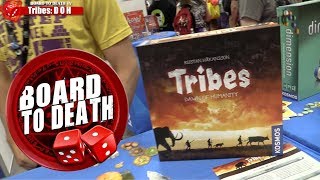
- Fast play time (under an hour)
- Strategic action selection
- Meaningful progression through achievements
- Impactful event tiles
- Can be stressful despite short playtime
- Civilization game where players lead their own tribe
- Paleolithic era, Neolithic, Bronze Age
Mechanics (from transcript analysis)
- action selection — Players choose one of four actions: procreate, move, explore, or go for an achievement. The first action in the row must be taken unless shells are paid to skip ahead.
- Area exploration — Players can explore by taking new territory tiles from a bag.
- event cards — Event tiles are added to the action track and trigger effects that can be beneficial or detrimental, often based on player strength.
- Resource Management — Shells are a resource used to skip actions.
- Set Collection / Achievement — Players earn victory points by achieving different goals through distinct eras (Paleolithic, Neolithic, Bronze Age).
- Track Advancement — Actions are moved to the end of a track after use, influencing future choices. Players also advance on multiplier tracks for certain actions after earning achievements.
Video topics + discussion points
Quotes (from this video)
- Gen Con is actually a lot of fun
- Tribes: Dawn of Humanity will be getting review copies of this and show you guys as well
References (from this video)

- Nations
Mechanics (from transcript analysis)
Video topics + discussion points
Quotes (from this video)
- this is puffin she's a six-month-old Minnie burna doodle and she is just the best
- it's just been wonderful having her around
References (from this video)
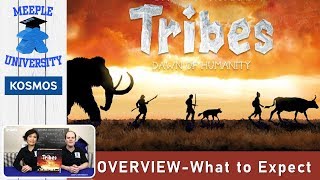
Mechanics (from transcript analysis)
Video topics + discussion points
Quotes (from this video)
- this is tribes dawn of humanity
- it was designed by Rothstein Hawkinson
- the game plays two to four players competitively with an estimated duration of 45 minutes
- the game ends at the end of the round
References (from this video)
- Light to medium complexity
- Short playtime (about 45 minutes)
- Supports 2-4 players
- Set in an early prehistory theme
- Shell scarcity can force non-preferred actions
- Negative events can be punishing
- civilization building
- early prehistory
Mechanics (from transcript analysis)
- Achievements — Advancement on achievement tracks by matching tiles and symbols to score victory points
- Action Drafting — Players select an action tile from a six-tile row; dropping a shell on left tiles, collecting shells on that tile, then moving the tile to the end
- Compound Scoring — Points from tracks plus bonuses for most tribe members and most unexhausted land tiles
- continuous action draft — Players select an action tile from a six-tile row; dropping a shell on left tiles, collecting shells on that tile, then moving the tile to the end
- Events — Event tiles added to the board can reward or penalize players; negative events can accumulate shells
- exploring — Draw land tiles based on position on the exploring track and add them to the map
- moving — Moving one tribe member based on position on the move track and moving on the map
- procreating — Adds new tribe members based on position on the procreating track
- scoring — Points from tracks plus bonuses for most tribe members and most unexhausted land tiles
- Track Advancement — Advancement on achievement tracks by matching tiles and symbols to score victory points
Video topics + discussion points
Quotes (from this video)
- this is tribes dawn of humanity
- it was designed by Rothstein Hawkinson
- the game plays two to four players competitively with an estimated duration of 45 minutes
- the game ends at the end of the round
References (from this video)

- Streamlined yet dense enough for meaningful decisions
- Event integration into the action row provides dynamic interaction
- Gateway-like depth that can scale with expansions or advanced rules
- Shell economy can be punishing if mismanaged
- Some players may find the pace too deliberate or the setup lengthy
- civilization development with achievements and events
- prehistoric tribes; growth and interaction on a modular board
- story-driven progression with personal goals and relationships between tribe members
- Nations
Mechanics (from transcript analysis)
- achievement-driven tech tree — achievements in the middle/top rows grant bear teeth, increase capabilities, and unlock events
- population management and exploration — move population, explore terrain, and achieve set-collection style achievements
- shell economy and action conveyor — players place shells to select actions; unused actions slide to the left as shells accumulate on front-most options
Video topics + discussion points
Quotes (from this video)
- income is super important this is almost more of an engine building game than it is really a worker placement game
- this is a fully cooperative game and everybody is simultaneously trying to figure out all of their words
- this game hums along at a great pace
- the events being integrated into the overall action row was such a cool idea
- it's a gateway level to have a game like Nations