/pic7176352.png)
Ex-champion football coach, Clyde Dugan may have retired from the game, but its spirit lives on in his new passion…ice cream!
Working at Coach Clyde’s ice cream shop is not only fast-paced and hectic but is also known to be highly competitive. Treating each day at the shop as a “game day”, Clyde challenges his employees to outshine each other on the field of battle (behind the counter). He keeps a tally of their best plays (displays of scooping skills) and his scoopers continually contend for the coveted role of team captain (shop manager).
Now, looking to expand the franchise, Coach Clyde has open tryouts for positions on his scooper squad.
In Triple Scoops, you will compete with other scoopers to serve customers by stacking cone and scoop cards in the proper flavor sequence. You gain points based on the flavors on the customer cards you serve. Flavors will vary in point value based on your hidden assignment.
On your turn, utilize special scooper tricks to manipulate your and/or your opponents' scoops to your benefit: swap a scoop from one cone to another, mix the order of scoops on a single cone, or plop a random scoop from the deck on any cone. You may also sway customers in line into changing their minds on what flavors they want!
Triple Scoops is delicious fun! With chaos and sabotage on the menu, can you scoop your way to victory?
-description from designer

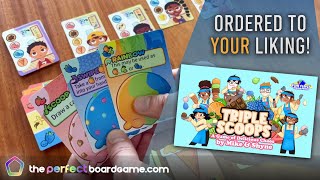
- high customization and flexible play styles allow tailoring the experience to player preference
- beautiful components and artwork with a cohesive, inviting theme
- cooperative mode provides a low-pressure alternative and broad appeal
- a large number of expansion options enables long-term replayability and varied challenges
- clear visual cues on cards, aiding accessibility and readability during play
- significant luck component from drawing the right orange flavor to satisfy orders
- frustration when held cards offer little value due to mismatched flavors
- endless combinations can overwhelm new players and raise the learning curve
- some interactions can feel opaque or underutilized if players don’t lean into specific strategies
- the reliance on flavor order constraints can hamper perceived agency for players seeking tighter control
- Ice cream orders, customer satisfaction, competitive scooping, and escalating shop races between players.
- Coach Clyde's ice cream shop competition with a scooper squad; fast-paced, competitive environment.
- competitive, humorous, with lighthearted charm; thematic focus on ice cream production and rivalry.
Mechanics (from transcript analysis)
- assignment cards (secret objectives) — Each player receives two assignment cards and selects one to pursue for end-game scoring; objectives influence strategy.
- cone management and scoring — Flavors are placed on cones; the cone content affects available actions and hand size, influencing risk/reward decisions.
- Cooperative Mode — An optional mode where players work together to fulfill orders, balancing individual objectives with team success.
- deck-building / card drafting — Each player builds a personal deck of flavor cards, power cards, and event modifiers; hand size is dynamic based on cones and moves.
- flavor switching and discard effects — Cards can discard to flip customer cards or swap flavors with other players, enabling dynamic engine manipulation.
- Hand Management — At the end of each turn, players refresh their hand up to the current limit, which increases with cone cards in play.
- Order Fulfillment — Players assemble flavor cones to meet customer orders, with certain orders requiring specific flavor combinations.
- order refresh and hand limit — At the end of each turn, players refresh their hand up to the current limit, which increases with cone cards in play.
- sparks and player powers — Sparks trigger unique player powers linked to an icon; powers modify draw, replacement, or manipulation of cards.
- Unique Player Powers — Sparks trigger unique player powers linked to an icon; powers modify draw, replacement, or manipulation of cards.
Video topics + discussion points
Quotes (from this video)
- There are so many ways to customize the game to your liking.
- If the game is too aggressive you can add friendly cards.
- If there's too much luck you can add cards that will help you balance out the look a little bit more.
- If it's not interactive enough you can add cards that will offer more interaction.
- There’s even a Cooperative mode.
- This is one of the highest quality card games I’ve seen; beautiful components and artwork.
- I want things that have a little bit more control so you can put in some strategy and I don’t see a lot of strategy in this game.
- It’s just very, very frustrating when you’re holding cards with abilities that are completely worthless.
- I still admire this element of customization; it’s a standout feature even if it isn’t my favorite playstyle.
References (from this video)
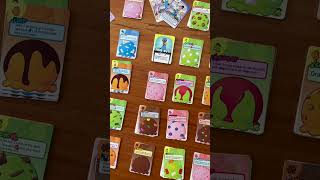
- Modular deck customization enables personalized and replayable experiences
- Accessible, dessert-themed premise with broad appeal
- Support for both cooperative and competitive play styles
- 11 card types to choose from, offering variety in each session
- Lighthearted dessert-themed competition with a mix of luck and strategy, balancing speed, disruption, and cooperation.
- An ice-cream shop world where players act as scooping specialists fulfilling increasingly challenging customer orders using a modular deck.
- Player-driven, configurable play through a modular deck and variable modes; emphasis on player choice and interaction over strict sequencing.
Mechanics (from transcript analysis)
- Card placement — On your turn you can play any number of cards onto your cone or to the discard pile to progress toward orders.
- customer order mechanics — Orders vary in requirements and timing, requiring adaptive play to meet diverse customer needs.
- Hand Management — Players must juggle flavors and actions in hand to optimize order fulfillment and deny opponents' progress.
- luck management — Luck elements influence draw and play options, adding tension between planning and randomness.
- mode variability — Includes multiple cooperative and competitive modes, affecting objectives and player interaction patterns.
- modular deck customization — At setup, players select 5 of 11 card types to form the active deck, enabling tailored gameplay experiences.
- opponent interaction — Mechanics enable stealing cards from opponents and actively disrupting their objectives.
- Push Your Luck — Luck elements influence draw and play options, adding tension between planning and randomness.
- Set Collection — Fulfill customer orders by assembling the right combinations of cards, driving scoring and progress.
- set collection / fulfillment — Fulfill customer orders by assembling the right combinations of cards, driving scoring and progress.
Video topics + discussion points
Quotes (from this video)
- on your turn you can play any number of your cards either onto your cone or to the discard pile
- the modular deck setup allows players to customize gameplay to their own liking ranging from friendly to aggressively Cutthroat at this time
- order triple Scoops through the gamecrafter.com or using the link under this video
- a customizable card game
- the base game of triple Scoops has several cooperative and competitive modes
References (from this video)

- Family-friendly, approachable for kids and casual gamers
- Creative deck-building with a playful, flavorful theme
- Cherries and assignment cards add variety and additional strategic layers
- Clear, tactile actions that reinforce the ice-cream shop theme
- Fast round times and light tension that keep players engaged
- Take-that and disruptive elements as opponents flip customers or swap scoops
- Some players may dislike the more chaotic interactions and the potential for abrupt shifts in control
- Bosses and assignment cards can complicate the game beyond a simple family-weight experience
- Certain rules (like the draw-at-end-of-turn) may feel arbitrary or unintuitive to some players
- The game can resemble a lightweight Dominion-like vibe without capturing the deeper engine-building complexity
- The core theme is ice cream service: building flavor combinations to meet each customer's order, using a mix of pattern recognition, set-collection mechanics, and hand management to maximize points. The theme is reinforced through visual cues like cones of differing shapes, colors of scoops, andCherry tokens that act as extra incentives, and through the idea of a playful “shop race” to serve five customers first.
- A bright, bustling ice cream parlor environment with a lineup of customers waiting their turn, vivid colors, and a playful, family-friendly vibe. The setting evokes the aroma of waffle cones, the chatter of a busy shop, and the satisfaction of matching orders with precise scoops and decorations. The narrative unfolds around a casual, friendly competition to fulfill orders as quickly and accurately as possible, emphasizing quick thinking, memory, and light strategy.
- Casual, instructional narration interspersed with light banter about customers’ preferences and the chaos of a busy shop. The tone leans toward accessibility for families and younger players, with occasional zippy asides about strategy and potential misfires.
- Dominion
Mechanics (from transcript analysis)
- boss and assignment cards — Boss cards alter core rules mid-game, and assignment cards award points based on finished customers. This introduces variability and a sense of evolving difficulty across play sessions.
- cherries and tokens — Cherry tokens provide incremental scoring or grant special abilities, adding a persistent tension between immediate scoring and strategic timing of when to cash in cherries.
- cone type manipulation — A player can flip a cone between sugar and waffle types by discarding cards, introducing a tactical layer where cone type can influence scoring and order fulfillment options.
- Deck Building — Players construct a personal deck of ice cream scoop cards as the central resource. Each turn, players add scoops (cards) to their deck to enable future plays. The deck evolves as scoops are played, discarded, or swapped based on card abilities.
- deck-building — Players construct a personal deck of ice cream scoop cards as the central resource. Each turn, players add scoops (cards) to their deck to enable future plays. The deck evolves as scoops are played, discarded, or swapped based on card abilities.
- hand size and draw dynamics — End-of-turn draw rules specify drawing two cards plus one extra per scoop on your ice cream cone, creating a ramp in hand resources and a consideration of opportunity costs with each turn.
- pattern matching — A core activity is stacking scoops on cones to mirror customers' orders. The finished order requires specific colors and cone types in specific sequences, rewarding strategic planning and careful card play.
- scoop-top trade and interactions — Certain scoop cards grant the ability to trade the top scoop on one cone with the top scoop on another cone, enabling disruption of opponents’ orders or optimization of one’s own stack.
- Set Collection — Customers line up and, when served, move down the line. The objective is to serve five customers first, triggering end-game scoring. Some mechanics hinge on matching the current customer’s needs and ensuring a consistent flow of scoops to the top of the cone.
- Set collection / order fulfillment — Customers line up and, when served, move down the line. The objective is to serve five customers first, triggering end-game scoring. Some mechanics hinge on matching the current customer’s needs and ensuring a consistent flow of scoops to the top of the cone.
- variable action turns — On a player's turn, they may play multiple scoop cards, chaining actions to stack more scoops and trigger embedded abilities on those cards. The optimal play typically involves balancing speed (serving customers) with the long-term benefits of powerful combos.
- wild scoop and special actions — Some scoops act as wild or have special effects, like flipping a customer in line or enabling other strategic adjustments. These actions create moments of swing and can dramatically alter the line’s dynamics.
Video topics + discussion points
Quotes (from this video)
- This game is good with kids, especially when there's a lot of different special things going on.
- I'll give this one a six out of 10
- This isn't Dominion. This is put out ice cream scoops and try to just match patterns and flipping the cones.
- There was one rule of the game I don't like.
- There's some fun stuff in here.
- I would definitely play with the cherries.
- But I found it to be a pleasant affair to play this to just go through and scooping ice cream and getting cherries.