













Vikings Deep Dive
What the Community Thinks About Vikings
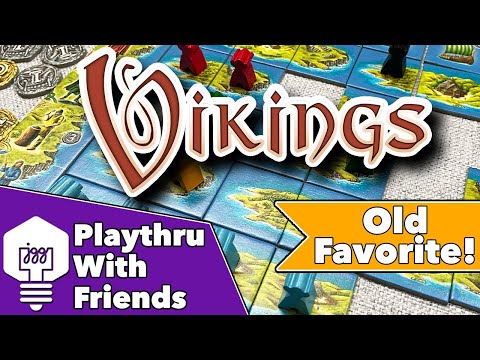
Vikings stands as a hidden gem in board gaming circles, earning passionate praise from reviewers who recognize it as a sophisticated tile-placement design that punches far above its perceived weight. Michael Kiesling's 2007 creation delivers the kind of elegant economy rarely seen in modern games, combining intuitive mechanics with surprising strategic depth. Despite its critical appreciation, Vikings remains frustratingly out of print, leading many in the gaming community to advocate loudly for its reprint potential.
Core Mechanics That Define Vikings
The Pricing Wheel and Dual Drafting System
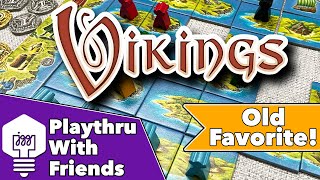
At Vikings' mechanical heart sits an ingenious pricing mechanism that elegantly handles both tile and meeple acquisition. Players draft from a shared pool of Viking meeples and island tiles that rotate on a wheel. The prices shift dynamically based on availability: as cheaper options sell out, more expensive options become accessible to subsequent players. This creates a subtle push-your-luck tension where spending heavily early can be rewarded with bonus tiles, but committing limited funds to a single round leaves you vulnerable later. The system encourages constant tactical recalibration rather than rigid long-term planning.
Island Construction and Row Placement
Players build their scoring area by constructing islands across six rounds, placing meeples and tiles into specific rows. Each row accommodates only certain Viking colors, forcing players to make placement decisions with real consequences. The physical act of building creates natural bottlenecks: you cannot immediately place newly drafted pieces if the appropriate row is full, requiring you to acquire storage-specialist meeples (boatsmen) to ferry blocked units into position later. This creates an elegant resource-allocation puzzle where timing and piece prioritization matter as much as raw income generation.
The Vikings Experience
Economic Tension and Income Management
The core gameplay loop revolves around money as the scarce resource. Yellow Viking meeples generate income during scoring phases, creating a reinforcing engine: more income allows you to buy better pieces, which generate more income. However, money remains tight throughout the game. Skilled players discover that securing a strong income engine early is often decisive, while neglecting this system leads to tournament-level pressure later when competitive players have already ramped their cash production. This creates genuine player interaction despite the lack of direct combat or blocking mechanics, control of income-generating pieces becomes the central competitive battleground.
Balancing Multiple Scoring Paths
While income generation dominates strategy, Vikings offers multiple viable scoring approaches. Red meeples provide immediate victory points. Green meeples score based on connected groups below them (chain scoring). Blue meeples enable feeding your workforce, preventing massive end-game point penalties. Black warriors defend against invading ships that appear on the market. Each color drives different strategic priorities, meaning victory emerges from dozens of possible approaches rather than a single dominant path. A player could win through raw point accumulation, another through perfect workforce management, and a third through superior early income optimization.
What Makes Vikings Stand Out
Simplicity Married to Sophistication
Vikings achieves the rare balance of being easy to teach but rich enough to reward repeated play. A first-time player grasps the core loop within five minutes: draft pieces, pay for them, place them, collect points. Yet beneath that transparent surface lies genuinely crunchy optimization. How tightly should you manage your storage space? When should you take a money-generating meeple versus a point-scoring piece? Should you exploit your current money advantage or invest in infrastructure? These questions emerge organically from play rather than being imposed by complex subsystems.
Tile Placement as Gateway to Strategic Depth
Unlike many tile-placement games that emphasize spatial puzzle-solving, Vikings uses placement constraints primarily as a pacing mechanism. The requirement that all tiles remain orthogonally adjacent prevents wild map sprawl but rarely creates genuine puzzle moments. Instead, the placement rules create natural pauses where players must decide: do I have room for this piece, or must I restructure my islands? This transforms placement from an optimized puzzle into a strategic checkpoint that forces commitment to earlier decisions. The result feels like a eurogame about economic development rather than a spatial game with economic trappings.
Potential Drawbacks
Limited Player Interaction and Indirect Pressure
Vikings' elegant economy comes at the cost of direct player interaction. Most decisions are made independently; the game exerts pressure through market scarcity rather than targeted attacks. For players accustomed to negotiation, blocking, or player elimination, Vikings can feel abstract and low-conflict. The game's tension emerges entirely from competing for the same finite resources, creating a genteel form of competition rather than confrontational gameplay. This makes Vikings excel as a family-weight game for experienced players but less engaging for those seeking dramatic moments or memorable combat.
Vulnerable to Early Advantage Snowballing
If one player secures a superior income engine by round three, catching up becomes mathematically difficult. The exponential growth of money generation means a two-round lead in cash infrastructure often translates to an insurmountable final-score gap. While this creates exciting early-game tension (knowing that the income race is effectively decided), some players find the endgame anticlimactic once the outcome becomes clear. The game rewards correct early positioning so heavily that strategic flexibility mid-game cannot fully compensate for a weak start, which can frustrate players who prefer comeback mechanics.
If You Enjoy Vikings
Players who gravitate toward Carcassonne will recognize similar tile-placement DNA, though Vikings offers far greater economic depth. Cascadia provides comparable spatial building with tighter optimization puzzles but less engine-building satisfaction. Wingspan fans seeking eurogame elegance rather than theme should absolutely seek out Vikings. Everdell and Maori share the economic-tableau building that drives Vikings' strategy, though both include more player-interaction mechanics. Those who found Splendor's engine-building satisfying but desired deeper placement strategy will find Vikings scratches a different but equally rewarding itch.
What Reviewers Are Saying
"I think with the right kind of release and the right kind of marketing this game could be as big as a game like Cascadia. I think this game's a better game than Cascadia and I really like that game."
— Chairman of the Board
"This is such a cohesive game here. I love the way everything works. I love that dual drafting mechanism. I like the way you're compensated by spending the most money because if you spend more money than anybody else at any time you get to take one of these bonus tiles which are really useful tools which will kind of increase the yield if you're certain Vikings, et cetera. Just a wonderful game."
— Chairman of the Board
"Vikings is such a wonderful little tile placement game. I love the tile placement with the drafting system kind of combining with each other and it's just brilliant. This is such a wonderful family weight style game."
— Chairman of the Board