



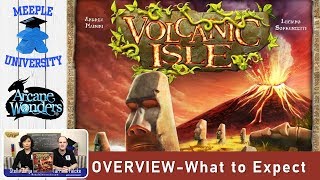

Volcanic Isle Deep Dive
What the Community Thinks About Volcanic Isle
Volcanic Isle is a 2019 area control game published by Arcane Wonders for two to four players, with a typical playing time of about 45 minutes and a light to medium complexity rating. Players are tribes settling a collapsing volcanic island on the lost continent of Mu, raising Easter Island style moai while the land beneath them comes apart. The most detailed discussion comes from Meeple University, whose full live play shows how quickly the board changes over a session. A shorter overview from Meeple University explains the scoring and the sinking rules in plain terms.
The Meeple University hosts were enthusiastic about the design. They argued that the game deserves more attention than it gets and described it as a really good game for two, three, or four players that is underrated because many people do not know about it. Their praise centers on the way every move changes the strategy of the other players, which keeps interaction high throughout.
Junkets Games covered Volcanic Isle in a monthly segment on games to watch, before playing it. Working from the rulebook and a single image of the game in play, the host described the premise of volcanic eruptions that sink parts of the island and the way moai construction determines where those eruptions land. That interest in the theme reflects how the game is generally perceived: a strong concept with a tense, physical implementation.
Core Mechanics That Define Volcanic Isle
Area Control Through Moai and Village Building
Each round, a player has four action points to spend on moving settlers, building villages, building moai, raising moai, producing new settlers from a village, or buying a prayer token. Building a village costs two action points and building or raising a moai costs one each, so a turn is always a choice between expansion and consolidation. Meeple University noted that the cost of prayer tokens climbs as more are purchased in a single turn, which makes protection a real trade-off against building.
Construction also consumes resources. Every village or moai uses up a lava token from the board, and lava is the rock that serves as building material. Because lava runs short in contested areas, players compete for the best locations. Scoring rewards clusters: a village earns a point when it is built, while raising a moai scores the number of villages in that area multiplied by the number of moai raised there. Building in tight groups is therefore the most rewarding approach, and the reviewers stressed that this is exactly what makes a cluster attractive to an opponent.
Eruptions, Fissures, and Sinking Islands
Every moai raised opens a fissure in front of it and triggers an eruption roll. Fissures act as barriers to settler movement, which can protect open space, but they also progressively split the island. Any portion completely separated from the largest part sinks into the ocean, and everything built on it is removed from play. The live play showed that this rule turns area control into a race to cut off rivals: when a section is cut off, the active player saves all settlers in it, while passive players can rescue only one settler per area.
Eruptions add lava to the board but destroy anything in their path, which is why prayer tokens matter. The game ends when only two volcanoes remain on the island. Anything left on the board is then scored, with villages worth three points, settlers four points, unspent prayer tokens two points, and moai two points or four points when adjacent to another of the player's moai. The Meeple University overview summarized the central tension of the design: a player's most profitable locations are also the most exposed to sinking.
The Volcanic Isle Experience
A Board That Looks and Feels Dangerous
The island shrinks visibly across a session, and reviewers described the physical changes as part of the appeal. The eight volcanoes are 3D pieces that rise above the board, and the live play frequently returned to the way sinking sections drop away and leave the remaining land smaller and more crowded. The experience is less like placing tokens on a fixed map and more like watching a landscape fail in real time.
Eruptions Keep Every Turn Tense
Because each moai raised rolls for an eruption, a turn that looks safe can end with a lost village or a flooded cluster. In the live play, the hosts repeatedly reconsidered their plans after eruptions and sinkings, describing strategies that shift with every opponent move. The result is a steady sense of tension rather than long stretches of quiet planning.
What Makes Volcanic Isle Stand Out
3D Volcano Components and Table Presence
Meeple University highlighted the 3D volcano pieces as a standout feature, noting that they have good table presence when viewed from the side as well as from above. The moai are also a visual highlight, and the hosts found the components appealing enough to film in close-up. Reviewers pointed out one minor physical quirk: the stacked volcano pieces do not sit flat on the table, though they considered this a small issue.
Scaling Across Two to Four Players
The live play tested the game at several player counts and concluded that it works at both two and three or four players, though the experience changes. In a two-player game, harming an opponent is as valuable as benefiting yourself, so the game is very direct. In three- and four-player games, the emphasis moves toward growing your own position while limiting the damage that opponents can do. The hosts felt the design holds up at each count while producing a different style of play.
Potential Drawbacks
Sinking Holdings Can Feel Punishing
The most common concern is that a single sinking can erase a large amount of work. In one live play, a host spent considerable effort sinking a third of the island, only to see the opponent sink more than half of what remained and win the game narrowly. In an earlier four-player game, a player whose holdings were sunk finished last. Some players may find that frustrating, particularly when a cluster built over several turns disappears in one move. Reviewers framed the cutthroat nature of the game as deliberate, so this is best viewed as a question of temperament rather than a defect.
Lava Channel and Settler Rescue Rules Need Clarification
The live play paused twice to check the rulebook. The first pause concerned whether a moai must be placed in a lava channel. The host had always played it that way, but the rules text did not strictly require it, and the group proceeded with the more permissive reading. The second pause concerned the one-settler-per-area rescue rule for passive players, which the hosts had to confirm mid-game. Players new to Volcanic Isle should expect to look up these details, and a clearer rulebook would reduce the number of interruptions.
If You Enjoy Volcanic Isle
Volcanic Isle suits players who enjoy area control in which the board itself changes under their feet. It is a good fit for groups who like tactile, physical components and who accept that a clever turn can sink an opponent's position as easily as strengthen their own. Two-player groups that want a direct, confrontational contest will find the game especially sharp, while three- and four-player groups who prefer to focus on their own growth will find a more measured version of the same tension. The Meeple University hosts compared the four action point structure to the action economy of Pandemic and The Underground, where players are never quite able to do everything they want in a turn.
What Reviewers Are Saying
"A major part of the game is trying to cut off your opponent's stuff. It's very cutthroat without cutting off your own."
— Meeple University
"Your most profitable locations within the game are also likely to be your most vulnerable due to all of the fissures that your point-scoring moai create. Opponents will be keen to stop you from scoring those profitable clusters in the endgame by opening that last fissure and sinking all of your hard work."
— Meeple University
"It's a fully competitive game, and people are building gigantic monolithic statues to try and appease the gods. It looks like how you build these statues will actually dictate how the different volcanoes erupt."
— Junkets Games