



Warhammer: Diskwars Deep Dive
What the Community Thinks About Warhammer: Diskwars
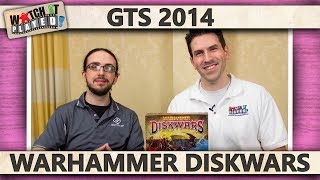
Reviewers see Warhammer: Diskwars as a miniatures-style battle game that trades sculpted models for flat, double-sided discs. Published by Fantasy Flight Games in 2013 for two to four players, it was announced around Gen Con that year. Board to Death TV framed the discs as the game's main selling point, calling it a portable unit combat game with four factions in the box and a strong Warhammer theme. Watch It Played took a similar view in a guided demo, arguing that the game captures the tactical maneuvering of a miniatures wargame without the setup time and measuring that many players find tedious.
The reviews are more divided once the game is judged as a long-term purchase. Board Games UnLocked placed the game on a list of disappointments. That reviewer bought it cheaply, wanted the miniatures that the box did not include, and found the flipping of discs less satisfying than moving figures. Their central complaint was that the game had little community around it, so opponents were hard to find. The consensus, then, is that the core design is clever and easy to teach, while the appeal depends heavily on whether a player is willing to commit to a game that is only as strong as its local player base.
Core Mechanics That Define Warhammer: Diskwars
Pinning and Combat Resolution
Pinning is the mechanic reviewers describe most often. Each disc is activated by physically flipping it end over end across the table, and a disc that lands on top of another disc pins it. A pinned disc cannot activate until the disc above it has been dealt with, which makes board positioning the center of the game. Watch It Played explained that overlapping discs do not fight immediately. Once every unit has activated, the overlapping pairs resolve combat together. Each disc shows two strength values, a black number used by the unit on top and a white number used by the unit underneath, so the outcome of a pin is printed directly on the disc. The demo showed how quickly this resolves: two units pinning each other could wipe each other out in a single exchange, and a leader with a special impact ability could deal damage the moment it pinned an enemy.
Because every stat is printed on the disc, reviewers note that there is almost nothing to look up during play. Range and movement are also simple, as Watch It Played noted: a unit with a movement of five is moved by flipping its disc up to five times, and the path can curve around other pieces. The published rules also use a command card system where each player secretly picks a strategy card to determine turn order, the number of units that can activate, and any special abilities. The strategies work in a rock-paper-scissors pattern, so reading an opponent's likely choice matters as much as positioning.
Command Cards and Activation Order
The command card step is the second system reviewers describe as central to each turn. Both players reveal a card at the same time, and the chosen strategy decides who goes first and how many of a player's discs may activate that round. Watch It Played's demonstration showed how this shapes tempo: the player who goes first can use their activations to pin key enemy units before the opponent has a chance to respond. Activated units are marked with a token, so a leader that has already acted cannot act again until the rest of the army has finished. The reviewers present this as an elegant way to keep turns short while still rewarding planning.
The Warhammer: Diskwars Experience
Quick, Tactical Skirmish Play
Reviewers describe the game as fast. The Watch It Played demonstration moved from setup to a complete round of combat in a short span of time, and the presenter emphasized that the physical act of flipping discs makes each turn feel immediate. Board to Death TV made a similar point when describing the game as very portable, which suits players who want the pacing of a battle game without a large table of painted figures. Much of the appeal is that the game feels like a miniatures battle even though nothing needs to be assembled or measured.
Chance and Swingy Outcomes
The dice in ranged combat create tension, and the reviewers do not hide it. In the demonstration, a crossbowman with three ranged dice rolled only misses, and the presenter observed that it was a painful result for a player who had hoped for hits or critical skulls that would have dealt three damage each. Magic works differently. A wizard always attacks at medium range without rolling dice, though the presenter pointed out that the caster also takes some risk. The result is a battle in which lucky rolls can change the outcome of a turn, and the reviewers treat that unpredictability as part of the fun.
What Makes Warhammer: Diskwars Stand Out
Printed Information and Accessibility
Reviewers consistently praise the way the discs present information. Watch It Played said that in addition to the art, each disc shows how far a unit moves, how hard it hits, how much damage it can take, and any special powers. Nothing needs to be referenced outside the game, which lowers the barrier to entry. The same reviewer noted that the Core Set includes the basics of two starter armies, the Empire and the Orcs, so new players can begin without buying additional product.
Army Building and the Core Set Contents
Army building is the second feature reviewers single out. Each army is built around two leaders, and each leader sets a points budget for the units that can follow. In the demonstration, the Orc leader Grom supported 35 points of units, while a shaman cost seven points. Board to Death TV highlighted that the box contains four factions, and that the expansions add more disc sets for Destruction and Order armies, including Dwarves and Vampire Counts. The reviewers see this as a system that rewards hero-centric planning and invites players to mix forces. Terrain pieces with their own special rules, such as forests, towers, hills, and ruined windmills, also make the table feel closer to a miniatures battlefield.
Potential Drawbacks
Limited Local Community
Board Games UnLocked raised the most serious concern. The reviewer argued that the game has little support in their area, and that few people play it, which makes the purchase harder to justify for a game meant to be played against opponents. Because a competitive army requires finding other players and building forces, the game's long-term value depends on a community that the reviewer did not find locally. That criticism applies to many tabletop games, but it is sharper here because the reviewer also believed that the disc format removes a key part of the appeal.
Discs Versus Miniatures
The second drawback is the format itself. Watch It Played acknowledged that some players enjoy the measuring and model-building of traditional miniatures games, and that Warhammer: Diskwars is designed for those who do not. Board Games UnLocked was less forgiving. The reviewer explained that flipping discs does not provide the same satisfaction as moving figures, and that the game was less appealing without the models that the reviewer had expected to own. The concern is less about rules than about the sensory experience of playing a Warhammer battle with cardboard tokens instead of sculpted miniatures.
If You Enjoy Warhammer: Diskwars
Players who like the tactical maneuvering of Warhammer: Diskwars will find the closest match in the miniatures tradition that Watch It Played used as its reference point. Traditional miniatures wargames keep the same sense of positioning, line of sight, and unit-based combat, but they add the measuring and model assembly that the disc format removes. For players who want a different kind of tabletop experience, Board Games UnLocked discussed Shadows over Camelot in the same breath as Warhammer: Diskwars. Shadows over Camelot is built around a hidden traitor and a card-driven quest rather than unit combat, so it suits players who want social deduction instead of a battlefield. Both games reward players who enjoy strategic planning, but they deliver it through very different systems.
What Reviewers Are Saying
"Instead of having fiddly little models, which while cool, or take a lot of time, all your units are just represented by discs, and what's great about there, in addition to having some great art, there is everything you need to know about your unit is printed right on there. There's nothing to reference outside of the game."
— Watch It Played
"Instead of miniatures, we have flat discs, and those discs are flipped on the board as you activate units. So it's very portable, and it's got four factions in the box."
— Anton Torres, Board to Death TV
"Two reasons that I don't like this game now is there's zero support, nobody plays around here."
— Board Games UnLocked