









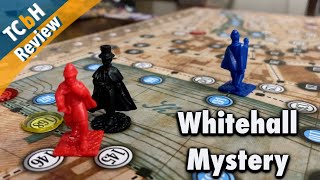

Whitehall Mystery Deep Dive
What the Community Thinks About Whitehall Mystery
Reviewers who have covered Whitehall Mystery converge on one idea: it takes the hidden movement format and removes what slows it down. Several channels present it as a condensed successor to Letters from Whitechapel that keeps the most tense parts of that design and cuts its longer setup. The Cardboard Herald calls it one of the most cohesive and focused games it has played in ages, and No Rolls Barred counts it among its favorite games ever made. Disagreement tends to center on temperament rather than quality. Board Games UnLocked placed it sixth on an all-time top ten, and The Cardboard Herald included it among the most-played games of 2021, but the theme and intensity are not right for every table, and No Rolls Barred openly admits the game is not for everyone. Reviewers also agree that player count changes the experience: two players face each other in a tense contest of guessing, while three or four players can hear the police plan out loud, which turns the hidden player into a spy inside the group.
Core Mechanics That Define Whitehall Mystery
Hidden Movement
One player takes the role of Jack, the killer, and moves secretly across a map of London. Jack picks four white circles in different quarters of the map as the places where body parts will be left, then records each step on a pad hidden behind a screen. No Rolls Barred traces the format back to Scotland Yard, released in 1983, and notes that the difference here is that the police pieces stay visible while the murderer's route stays hidden. Jack must move every turn, so the hidden player is always pushed toward the next drop zone rather than waiting in place. The Cardboard Herald points out that Jack must reach each of the four circles within a limited number of moves, and the investigators gradually narrow down where the final ones can be.
Deduction Through Clue Checks
The police side runs on a deduction loop. After moving, each investigator may check the circles adjacent to them by asking whether Jack has ever been there. A yes leaves a footprint marker on the board, and a no lets the officer keep searching neighboring circles. Arrests are the high-risk alternative: an investigator names a circle next to them and asks whether Jack is standing there right now, which wins the game outright if correct. The Cardboard Herald describes this as a risk and reward decision, weighing the value of gathering more information against the chance of a decisive arrest. No Rolls Barred adds that one lucky clue can suddenly tighten the net around the murderer.
The Whitehall Mystery Experience
Noir Tension Over a Victorian City
Reviewers describe the game as a grim Victorian crime story drawn from the real Thames torso murders of 1887 to 1889, a series of unsolved killings linked by body parts found along the river. The tension is less spooky than noir in tone: sudden footprints, a killer holed up in an alleyway, and policemen rushing past within inches of the hiding place. The Cardboard Herald says the theme pulls players in quickly, and that everyone at the table feels how intense the hunt becomes.
Quick, Lean Sessions
Pace is a recurring point of praise. Board Games UnLocked gives a typical game roughly 45 minutes, and No Rolls Barred says that even a full three-round game usually runs under an hour. There are no points to tally and no end-game bonus calculations to work through, so the finish is decided on the board: Jack either reaches the last circle or is arrested. The Cardboard Herald notes that the short playing time keeps the tension concentrated rather than stretched across a long evening.
What Makes Whitehall Mystery Stand Out
A Chase That Never Resets
The feature reviewers praise most is the continuous structure of the chase. When Jack completes a drop zone, the movement track resets to zero and the next leg begins immediately. No Rolls Barred contrasts this with Letters from Whitechapel, which it says requires resetting the board between four or five rounds, a pause that drags the game out. The result is what No Rolls Barred calls one unbroken string of tension, where the murderer never gets a break and the police never lose momentum. The Cardboard Herald adds that the investigators steadily learn where the remaining drop zones lie, so each round feels more tense than the last.
Easy to Teach, Easy to Replay
Multiple reviewers emphasize how quickly the rules click. The Cardboard Herald says it has taught the game to gamers and non-gamers alike and that it works well with two players as well as four. Replay value comes from the asymmetry: No Rolls Barred notes that playing as the murderer and playing as the police feel very different, and that switching sides makes for a satisfying second game. Jack's six limited-use special moves for carriages, alleys, and boats add a small set of tricks that must be spent carefully.
Potential Drawbacks
Cheap-Feeling Components
The Cardboard Herald raises production as its main complaint. The plastic is described as cheap, and the bright yellow, red, and blue color scheme clashes with the murky Victorian London setting the board otherwise conveys. The reviewer frames these as cosmetic issues that do not change how the game plays, and says they are about the worst things it can say about the game.
A Grim Theme That Not Everyone Wants
No Rolls Barred acknowledges that a killer leaving body parts around London will not suit every table. Some players want lighter games and do not want to take on the role of one of history's most grotesque killers. The two-player version can also feel intense in a way some groups find stressful: the police and the murderer face each other in near silence, with each side watching for bluffs. The reviewer describes it as murder chess played in horrible silence.
If You Enjoy Whitehall Mystery
Players who enjoy Whitehall Mystery's hunt will find the closest comparison in Letters from Whitechapel, the game it condenses. No Rolls Barred describes that version as longer, with four or five rounds and board resets between them, while Whitehall Mystery delivers the same core of secret movement and clue checking in a single focused session.
Players who want the classic starting point for the genre should try Scotland Yard, the 1983 game that No Rolls Barred credits with establishing it. Fury of Dracula is another popular example that No Rolls Barred names, and Escape the Aliens from Outer Space appears on the same list of notable hidden movement games. For a different theme built around a similar secret pursuit, Board Games UnLocked suggests trying Hunt for the Ring.
What Reviewers Are Saying
"Having an extremely distilled experience like Whitehall Mystery where it just cuts down to the most bare bones aspect to that game where you are removing all of the barriers to the fun and just emphasizing the cold hard deduction aspects is so brilliant. The game is so easy to teach, it plays in a short amount of time and delivers all of that experience of hunting down your subject or avoiding the people hunting you if you're on the other side while not really having to worry about all of the other larger game elements that this genre tends to have."
— The Cardboard Herald
"The police they start off clueless but slowly build their case up and up, charting routes on the map until they know exactly where you've gone and exactly where you're going. This is the magnificent story arc that makes Whitehall Mystery such a satisfying play experience in one basically unbroken sequence of events."
— No Rolls Barred
"This is such a tense invigorating and fascinating game to play. It is so easy to learn. I played this with gamers and non-gamers alike and everyone has latched on to the theme. They feel how intense it is."
— The Cardboard Herald