



Zombie 15' Deep Dive
What the Community Thinks About Zombie 15'
Reviewers describe Zombie 15' as a short, loud, cooperative real-time game in which a small team of teenage survivors must finish a scenario objective before the soundtrack runs out. Cardboard Rhino (cardboardrhino) gives it a clear recommendation, calling it light, fast, and full of tension. Actualol (Actualol) is more divided. The reviewer sees the timed format as a strong fit for players who enjoy race-against-the-clock survival games, but finds the bookkeeping and the stress less appealing at their own table. Rum & Board (Rum & Board) played through a full mission, and their session shows a game that rewards quick decisions and punishes a group that stops communicating. Watch Review (Watch Review) emphasizes the friction that arises naturally between teammates, which the reviewer links to the tension of an actual zombie apocalypse.
The consensus is that Zombie 15' delivers a concentrated, time-boxed experience that is quick to teach and hard to play calmly. Reviewers disagree mainly on whether the clock is a pleasure or a chore. Those who enjoy the pressure praise the game's tempo, while those who prefer a slower, more deliberate table find the constant timing and tracking tiring.
Core Mechanics That Define Zombie 15'
Resource Management
Zombie 15' makes scarcity the center of every turn. Each hero can carry only one green weapon, one green or yellow weapon, and one blue light item at a time, so searching is always a trade-off between what to keep and what to leave behind. Weapons wear down with use, and Actualol notes that this forces players to keep searching for new and better gear. Reviewers also treat noise as a resource cost. Cardboard Rhino explains that every weapon use that is not silent adds a zombie to the Horde box, which will arrive later and in bulk. Rum & Board's session shows the pressure in practice, with players repeatedly debating what counted as an action and whether a found item was worth the turn it took to grab. Deciding whether the next of four actions should go to searching, fighting, or moving is the decision that drives the game.
The Horde Timer
The soundtrack acts as the game's clock. Roughly once a minute it growls, and the active player flips the top card of the zombie deck and adds that many zombies to the street area of their tile. Cardboard Rhino describes this as the core rhythm of play. When a Horde card is drawn, every zombie stored in the Horde box is placed on the active hero's street at once. Watch Review calls this a truly breathtaking number of zombies, one that can overwhelm a hero in a single turn. Watch Review stresses the turn discipline that the system demands: a player's turn ends as soon as they finish fending off, and the next player starts immediately. Together these rules turn the soundtrack into a pacing mechanism that punishes hesitation.
The Zombie 15' Experience
Relentless Time Pressure
Playing Zombie 15' feels like a sprint against a soundtrack that never slows down. Players take turns as quickly as they can, and each growl of the soundtrack brings more zombies onto the board whether or not the group is ready. Actualol describes the game as a race against time that suits survival themes well, and found the fifteen minutes of play genuinely exhausting. Cardboard Rhino makes the same point from a different angle, describing a frantic pace in which important decisions must be made very fast. The result is a game where a clear plan matters more than a perfect one, and where indecision costs as much as a bad roll.
Tense Teamwork
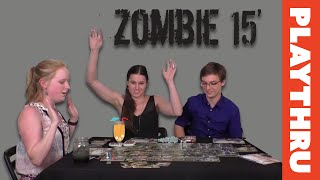
The second feeling is a crew under strain. Cooperation is necessary, since a hero can only attack zombies in their own area and a fallen hero contributes nothing to fend-offs, yet the rush of the clock makes that cooperation fragile. Watch Review reports that teammates inevitably yell at one another when someone makes a mistake or is slow, and that the reviewer found this tension fitting for a zombie apocalypse. Rum & Board's session shows the same dynamic. Their play included sharp disagreements about who should act next and what the group should prioritize, and by the end of the session the players were openly saying that their team was falling apart. That friction is what gives the game its drama, and it is also why the experience works best with players who can laugh off a bad turn.
What Makes Zombie 15' Stand Out
A Fifteen-Scenario Campaign With Gentle Starting Points
Cardboard Rhino notes that the game is designed as a campaign, but each scenario can also be played on its own or replaced with custom scenarios. Actualol points out that the box holds fifteen scenarios, giving players a substantial amount of play. Watch Review recommends that newcomers begin with the tutorial scenarios, which introduce the more complicated mechanics gradually and offer a slower difficulty curve. Items and search tokens can also carry from one mission to the next, which gives campaign players a sense of progression that single games lack.
Easy Rules, Real Decisions
Cardboard Rhino says the rules are easy to learn, but the choices are not. Each hero brings special abilities, and the reviewer stresses that teams must cooperate well to use those abilities wisely. Watch Review reinforces the simplicity of the core turn, which allows up to four actions taken in almost any order, while the board state keeps shifting around those choices. The combination makes Zombie 15' approachable for a new group while still demanding real planning from experienced players.
Potential Drawbacks
Bookkeeping That Eats Into the Clock
Actualol's most consistent complaint is that Zombie 15' asks for a lot of administration in a game played against a timer. Tracking ammunition with small markers and managing item slots take time that the reviewer felt should go toward meaningful decisions. Actualol wanted the clock to add pressure to choices rather than to measure how quickly the group could shuffle components. The reviewer also described the game as more stressful than relaxing, which makes it a poor filler and a title best saved for the right mood.
Idle Players and Rules Questions
Rum & Board's session exposed two frictions. When a hero falls unconscious, that player cannot take further turns and must wait while the others finish, and Watch Review notes that the fallen hero can only be dragged along by teammates. The group also paused repeatedly to settle rules questions, such as whether standing up counts as an action and what could be taken from a searched pile. New groups should expect these pauses early on, and the tutorial scenarios are the best remedy for them.
If You Enjoy Zombie 15'
- Last Night on Earth: Actualol describes it as a loose, cliched zombie game where dice decide movement and combat, and says it is to be enjoyed for its spectacle rather than its airtight design. It suits players who want theme and chaos over tight timing.
- City of Horror: Actualol presents it as a negotiation game in which players vote on who survives and form hidden alliances. It is a good pick for groups who want table talk and social maneuvering in place of real-time pressure.
- Dead of Winter: Actualol calls it one of the reviewer's favorite board games, praising its secret objectives, the threat of a betrayer, and the crisis cards that force hard choices about feeding the colony. It rewards players who want a longer, more narrative survival experience.
- Zombicide: Black Plague: Actualol praises its cooperative play, clear dashboards for tracking items, and XP progression that steadily raises the threat. It is a strong choice for players who want cooperative zombie combat with a slower, more deliberate clock.
What Reviewers Are Saying
"It's light, it's fast, it has lots of tension, so Rhino says yes to Zombie 15. You should definitely give it a try."
— cardboardrhino
"Half the time is wasted doing the admin of the game if I'm being timed. I want the time to be a pressure on my decision making and not a test of how quickly I can move things around."
— Actualol
"You can think you're being really helpful, but you're not being helpful."
— Rum & Board