






Winter Rabbit Deep Dive
What the Community Thinks About Winter Rabbit
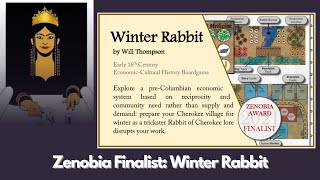
Winter Rabbit has garnered enthusiasm from reviewers and game designers who recognize it as a thoughtfully crafted exploration of both mechanics and cultural representation. The game presents itself as a semi-cooperative experience grounded in Cherokee cultural values, offering players a fresh perspective on how board game systems can embody alternative economic frameworks rooted in indigenous principles rather than colonial models.
What strikes reviewers most is how the game balances thematic authenticity with engaging gameplay mechanics. The attention to cultural detail, from bilingual components to collaborations with Cherokee artists and cultural consultants, demonstrates a design philosophy that refuses to treat culture as mere window dressing. Reviewers note that the game succeeds in making players feel the tension between individual and communal goals, both in the rules and in the thematic experience.
Core Mechanics That Define Winter Rabbit
Semi-Cooperative Village Preparation
Winter Rabbit positions players as animal characters from Cherokee lore preparing their village for winter while Rabbit the trickster disrupts their work. The core tension defines the entire experience: players must work together to gather enough resources and complete provisions, or everyone loses collectively. If the village is ready when winter comes, however, the player with the highest individual score wins. This push-pull creates what reviewers identify as a genuinely novel approach to semi-cooperative design. Players cannot simply abandon the shared goal to pursue points, because failure means everyone shares a collective loss. Equally, pure cooperation leaves no room for the individual advancement that drives gameplay.
Hidden Worker Placement and the Bag Draw System
The mechanical heart of Winter Rabbit is its hidden worker placement system. Players draw villager tokens from a bag, see what they drew, and place them face-down on resource production spots. This hidden placement creates information asymmetry: you know your own token, but others can only guess. Once enough tokens fill a spot, that resource is produced, and every player with a token present gains resources. Rabbit tokens, drawn randomly into the bag, steal those resources entirely, adding an element of sabotage and unpredictability. Reviewers highlight how this mechanic elegantly enforces cooperation while maintaining genuine uncertainty about outcomes. The bag draw creates dramatic moments where resource generation succeeds or fails, and players cannot fully control the situation. The sharing token adds negotiation opportunities, allowing players to signal resource needs and strike informal deals across the table.
The Winter Rabbit Experience
Economic Systems Built on Reciprocity Rather Than Exploitation
Winter Rabbit consciously rejects the colonial economic frameworks that dominate strategy games. Instead of the typical 4x model (Explore, Expand, Exploit, Exterminate), designer Will Thompson articulates a 4C framework: Cultivation, Continuation, Conservation, and Competition. Resources are produced through community effort, stored in personal spaces, and directed toward shared and individual goals. Reviewers note this creates a different emotional and strategic rhythm. Rather than racing to expand territory or extract resources, players manage limited production cycles and make conscious choices about conservation versus extraction. When players over-exploit resources through storage limitations or trickster disruption, they feel the consequence immediately in reduced future production. This embeds the cultural principle of gadugi (communal work) directly into the game's turn structure.
Thematic Richness Grounded in Cherokee Folklore and Values
The game immerses players in the world of traditional Cherokee animal stories while exploring actual cultural principles. The Rabbit character carries genuine mythological weight, not reduced to a mechanical obstacle but representing a real tradition of trickster figures in Cherokee lore. Reviewers appreciate that the game's challenge is not imposed by abstract difficulty but flows from the tension between a community's needs and one member's chaos. The bilingual components, artwork by Cherokee artists Kendra Sparks and Johnny Catcher, and the integration of a first-language speaker as cultural consultant all signal that representation is not surface-level. Players experience Cherokee cultural values reflected in the game's systems, not simply stated in flavor text.
What Makes Winter Rabbit Stand Out
An Innovative Economic Engine That Feels Fresh
Reviewers consistently highlight the uniqueness of the resource system. One deep observer notes the game presents "a very different thing that I have not really seen in a game before" in terms of its economics. The interplay between communal production, personal storage, and the Rabbit's disruption creates a system that snowballs as players build their village with cards, adding storage and generating resources more reliably. Early rounds feel slow and uncertain. By mid-game, engines churn and turns move quickly. This natural progression in pacing and scope surprises players who expect the rule complexity to match the clean turn structure. Reviewers praise how the game remains quick and snappy while delivering meaningful strategic depth.
Cultural Representation That Respects Authenticity
The game stands out in its commitment to authentic representation. Designer Will Thompson, who is Cherokee, worked with a cultural consultant who is a first-language speaker and collaborated directly with Cherokee artists on every card. Reviewers note the care visible in every design decision, from the choice to include the Cherokee syllabary and bilingual rules to the deliberate effort to avoid stereotypical Southwestern or generic Native American aesthetics. The game offers people outside Cherokee culture an entry point to elements they may not have encountered, while remaining legit and respectful to community members. This dual approach, while admittedly challenging to balance, appears to succeed through the designer's deep personal investment and community collaboration.
Potential Drawbacks
Semi-Cooperative Complexity in Design and Play
Designer Will Thompson notes that semi-cooperative games are "really hard to make," and Winter Rabbit's balance between individual and communal goals requires constant player attention. The hidden information and disruption potential mean that luck plays a role in resource availability. Some players may feel their personal strategies are undermined when Rabbit tokens appear frequently or storage limitations force them into difficult position. The game's elegance in theme and turn structure masks the underlying strategic complexity, which can catch players unprepared. A table of players focused solely on winning individually will struggle to complete the communal provisions and face collective loss.
Rule Density Despite Clean Gameplay
While each individual turn is quick and straightforward, the rulebook contains several pages of text, provision tracks, story card effects, and village card interactions. The game occupies an interesting space: not a light intro game, but not a rules-heavy euros either. Reviewers highlight that the game requires a patient learning phase before the elegance becomes apparent. New players in their first round may feel the rules are more complex than the clean turn structure suggests. The semi-cooperative framework also means that experienced players can dominate the table if others are still grasping the system.
If You Enjoy Winter Rabbit
Reviewers compare Winter Rabbit favorably to Paleo Vet, Will Thompson's earlier design, suggesting it represents significant design growth. Paleo Vet came together quickly with strong mechanics; Winter Rabbit took considerably longer to refine, particularly because semi-cooperative balance is genuinely difficult. The game's cultural foundation and commitment to authentic representation have no direct comparison in the hobby. For players seeking semi-cooperative experiences grounded in indigenous values and mechanically innovative resource systems, Winter Rabbit offers something the broader hobby rarely provides.
What Reviewers Are Saying
"There's a lot of really interesting things I really like about this game. The economics of it is such a very different thing that I don't think I've ever seen in a game before, where you have this sort of brinkmanship, piggybacking thing on these various different resources, which could be changing based on how players take the action to sort of carve out some space and take some of the wood tokens or put some back, and that kind of thing."
— Zenobia Awards Showcase
"I've played Winter Rabbit and that was such a strange, different experience of approaching the idea of semi-cooperative play. I've never played a game before where everyone just deliberately, strategically vocalized their plans: this is what I'm going to do, this is what I'm planning on doing, and this is why, because if I do this, I will then be able to do this in a competitive game. I've never seen another game do that."
— Beyond Solitaire
"I showed her the prototype like I showed her some of the cards and she just like was so happy and smiled and laughed, and like I cannot express to you how like good it feels to see somebody just like give it that level of approval and excitement from somebody who is a first language speaker, an elder."
— Will Thompson, Beyond Solitaire