








Cascadia Junior Deep Dive
What the Community Thinks About Cascadia Junior
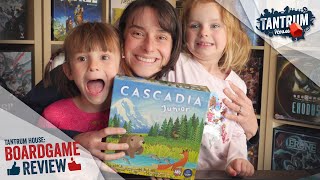
Board Game Dad, Tantrum House, and kovray all frame Cascadia Junior the same way: a stripped-down, family-weight version of Cascadia from the same design team, built to be fast and easy enough for young kids while keeping the original's look and feel. Board Game Dad calls it a two to four player game from AEG and sets out specifically to test whether it succeeds at making Cascadia accessible to younger players. Tantrum House played it with their own daughters, ages four and six, from publisher AEG and FlatOut Games, and came away calling it a scaled-down version of Cascadia that the whole family enjoyed. kovray covers it as part of a full franchise rundown, noting it comes from the same team with an added co-designer, Tessa Elise, working alongside Randy Flint, with new artwork by the Cascadia illustrator. Where the three differ is in how comfortable they are with the randomized scoring at the center of the game. Board Game Dad is the most critical, arguing the luck factor keeps the game from rewarding good play. One voice in the kovray duo says the randomness is a little too much for their own taste, while still understanding the appeal, and Tantrum House treats the same randomness as simply part of what makes the game work for young children.
Core Mechanics That Define Cascadia Junior
Drafting Two-Piece Habitat Tiles
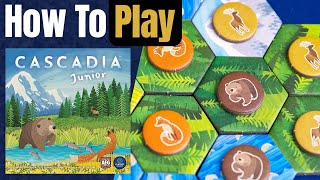
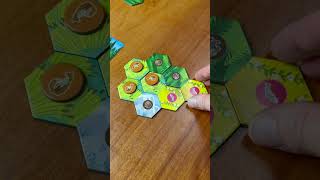
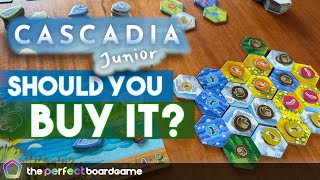
Board Game Dad describes players taking turns drafting one of two hexagonal dominoes and adding it to their own environment, with every tile carrying two terrain types and two animal types already printed on it. kovray's breakdown fills in the turn structure: on a turn a player chooses one of two tiles available in a shared market, adds it to their personal board so that at least one edge touches an already placed tile, then checks for three matching wildlife markers before refilling the market with a new face-up tile. Tantrum House adds that the hexagons come as two pieces that have to be put together, and that making groups of animals or terrain does not require any particular configuration, just three of the same type touching.
Randomized Scoring Tokens
Whenever a player completes a group of three matching animals, Board Game Dad explains, they immediately take a token and cover the animals to mark them as scored, while terrain groups are only tallied at the very end of the game. kovray describes the same token as a wildlife or habitat sighting token that cannot be flipped over until the game ends. In both cases the token is worth one or two points, and nobody knows which until the final reveal. Tantrum House notes that this can mean a player who technically collected more tokens still loses because too many of theirs turned out to be worth only a single point.
The Cascadia Junior Experience
A Short, Approachable Session
Board Game Dad singles out the pace as a favorite change from the original: the game still uses twenty tiles, but spreads them over only ten turns, which keeps it moving quickly enough to hold a six-year-old's attention, and the youngest player in that household, age eight, had no trouble with it. Tantrum House describes a similar experience with children as young as four and six, saying their daughters needed a game or two to really grasp the strategy but were having fun with the tiles and tokens from the start. Board Game Dad adds that a session can run as short as fifteen minutes, which they consider ideal for getting kids who are not already into the hobby to experience the satisfaction of finishing a game.
Luck That Cuts Both Ways
Because token values are hidden until the end, Board Game Dad notes that a younger player can end up ahead of a parent purely on luck, which they say helpfully levels the playing field at a family table. They are less comfortable, though, with the flip side: a child who plays a genuinely strong game can still lose to chance, and they are not sure that is the right kind of handicap. Tantrum House experienced the same swing directly, watching a player accumulate more tokens overall and still come up short because too many were low-value pine cones.
What Makes Cascadia Junior Stand Out
Familiar Art and Feel in a Simpler Shell
Board Game Dad credits the game with capturing the artwork of Cascadia and making it cute for kids while retaining the quality that signals this is a game about caring for nature. Tantrum House makes a related point about the physical tokens themselves, saying they are friendlier and chunkier than the ones in the original Cascadia, which appealed enough to their daughters that they enjoyed collecting and arranging them even outside of scoring. kovray frames this as the game doing a very good job bridging the gap between a mass-market feel and a hobby game, saying that despite the new artwork it still has a familiar feel, and that it works really, really well.
A Low-Friction Entry Point Into the Series
kovray recommends Cascadia Junior specifically as an on-ramp for people newer to board games who want to see what tile placement can look like, suggesting a path that starts with Cascadia Junior before moving on to the full Cascadia and then its Alpine Lakes expansion. Board Game Dad makes a related point from the other direction, saying that for anyone who already loves Cascadia, this version is going to be some really good fun on its own terms.
Potential Drawbacks
A Strategic Ceiling
Board Game Dad's biggest reservation is that the game levels out too much once everyone understands it: without the randomized scoring, they argue, skilled players would simply tie because the design is so simplified, which means the luck element is doing load-bearing work rather than just adding spice. They describe hitting a ceiling where the game stays enjoyable with kids but never lets players go any further, and say they personally prefer trimming rules out of adult-weight games over buying a dedicated children's title for that reason.
Randomness That Isn't for Everyone
The same hidden-token scoring draws criticism inside the kovray conversation, where one host admits the game has a little bit too much randomness for their own taste even while understanding why it appeals to others. Tantrum House's account of the random scoring is more descriptive than critical, but still flags the same mechanical quirk: because token values are hidden, a player can gather plenty of tokens and still lose if too many of them land on the lower value.
If You Enjoy Cascadia Junior
Every channel treats Cascadia Junior as a doorway into the rest of the line rather than a standalone destination. Board Game Dad and Tantrum House both measure it directly against Cascadia, the original game it strips down, pointing to missing nature tokens and simplified scoring as the main differences. kovray goes a step further with an explicit recommendation for newcomers: start with Cascadia Junior to learn what tile placement feels like, then move on to Cascadia, and from there to Cascadia Alpine Lakes once a player is ready for more complexity.
What Reviewers Are Saying
"I appreciate it if my child kind of plays a little worse than me and wins because I think there's a handicap that might be needed, but I don't know if that handicap should just be dumb luck."
— Board Game Dad
"It's a little bit random with the scoring because of that. So, somebody may have technically gotten more tokens, but they might lose the game because they got more of the tokens that only had single pine cones on them."
— Tantrum House
"I will say that Cascadia Jr. does a very good job of bridging that gap between a mass market feel type game and a hobby game because Cascadia and the rest of the games that exist in this line are a bit more strategic and do tend to fall in that hobby space more. Whereas Cascadia Junior does a good job. And although the artwork is new and different than the other games, I feel like it still has this familiar feel."
— kovray