


En Route Deep Dive
What the Community Thinks About En Route
En Route has earned unanimous praise from experienced board game reviewers as a standout entry in the flip-and-write category. Reviewers describe it as substantially more strategic and layered than typical games in the genre, with one calling it "the best [flip and write] I've ever played." The game strikes a balance that appeals to both casual families and experienced strategists. Board Game Dad consistently highlights its educational value and authentic geographic design, while Chairman of the Board emphasizes the depth of player interaction and the variety of paths to victory. Both reviewers note that the game initially feels somewhat fiddly, but becomes elegant once players internalize the systems. The consensus is clear: En Route stands as a one-stop shop for route-building mechanics that avoids the trap of overwhelming complexity despite packing in numerous scoring avenues and strategic layers.
Core Mechanics That Define En Route
Card Drafting System
The drafting mechanism forms the heart of player interaction in En Route. Each turn, the lead player selects a card from their hand, and the players to their left and right each contribute one card as well. The lead player then decides which neighboring card to pair with their own. This creates a genuine dilemma with real consequences: neighboring players can predict what you want and deny it to you, or offer low-value cards to force you into difficult choices. As Chairman of the Board explains, players develop a vested interest in the lead player's decision, creating a push-pull dynamic where risking a good card might leave you vulnerable to opponents offering something better. The drafting system ensures all players remain engaged at all times, preventing the downtime that can plague games with longer turns.
Network and Route Building
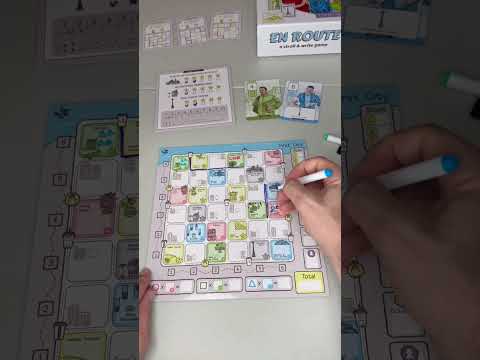
The core mechanic is constructing a connected tour route that satisfies color-matching tourists at landmarks. Players use the coordinate pairs from drafted cards to plot tourist locations on their map, then draw segments of a walking route connecting those locations. The scoring is fundamentally based on multiplying the number of tourists picked up by the number of color-matching destinations on a single contiguous route. This creates a compelling puzzle: you spend ten turns building routes, but at the end you must choose one continuous path. Any side routes or diversions drawn during the game must be erased, meaning all effort on those paths is lost. This forces constant adaptation as new coordinates emerge, and players must be willing to abandon earlier plans for better scoring opportunities.
The En Route Experience
Careful Planning Under Uncertainty
Playing En Route is an exercise in strategic foresight mixed with tactical flexibility. You begin each game with a vision of how to maximize tourists and destinations, but the random draw of coordinates unravels your best-laid plans. Reviewers note that this creates genuine tension: you must balance investing effort into growing your network against the risk that those segments will be erased. Board Game Dad emphasizes how the game rewards "careful planning and predicting your opponent's priorities," but also acknowledges that plans must shift as the game evolves. The drafting system means you cannot fully control which coordinates you receive, introducing an element of luck alongside your strategic choices. This tension between planning and adaptation defines the emotional arc of each game.
Escalating Complexity That Rewards Mastery
En Route feels fiddly and somewhat clunky on first play, but reviewers universally report that this sensation dissolves quickly. Once you grasp how the coordinate system, drafting mechanic, and route plotting work together, the game clicks into place. Chairman of the Board notes that "by a game or two, you start to really appreciate the amount of different things you can go for." The game offers multiple scoring pathways: public objectives tied to route properties (biggest loop, most turns), personal checkpoints, yellow locations worth pure points, and dynamically scaling landmarks that increase in value as other players visit them. This variety means experienced players can pivot between strategies mid-game without feeling locked into a single approach, creating a satisfying puzzle that deepens with repeated plays.
What Makes En Route Stand Out
Geographically Authentic City Maps
En Route includes maps of real-world cities rendered with careful attention to geographic accuracy. Board Game Dad, who lived in New York, describes seeing the game's New York map as "mind blown," noting that it actually looks like the city rather than being generic. This authenticity extends to themed rules: players might use ferries to cross water or subways to traverse underground. The designer's commitment to representing each city's actual geography adds an educational layer that appeals to both families seeking enrichment and adults who appreciate thematic consistency. The game currently ships with multiple maps (London, Paris, and others), each with distinct rules and objectives, ensuring high replay value and variety between sessions.
Multiple Scoring Paths Without Overwhelming Complexity
The genius of En Route lies in how it offers numerous ways to score points without creating analysis paralysis. The primary scoring method (tourists × matching destinations) is straightforward, but it sits alongside public objectives that anyone can pursue, personal secret objectives only you track, landmarks that increase in value dynamically, and yellow locations offering flat points. This creates a game where players are "not pigeonholed to do a certain thing." Some players tunnel-vision on a single objective while others "dip their toes into all the different scoring categories." Despite this variety, reviewers emphasize that the game successfully adds all these elements "without feeling overwhelming." The balance is tight and intentional, making En Route feel accessible on first play while offering depth for multiple revisits.
Potential Drawbacks
Initial Fiddly Learning Curve
Both reviewers note that En Route can feel "a little bit fiddly and a little bit clunky" during the opening plays. The coordinate system (interpreting pairs as either row-column or column-row), the relationship between drafted cards and route placement, and the variety of scoring categories create a moderate learning curve. New players may struggle with pacing as they learn to parse the board layout and understand how different mechanics interconnect. Chairman of the Board indicates the game becomes clear quickly, but groups playing their first game should allocate time for explanation and be prepared for a slower opening round. This is not a flaw that persists, but it does mean En Route works best with players willing to invest a game or two to unlock its systems.
Wasted Effort on Abandoned Routes
The rule that only a single continuous final route counts toward scoring can lead to frustration if not understood properly. Throughout the game, players may sketch out multiple side routes and diversions that feel promising, but at game end, only the main path matters. Any time invested in those side routes yields zero points. While reviewers acknowledge this creates interesting strategic tension and the need to pivot strategies, players seeking low-stakes gameplay may find the sunk-effort mechanic discouraging. This is particularly true if a player builds extensive side routes early, only to find a better main route emerges mid-game, rendering their earlier work meaningless. The mechanic is intentional and creates the game's signature decision point, but it's worth noting for groups that prefer games with less volatility in effort-to-reward ratios.
If You Enjoy En Route
En Route's blend of route building, card drafting, and multiple scoring paths suggests natural follow-ups for interested players. Reviewers describe it as succeeding where similar roll-and-write games sometimes falter, offering more strategic depth and player interaction. Games emphasizing route optimization and network building, such as those in the spatial puzzle category, share En Route's appeal. The drafting mechanism and multiple paths to victory align with games that reward flexible planning over rigid strategies. For families seeking games with educational themes and authentic geographic representation, En Route's commitment to accurate city design and accessible-but-deep gameplay makes it a natural gateway to more complex route-building systems. The 40-minute playtime and scalability across player counts (1-4) mean En Route fits neatly into game nights where lighter games outpace heavy strategic simulations.
What Reviewers Are Saying
"One of the things I love about the game is the cities are approximately geographically accurate. I used to live in New York. When I saw the map of New York, I was like mind blown because it looks like New York."
— Board Game Dad
"This is my favorite part of the game, actually. You are going to plot your final route. So you can only ever have one route with a start point and an end point and any kind of side routes or little diversions you've taken will have to get rubbed off the board, meaning that all that effort was completely wasted."
— Chairman of the Board
"This one does a really good job of adding so many different elements into the game without feeling overwhelming. I think at first it can feel a little bit fiddly and a little bit clunky, but once you go through a few rounds, you understand how that drafting system works."
— Chairman of the Board