





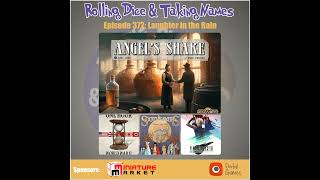


Angel's Share Deep Dive
What the Community Thinks About Angel's Share
Reviewers across the board gaming community embrace Angel's Share as a sophisticated economic game that brings genuine market manipulation mechanics to life. Heavy Cardboard's team was emphatic: for those drawn to stock market gameplay, this title stands apart. Rolling Dice and Taking Names praised the game's core concept, with reviewers noting how naturally the whiskey-aging theme integrates into meaningful decisions. Good Time Society highlighted the game's weight and production quality, while Grant Lyon emphasized the depth of investment strategy involved. One notable dissent came from Board Gaymes James, who found the mechanics constraining despite acknowledging the innovative design.
The consensus leans strongly positive on the game's design philosophy. Reviewers appreciate that Angel's Share delivers on a specific promise: players who love economic games with teeth, who enjoy making calculated financial decisions, and who can handle complex turn sequences will find it rewarding.
Core Mechanics That Define Angel's Share
Market Manipulation Through Supply and Demand
At the heart of Angel's Share lies a sophisticated market matrix. Players don't simply buy and hold; they actively shape prices through strategic selling. When a barrel is sold, the market value for that distillery drops, since scarcity creates value and abundance erodes it. This mechanic forces players into genuine tension: selling a barrel early locks in profit but floods the market and crushes prices for competitors holding the same stock. The game's X and Y axes track competition and market demand separately, and their intersection determines whether prices rise or plummet at round's end. Reviewers noted this system creates the sort of emergent economic gameplay where skilled players can force prices, not merely predict them.
The Art of Timing: Barrel Aging and Deterioration
Each barrel ages five years per round over ten rounds, creating a natural path from five-year-old whiskey to twenty-five-year-old premium stock. But the twist is brutal: some batches break down. Reviewers emphasized that players must not only decide when to sell based on current prices, but also predict the aging curve of each whiskey type. A premium barrel might command top prices at twenty years; the wrong distillery might become worthless if held too long. This mechanic forces players to balance the engine-building appeal of compound growth against the real risk of holding devalued goods. The tension between letting a barrel age one more round and selling now before it spoils defines the gameplay loop.
The Angel's Share Experience
Heavy, Deliberate Economic Gameplay
This is not a light evening game. Reviewers consistently described Angel's Share as a weighty economic euro, typically running 75 to 120 minutes with two to five players. The action turns involve selling (optional), moving to a distillery, taking a mandatory action, buying a barrel, and seeding cards, all of which ripple through the market and affect competitors. The complexity emerges not from fiddly rules but from interconnected decisions. Every choice matters. Reviewers appreciated the intellectual depth, though the long play time and decision density mean Angel's Share rewards players who relish crunchy economic systems and are willing to sit with the tension of each move.
Navigating Randomness and Uncertainty
Despite its economic scaffolding, Angel's Share introduces randomness through event tokens and competition cards. Players place numbered competition cards face down; these cards rank distilleries each round, determining price adjustments via the market matrix. Reviewers noted that this randomness cuts both ways. One player lamented that a high-value barrel dropped sharply in worth due to an untimely aging event token fired by an opponent, undoing months of strategic investment in a single round. Others found the uncertainty thematic and challenging, since skilled players must hedge against surprises. The randomness prevents runaway leaders but frustrates players who prefer pure economic optimization.
What Makes Angel's Share Stand Out
A Thematic Execution That Serves Mechanics
The whiskey-aging theme is not mere window dressing. The angel's share, the poetic term for evaporation during barrel aging, becomes mechanically relevant. Reviewers loved that players are literally managing the tension between aging liquor that becomes more valuable over time and the natural loss that occurs every round. Grant Lyon noted that touring actual distilleries adds resonance, since the real-world economics of whiskey production mirror the game's decision space closely. The theme invites players into a world where timing and market knowledge drive profits, making the abstract economics feel tangible.
Multiple Paths to Victory Through Economic Strategy
Angel's Share does not funnel all players toward a single winning approach. Reviewers observed that players can emphasize buying and holding premium stock, aggressive market manipulation to favor their own barrels, aggressive early selling for quick cash, or patience-based long-term investment. Heavy Cardboard's team discussed various tactical choices throughout their playthrough, suggesting the game rewards both risk-takers and conservative planners. This design breadth means repeated plays feel fresh, since the strategies that crushed opponents in one session may falter when the market dynamic shifts.
Potential Drawbacks
Randomness Can Undermine Careful Planning
The event tokens introduced each round and the competition cards placed by opponents create volatility that some reviewers found frustrating. Rolling Dice and Taking Names highlighted moments where barrels that should have aged well were destroyed by untimely events, and where competition cards flipped in ways that tanked anticipated prices. For players who prize optimization and want their plans to survive intact, this randomness stings. Unlike pure economic games where all information is known, Angel's Share punishes perfect foresight. Reviewers who prefer games where skill triumphs over luck found this element limiting.
Length and Complexity May Exclude Casual Audiences
At 75 to 120 minutes with intricate turn sequences, complex market interactions, and multiple decision points per round, Angel's Share demands engagement and cognitive load. Grant Lyon's overview positioned it as a heavier-weight economic game, meaning players need patience and comfort with long sessions. Board Gaymes James, despite respecting the design, found the game too restrictive for their preferences, a reminder that depth and elegance do not guarantee universal appeal. Reviewers new to economic games or seeking lighter play should start elsewhere.
If You Enjoy Angel's Share
Reviewers mentioned several comparable games that capture overlapping appeal. Ark Nova, mentioned in the transcript discussions, shares the engine-building and strategic depth that makes Angel's Share rewarding. Stockpile and Race to Berlin offer similar economic tension and player interaction. The Quartermaster General came up as a game with cooperative and competitive layers alongside resource management, similar to the interaction layer in Angel's Share's market dynamics.
For those drawn to whiskey-themed or production-focused euros, Angel's Share delivers on theme while maintaining mechanical sophistication. Fans of other Scott Almes designs will recognize the clean mechanics and meaningful decisions, though Angel's Share is notably heavier than the Tiny Epic series. The game rewards players who love economic games, long play sessions, and the thrill of outmaneuvering opponents through smart market timing rather than luck alone.
What Reviewers Are Saying
If you're into market manipulation games, I feel pretty confident saying you don't have one like this.
— Heavy Cardboard
And one thing I think is really cool about this is once you invest in a barrel of whiskey, you're trying to decide or determine when is the best time to sell it after it ages because it's naturally going to age five years at the end of every round.
— Rolling Dice and Taking Names
As time goes on, a bit of each barrel evaporates, which can leave you with a prestigious whiskey or a low volume of a broken-down spirit. So, it's a lot about timing and investing in the right stuff.
— Grant Lyon