
A group of black-hat hackers known as POSIWID plots to hijack the moon Io and hold the entire Jovian power grid to ransom. Standing in their way are the ultra-corporate LFA, the constructors of the lunar energy facilities. Both sides have engaged a fleet of ROV – advanced remotely-operated robots — to battle across the treacherous landscape.
The machines are activated. Initiate combat sequence. The battle for Io has begun.
Line of Fire: Burnt Moon is a standalone two-player card game that fuses the lean deck-building of the award-winning Undaunted series with fast-paced lane battling. Sharp decision-making and clever positioning combine in a nail-bitingly tense, endlessly replayable, and lightning-fast experience.
—description from the publisher


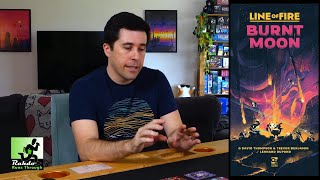
- Visually appealing with evocative artwork.
- Inherits tense mechanics from Undaunted.
- The casualty system creates tension.
- The war of attrition feel is present.
- When it works, it hits hard.
- Casualty system might not work as well as in Undaunted due to fewer starting cards/units.
- Games can be over very quickly or drag on.
- Standoffs can be less exciting.
- Lack of asymmetry in units.
- The game can sometimes stall out.
- Some players might prefer more starting effectiveness.
- A war between a corporate coalition operating robotic vessels and a black hat hacker group.
- The volcanic Galilean moon of Io
- Undaunted Kalisto
- Undaunted
Mechanics (from transcript analysis)
- Area Majority — You need majority in order to take control of locations... controlling is what we're trying to do. It's how we win the game.
- Casualty System — If one of your units takes a hit and you’ve got that unit card in your hand, it’s gone, which means your turn is worse. Otherwise, it’s coming out of your discard pile or your deck.
- Deck Building — this is a deck building game where we are going to be facing off in five different locations.
- Initiative system — each of us is going to draw our hand of cards. We draw four cards, and then we choose one of these cards to play for its initiative value... whoever has the initiative wins on ties.
Video topics + discussion points
Quotes (from this video)
- I absolutely love how this game looks. The artwork on these cards is so evocative.
- The initiative system which is always a tense decision.
- It hurts a little bit more when you get hit in this game because there are just so many fewer cards that you are working with.
- When it doesn't do that, when it moves the way that you want it to and uh the turns are quick, the turns are punchy, you end up like, you know, hitting each other's units enough that there is at the very least a war of attrition going on.
- I would like it maybe I would play this if I would do a house role on this personally where one side starts with one of those defensive units and one side starts with one of those offensive units just in their deck among everything else.
References (from this video)
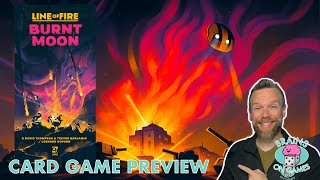
- Distinct blend of Undaunted-style deck-building with a lane-battling two-player duel
- Five lanes provide strategic depth beyond typical 2D duels
- Clear components with organized storage and intuitive labeling
- Deterministic combat removes dice randomness and emphasizes planning
- Accessible core rules with a deeper suite of card abilities for experienced players
- Strong thematic presentation and visually striking components that fit the sci-fi moon setting
- Learning curve due to the large number of card abilities and a separate action rulebook
- Setup and table hog due to multiple piles and fleets; not as streamlined as some two-player games
- Art style may not appeal to everyone and some found rulebook heavy
- First-timer sessions can feel dense as players come to grips with A/B card mechanics and lane interactions
- Two-player sci-fi lane-control duel with robots and tactical card-driven actions
- Moon surface, a volcanic moon of Jupiter
- Line-of-play mechanics are driven by card-based actions across five lanes, with A/B card choices, fortifications, and memory components shaping each turn
- Deterministic, tactical, with emphasis on positioning and card timing; no dice-based randomness
- Undaunted
- Undaunted Stalingrad
Mechanics (from transcript analysis)
- A/B card differentiation — Vehicles and personnel cards have A and B variants that must be used together to activate actions, adding combinatorial depth.
- card-based combat without dice — Attacks and defenses use card values; the attacker’s total vs defender's total, with shields and fortifications influencing outcomes.
- Deck cycling and memory — When the deck runs out, discard piles are reshuffled; players manage memory of which cards are available and which have been used.
- Deck Manipulation — Players add cards to their deck each turn with a system where certain cards must be discarded to activate actions; no random draws from a bag or dice.
- Deck-building with discard management — Players add cards to their deck each turn with a system where certain cards must be discarded to activate actions; no random draws from a bag or dice.
- Discard-pile synergy — Deploying cards often requires discarding a matching card to enable actions, keeping the deck cohesive and preventing underuse of key cards.
- Fortifications and defensive upgrades — Special defensive units can fortify spaces, increasing defense values and protecting lanes.
- initiative bidding — At the start, players bid with one card to determine who acts first; the bid card is discarded after use.
- Lane control / area majority — Five lanes are randomized; controlling lanes grants victory points and strategic advantage.
- Multi-Use Cards — Vehicles and personnel cards have A and B variants that must be used together to activate actions, adding combinatorial depth.
- Position-based actions — Vehicle placement and lane positioning unlocks or enhances card actions; placement decisions are central to gaining lane control.
- resource/hand management — Players manage personnel and vehicle cards to maintain a viable engine of actions across turns.
- Symmetry and lane randomization — Lanes are shuffled so both players face the same randomized map, preserving fairness and variability across games.
Video topics + discussion points
Quotes (from this video)
- Line of Fire: Burnt Moon is a quick but very strategic two-player game.
- Five lanes is huge and changes the tempo of a duel.
- This is a kind of deck builder that I really like.
- I like those Undaunted-style deck-building elements being turned into a lane battler.
- It's not for the faint of heart; there’s a learning curve, but the payoff is worth it.
- If you're into deck-building or lane battlers, you should check this out.
- Line of Fire blends elements from great games into something that feels fresh and fast.
References (from this video)

- Streamlined and fast-paced gameplay compared to other games in the genre.
- Strategic placement of cards and knowledge of deck combinations.
- Appeals to fans of deck builders.
- Nice box and production quality.
- Sharp art.
- Solid deck-building mechanics in a two-player game.
- Can be confusing for players not familiar with the Undaunted series.
- Uses new terminology for units (e.g., Xed, Moss) that players need to learn.
- sci-fi universe
- Undaunted
- Compile
Mechanics (from transcript analysis)
- Area Control — Players aim to take control of specific zones on the board, which are worth points.
- Deck Building — Core mechanic where players build and improve their decks throughout the game, similar to the Undaunted series.
- Hand Management — Players manage cards in hand, including 'interference' cards that are considered junk unless a specific card allows for their free use.
- lane battler — Gameplay revolves around battling in lanes or zones, with the goal of controlling these areas.
Video topics + discussion points
Quotes (from this video)
- We don't come to this show with our intro like what can we talk about this time? Literally a lot of the topics we talk about are what we sit around and talk about during game night.
- If you've played Undaunted it's going to feel very familiar
- The point is what if you're not familiar with Undaunted, will people like it? You know, I I think so because of how streamline and fast it plays where Undaunted can drag.
- I was really surprised at how good this game is. when you just look at it on the table, you think this is just like a colorful kids game.
- This is probably one of the most convoluted victory scoring systems I've seen in a while.
- Man, this is one of those games that just totally surprised me and how much I like the co-op thing.
- It's honestly was just one of the best games I have played in a very long time.
- The acting is incredible.
- My game of the year by far.
References (from this video)
- Striking card art and mechanical expansion of the Undaunted system into space warfare
- Visuals are highlighted as exceptionally strong
- Early teaser; fewer concrete rules details available yet
- Lane battler with sci-fi gadgets and robotic rovs
- Jupiter's moon IO; hackers vs. government corporations
- Future-oriented, continuing Undaunted arc
- Undaunted Kalisto
Mechanics (from transcript analysis)
- Boss Battler — Units battle on lanes with flip-side abilities and lane-specific effects.
- Lane-based battle — Units battle on lanes with flip-side abilities and lane-specific effects.
- Rov units and flip abilities — Robots with various flavors and abilities that reveal as flip, similar to unit cards.
Video topics + discussion points
Quotes (from this video)
- Undaunted 2200 Kalisto is now out, it is out, ready to rock
- we've been releasing a new game every year for the last five years
- it's big historical battles we're playing Rome versus Carthage here
- Line of Fire Burnt Moon is the future of the Undaunted 2200 Series
- this is going to be the third in our Trilogy of Fabio games
References (from this video)
- Deep, puzzle-like hand management and lane interaction
- Two distinct win conditions create strategic tension
- Compact core footprint with high table presence for a lane battler
- Mirrored player setup promotes tense head-to-head play
- Steep learning curve and significant keyword density
- Rulebooks split into two manuals, causing frequent flipping and cross-referencing
- Potential for stalling due to hand management and bid dynamics
- Relatively large table footprint for a two-player lane battler
- Strategic control of zones using ROVs (robots) with mixed offense/defense interactions and modular lane layout
- Two-player tactical lane battler with robotic units fighting over control of lanes on a shared board
- abstract tactical with light sci-fi flavor; thematic flavor arises from ROVs contesting lanes and upgrading through actions
- Undaunted Kalisto
- Rift Force
- Radlands
Mechanics (from transcript analysis)
- Bid for initiative — Each round, players select an initiative card from their hand; higher bid goes first; ties retain previous initiative
- Combat resolution with shields — Attacks compare to shield/defense values; shield and health determine whether a unit is destroyed or retained, with layered destruction logic
- Combat: Damage Based — Attacks compare to shield/defense values; shield and health determine whether a unit is destroyed or retained, with layered destruction logic
- Deck Building — Players start with mirrored decks; they purchase and deploy ROVs and other cards to their display, expanding options over the game
- Deck-building from personal pool — Players start with mirrored decks; they purchase and deploy ROVs and other cards to their display, expanding options over the game
- Interference and fortification — Interference cards enter discard and deck, adding tension; fortifications provide defensive bonuses to lanes
- Lane control and majority — The central lanes are contested; controlling a lane flips tiles to show control and earns victory points; lanes have different point values
- Turn actions via types and discards — Cards are discarded to activate actions; matching A/B types affect activation and you must discard matching types to reuse actions
- Two win conditions — Win by reaching eight control points or by destroying all Moss-type cards that provide control actions
Video topics + discussion points
Quotes (from this video)
- it is very similar to Undaunted
- This is undaunted the lane battler pretty much
- two win conditions
- there's a lot of keywords
- every hand is more of a puzzle that you need to solve
- you bid for turn order
- not a game for everybody, and that's okay
References (from this video)
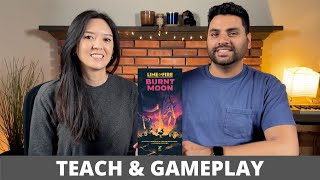
Mechanics (from transcript analysis)
Video topics + discussion points
Quotes (from this video)
- So the game is played over the course of several rounds, basically until either player has met either of those win conditions
- The moss cards will allow you to either move, attack, or control