



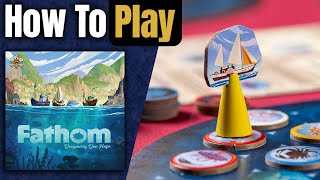

Fathom Deep Dive
What the Community Thinks About Fathom
Reviewers see Fathom as a light, snappy take on undersea exploration, with a theme that draws people in before they ever sit down to play. Board Stupid previewed it ahead of UK Games Expo and framed it as a lighter alternative to Endeavor: Deep Sea, with the premise of marine biologists scanning the ocean depths for new creatures and scoring points for the species they document. Kovray, who taught and played the game, came away more enthusiastic still. Their praise centers on how smoothly the game runs with everyone acting at once, how the player console keeps the table oriented, and how the scoring rewards careful planning on your own ocean board. Fathom is published by Paper Fort Games and designed by Dan Heller, and reviewers connected it to the publisher's earlier work.
Core Mechanics That Define Fathom
Tile Placement on Your Own Ocean Board
The heart of Fathom is what happens in the ship phase. Each player moves their ship to any zone on their ocean board, drawing and placing discovery tiles in the empty spaces around it. Kovray explained that placement matters because the ship's location determines which tiles you can reach and which undiscovered tile you flip at the end of the action. Those tiles then score in ways that reward thoughtful arrangement: coral scores by the size of each connected group of matching color, schooling fish score in groups of six or more, and crustaceans score when they sit next to coral, with extra points for touching multiple colors. Because discovered tiles stay put, every placement is a commitment, and the board you build becomes the visible record of your expedition.
Simultaneous Actions
Nearly everything in Fathom happens at the same time. In the ship phase, every player moves their ship, passes their tile bag clockwise, draws tiles, and places them without waiting for a turn. The submersible phase works the same way, with each player choosing from four actions and repeating them as needed. Board Stupid compared the feel to Planet Unknown and Overpack, where the whole table stays engaged through the round. Kovray noted that the player console walks everyone through the steps, so you can glance at the other boards to see who is ready for the next phase without anyone calling out "whose turn is it?" Six rounds later, the game is over, and the downtime that usually comes with a multiplayer game has been largely removed.
The Fathom Experience
Wonder at What Lives Below
Board Stupid and Kovray were drawn in by the theme. Board Stupid said they loved the biodiversity angle, and the idea of going into darkness and revealing unfamiliar creatures gives every flipped tile a small moment of discovery. Kovray described the game as a place where they could not predict what would come up from the sonar board or which bag would deliver the species they needed. That sense of the unknown carries through the whole game, and it keeps the scoring feeling like a natural outcome of exploring rather than a spreadsheet exercise.
Busy, Shared Momentum
The other feeling reviewers kept returning to is the rhythm of the table. Because everyone acts together, the game feels brisk, and nobody sits idle while others take long turns. Kovray said the game is smooth and fun to run, and the console gadgets keep the round moving from one phase to the next. Board Stupid expected the same thing from the preview, predicting that the simultaneous play would keep everyone engaged and that the game would feel nice and snappy.
What Makes Fathom Stand Out
Expeditions That Change the Rules
Fathom ships with four expeditions, and each one adds its own species, scoring, and special rules. Expedition one introduces the whalefall and siphonophores, while expedition two adds a deep sea camera that scores species in its line of sight and anglerfish that score when stacked. Expedition three brings jellyfish that score specific shapes and an octopus that flips every tile around it, and expedition four adds stingrays and sharks, where the sharks can eat stingrays that are not yet protected. Kovray admitted they first assumed the expeditions were just a way to shuffle the deck and pick four species, but after a second play they saw the expeditions as a real layer that changes how the whole game feels.
Passing the Bag
Rather than keeping a bag of your own tiles, you pass your bag to the next player in each round, so the tiles you draw come from someone else's supply. Kovray found this clever because it creates a layer of table awareness: after a few plays, you start to notice who took which species and how many of each remain, and you plan your drafts around what others have left behind. The sonar board adds a second source of tension, since leftover tiles pile up there and can crowd out your options. Together these systems make Fathom feel like a game about reading the table as much as building your own ocean.
Potential Drawbacks
A Lot to Track at Once
Fathom asks a good deal of attention from its players. Kovray's walkthrough covered an extensive setup, including the expedition tuck box, sonar beams, bonus tokens, and the four submersible actions, before reaching the three-phase round structure. The console helps, and reviewers praised its design, but the early rounds involve tracking many small pieces and rules at once. Players who prefer a game they can learn in a few minutes may need a round or two before the flow settles in.
Expeditions Reset Your Strategy Each Game
Because each of the four expeditions introduces its own species, scoring, and special rules, a plan that works in one session may not carry over to the next. Kovray noted that the expeditions can feel, at first glance, like a simple swap of species rather than a true variable layer, and it took a second play before the deeper changes became clear. Players who want a single system to master over many plays may find that Fathom's foundation shifts under them each time, trading long-term strategic depth for session-to-session variety.
If You Enjoy Fathom
Board Stupid pointed directly to Planet Unknown and Overpack as the closest comparisons, both for their simultaneous play and for the way the whole table stays busy at once. If you enjoy the feel of Planet Unknown, Fathom offers a similar sense of exploration with its own ocean-board puzzle. If Overpack is your favorite, expect the same engaged rhythm but a different theme, with the scoring tied to species and their arrangement rather than the packing and planning of Overpack's board. Either way, Fathom is a good pick for players who want a tile-placement game that keeps everyone involved from start to finish.
What Reviewers Are Saying
"It is essentially a tile laying pattern building game but done with simultaneous play, something like with like planet unknown things like that. Or overparked where you're everyone's doing something at the same time. So, everyone is completely engaged. It looks like it's nice and snappy."
— Board Stupid
"Honestly, I really fall in love with this game. It has a lot of things I really, really like. It has simultaneous play. A lot of what you're doing you'll be doing at the same time as all the other players and it's really smooth."
— Kovray
"You'll navigate your ship across the ocean board, discovering various species of aquatic life by placing and flipping discovery tiles in order to score the most points. The game is played in six rounds with three phases in each round."
— Kovray