








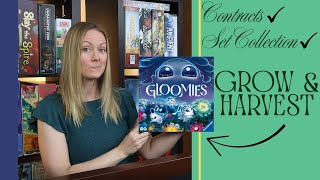
Gloomies Deep Dive
What the Community Thinks About Gloomies
Gloomies has earned genuine enthusiasm from reviewers who appreciate its elegant two-phase design and satisfying gameplay flow. Community response centers on how well the game balances accessibility with strategic depth, creating an experience that feels both simple to teach and rewarding to play. Some reviewers describe the moment of discovery with particular warmth, suggesting the game carries an almost irresistible charm once you understand what it offers.
Core Mechanics That Define Gloomies
Two-Phase Planting and Harvesting
The backbone of Gloomies is its elegant two-phase structure, where players first plant flowers on a shared board, then harvest those same flowers in reverse. In phase one, players draw cards and play up to three flower cards to columns on the main board, receiving bonuses for their final placement each turn. These bonuses can include contract cards that set scoring targets, additional cards, or helper tokens. Once the shared board fills to a threshold, players transition to phase two, where they shuffle the cards they played in phase one into a personal deck. Now they use those same cards to remove flowers from the board and fulfill the orders they collected, working toward a common goal while still competing for the best scoring opportunities. Reviewers highlight how remarkably this structure connects the two halves: the cards you choose to place become the exact tools you use to harvest, creating a satisfying cause-and-effect loop that rewards forward planning.
Set Collection with Strategic Drafting
The flower cards themselves drive set collection through intentional drafting. Each card shows a flower of a specific color with special abilities along its edges that trigger when placed in certain board positions. Reviewers appreciate the cleverness of this system because it creates meaningful tension: you must draft cards not just for the flowers you want to harvest later, but for how you can place them now to access bonuses. The grid of the shared board is restrictive, so you often find yourself choosing cards you do not primarily want simply to clear your hand and make room for more optimal plays. Some cards offer a choice between two flowers, but you only get one unless you draft that card again, adding another layer of strategic weight to each decision. The result is a game where every card choice ripples forward, affecting both your immediate board position and your future harvesting options.
The Gloomies Experience
Cute and Whimsical Charm
Gloomies stands out for its aesthetic warmth and personality. The creatures themselves are "weird flying space ghosts" with soft textures and bendy ears that reviewers find delightful and adorable. The wooden flower pieces are lovely to handle, and the color palette throughout the game feels inviting. The board fits inside the box, which means setup is elegant and the table presence is immediately charming. Reviewers consistently describe the visual presentation as gorgeous, with the flowers and gloomies working together to create a game that feels more like a cozy puzzle than a competitive engine. The overall effect is disarming: the game does not announce itself as strategic, yet it rewards careful planning and delivers genuine brain-burning moments during the harvesting phase.
Streamlined and Satisfying Flow
What separates Gloomies from other games with similar mechanics is how effortlessly it guides players through its rules. Reviewers emphasize that the game does not overstay its welcome despite its strategic depth. Turns are quick and straightforward: play cards, claim your bonus, draw new cards. The transition from phase one to phase two feels natural, with the board itself showing you what comes next. The push-your-luck element of phase two adds tension without complexity: you must commit flowers to incomplete orders, risking zero points if you cannot finish, or play safely to your personal board for guaranteed but smaller rewards. The pace remains snappy throughout, keeping the action moving even as decisions grow tighter toward the end.
What Makes Gloomies Stand Out
A Two-Phase Design That Genuinely Connects
Reviewers and designers alike single out Gloomies for how skillfully it weaves its two phases together. The first phase is not merely setup for the second; it is an active mirror of it. The cards you place become your tools. The bonuses you collect drive your second-half strategy. The board state you create constrains your harvesting options. A designer from Stonemaier Games identified Gloomies as a standout example of games with two distinct halves because the connection between them feels intentional and elegant rather than arbitrary. Players spend the first half doing one thing (planting), then spend the second half doing the opposite action with the same components (harvesting). This reversal, combined with the fact that all players share the board, creates rich interaction throughout.
Elegant Presentation That Reduces Friction
The game's modular board, which fits inside the box and can be configured in multiple ways each game, offers both variety and practical elegance. Each configuration changes which bonuses are available and where, shifting strategy without requiring any additional components or setup complexity. The rule cards on each player board clearly explain what to do on each turn and what you score at the end of each phase. This attention to guiding the player means that even though Gloomies contains meaningful decisions, it rarely feels overwhelming. Reviewers note that this clarity extends to the helper tiles (the gloomies themselves), which function as flexible wild tokens for drawing extra cards or playing extra flowers, with payoff in both phases. Everything in the game serves a purpose, and nothing feels like busywork.
Potential Drawbacks
Card Draw Luck and Inconsistent Component Quality
Gloomies does incorporate a luck element that not all players will embrace. The flower cards you draw from the display are the only options you have each turn, and if multiple wild cards appear in succession, you lose access to regular cards entirely, a harsh but intentional constraint. Reviewers note this happens occasionally and can feel frustrating if you are counting on specific colors. Additionally, some reviewers observed that while the wooden flowers and discs are lovely and thick, the cards themselves feel flimsy for a mid-weight game. This mismatch in component quality is a minor note but worth considering for long-term durability, especially if the game gets frequent plays.
Not Necessarily a Long-Term Keeper
While the community response is warm, not every reviewer feels compelled to return to Gloomies repeatedly. One designer noted they enjoyed their first play but hesitated to prioritize replays, a pattern they have observed with several games featuring two distinct halves. Another reviewer described it as a solid, well-made game but questioned whether it achieves greatness, rating it as "good but is it great." This is not a criticism of the game itself but an acknowledgment that for some audiences, Gloomies lands in the "excellent for what it is" category rather than becoming a table staple or lifelong favorite.
If You Enjoy Gloomies
If Gloomies resonates with you, consider exploring Calico, which shares Gloomies' approach to set collection and puzzle solving but applies it to quilt making. Both games reward satisfying tableau building and offer that same warm, cozy aesthetic alongside genuine strategic puzzles. Wingspan, while more elaborate, also excels at streamlined gameplay with surprising depth, guiding players through a beautiful puzzle of card placement and engine building. Those who appreciate the clever mirroring of phases in Gloomies might also enjoy games that play with action sequencing and timing, where decisions in one phase create constraints and opportunities in the next.
What Reviewers Are Saying
"The flow of it all is just so smooth. The board just guides you what to do. You It's such a gorgeous game. The glooies are so delightful. The little helpers are so cute."
— kovray
"It's a game of two distinct halves where those two halves are very connected based on the cards that you're playing and how you are changing the shape of the garden. That's this garden is shared by all players. So you're there's a lot of interaction in terms of which flowers you're picking and which flowers you're putting back in the garden you're planting."
— Stonemaier Games
"It's a simple set collection, but the way the game just flows is just incredible. It's super easy to follow. It's fun to follow along."
— kovray