





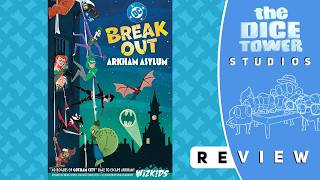

DC Breakout: Arkham Asylum Deep Dive
What the Community Thinks About DC Breakout: Arkham Asylum
DC Breakout: Arkham Asylum occupies a strange and deliberate middle ground in the racing-game landscape. Released by WizKids and designed by the Engelstein family, it draws clear inspiration from Magical Athlete, the now-reprinted wacky racing classic. Yet rather than shy away from that connection, reviewers embrace it, recognizing the game as a thoughtful refinement rather than a clone. Community consensus skews positive, ranging from 6 to 8 out of 10 across the reviewers who examined it. The game finds its strongest advocates among those who appreciate strategic depth combined with chaotic humor; it finds its softest reception among reviewers who already own and prefer Magical Athlete's simpler ruleset. The Discriminating Gamer's Cody Carlson rates it a 6, seeing it as a fun but disposable diversion for younger or more casual players. By contrast, multiple Dice Tower reviewers, including Tom Vassal and Chris Yee, give it an 8, arguing it refines Magical Athlete's core appeal with additional mechanical and thematic layers worth the added complexity.
Core Mechanics That Define DC Breakout: Arkham Asylum
Multi-Use Villain Powers and Team Drafting
The defining mechanical twist of DC Breakout: Arkham Asylum, and the feature that most clearly separates it from Magical Athlete, is the pairing of two villain powers into a single team. Rather than piloting one character per race, players draft two villains from their hand and slot them into a shared base, combining their abilities. Reviewers consistently point out how elegantly this mechanic works in practice. Each villain brings a distinct power, some triggered passively (like moving forward one space when an opponent rolls a one or two) and others requiring a henchman token spent to activate. The combination creates emergent decision trees. A player might pair a villain whose power triggers on specific board symbols with another who benefits from landing on those same spaces, creating intentional combos. Tom Vassal and the Dice Tower team emphasized this drafting layer as one of the mechanical standouts: you are not locked into random powers, but actively building synergies between your available villains, round by round.
Take-That Gadget Cards and Rule Breaking
WizKids implemented a card play system that Marty from Rolling Dice and Taking Names called a "great addition" to the racing formula. Gadget cards are one-time-use interrupts that break the normal flow of the game in dramatic ways. Land on a gear symbol instead of moving farther, and you can draw a gadget. These cards might force an opponent to move backward, swap positions, or skip certain space types. Unlike the static villain powers, gadget cards create moment-to-moment tactical choices and memorable table disruptions. The Discriminating Gamer described a three-player game where Al's villain had an ability that allowed Al to move forward one space if another player rolled a one or two; Ray rolled a one, Al moved forward and won the game. That swing, that chaos, is what the gadget system amplifies. Reviewers note this makes the game feel less about optimizing a single strategy and more about adapting to cascading surprises. The take-that nature produces what Cody Carlson explicitly praised: "a ton of take that in this game" that generates genuine laughs at the table.
The DC Breakout: Arkham Asylum Experience
Zany Momentum and Absurdist Humor
Multiple reviewers describe the experience of playing DC Breakout in remarkably consistent terms: absurd, silly, wacky, zany. The game does not try to simulate a serious escape. Instead, it leans into the cartoonish rogues gallery aesthetic, pairing obscure villains like Condiment King alongside iconic figures like the Joker. Grant from another Dice Tower segment summed it up: "If you want silliness and laughs, this is a great one." Tom Vassal called it "a lovely racing style game with a lot of heart and a lot of humor, a lot of bombastic big laughs and silly moments." The tone is set partly by the art direction (reviewers praised Ryan Goldberry's character illustrations as "some of the best interpretation of these characters"), partly by the rules themselves, which encourage wild power interactions, and partly by the player interactions that emerge. When you can steal gadget cards from opponents, reset their position on the board, or use your villain's special ability to nullify an opponent's move, the table atmosphere shifts from "who will optimize best" to "what chaos unfolds next."
Fast and Forgiving Play Experience
Despite its mechanical complexity, reviewers consistently noted that DC Breakout plays quickly and with a light touch. Marty and Tony from Rolling Dice and Taking Names emphasized that the game resolves "a lot faster" than Magical Athlete, with the same combo interactions happening but "resolving quicker." Chris Yee agreed: "It's 30 to 45 minutes...pretty close to what it could be as long as everyone's not being silly." This speed comes from the streamlined turn structure (roll, move, land on effect or choose to stop) and the fact that gadget card effects trigger immediately rather than requiring multi-step resolution. The game forgives analysis paralysis because the dice will move the action forward, and the next player's turn comes quickly. This makes it accessible to families and casual tables while still maintaining enough decision points to keep engaged players thinking about villain drafting and gadget timing.
What Makes DC Breakout: Arkham Asylum Stand Out
Character Synergy and Drafting Depth
One feature that reviewers highlighted as a genuine innovation is the ability to swap out villains between races. At the end of the first race, the first-place finisher can select a random bonus villain and exchange one of their remaining villains with it. Every subsequent player gets the same choice with what was discarded before them. This drafting layer creates strategic foresight: you pick two villains for the first race knowing you might swap one out; you see what other players drafted and consider how that changes your options for the second race. The Dice Tower team noted this as a deliberate design choice that differentiates DC Breakout from simpler roll-and-move games. You are not just riding a lucky die roll to victory; you are actively assembling a power combination that synergizes, then potentially rebuilding for the final push.
Meaningful Card Play Without Overwhelming Complexity
Reviewers appreciated that WizKids resisted the temptation to drown the game in rules. Chris Yee specifically commended the rulebook terminology, noting they used terms like "auto roll" to "draw lines in the sand" and clarify interaction between powers and cards, preventing the "FAQ that could be a mile long" that can plague intricate games. Tom Vassal noted: "The little extra mechanical stuff you have to keep in your head is worth it for me." This balance allows gadget cards and villain abilities to create explosive, rule-breaking moments without requiring a Ph.D. in the rulebook to understand what just happened. The game trusts players to learn a few key concepts (how spaces trigger powers, how gadget cards work, how henchman tokens gate abilities) and then play organically from there.
Potential Drawbacks
The Magical Athlete Elephant in the Room
Every single reviewer invoked Magical Athlete, and for good reason: the game came back into print during DC Breakout's development and release cycle. Mike Delisio stated plainly: "This game is absolutely a riff on Magical Athlete." While not controversial (the designers have acknowledged the inspiration), the comparison inevitably positions DC Breakout as a more complex alternative to a game that already satisfied that itch for thousands of players. Zee Garcia emphasized giving Magical Athlete a 10 out of 10; by that standard, DC Breakout's added complexity feels like overkill for a similar effect. If your table already owns the streamlined, charming Magical Athlete, the case for switching is less compelling. The Discriminating Gamer's Cody Carlson noted the "charm would wear off pretty quickly" for players in that camp, suggesting that hardcore gamers gravitating toward this for deeper strategy will find themselves returning to Magical Athlete anyway.
Cognitive Load and Production Friction
Zee Garcia raised an important caveat: the added complexity of two powers plus cards plus modular board creates "a lot more possible combos" that "could be a mile long" in an FAQ. For very casual players, this represents a cognitive hurdle that Magical Athlete simply does not have. Mike Delisio also flagged production issues; standee pieces on the winding path can obscure the board symbols you need to see, leading to miscounts and momentary confusion. Reviewers reported having to ask "what's behind that piece" frequently. Chris Yee noted that larger player counts (five or six) compound the cognitive load; the game "plays at lower counts better" due to the sheer number of villains and gadget cards in flight.
If You Enjoy DC Breakout: Arkham Asylum
If DC Breakout resonates with your table, Magical Athlete (Restormation Games' recent reprint) is the natural companion, though reviewers actually prefer DC Breakout's mechanical depth. That said, if you are looking for strategic reach beyond DC Breakout, consider Smash Up, another drafting-based game that builds combos from paired factions, or Magical Athlete itself if you want a lighter, purer racing experience.
What Reviewers Are Saying
You may think you're out ahead, somebody plays a guard card, maybe they pull you back, maybe they switch places with you. Maybe you have to go backward on your next turn. There's all sorts of interesting things that will pop up with these gadgets.
— The Discriminating Gamer
The zaniness, I just I get a kick out of rolling the die and seeing what happens. And oh, I'm playing these two cards in combo. Holy cow, it's overpowered. Yes, but who cares? It's a short game.
— Zee Garcia, Dice Tower
It is a lovely racing style game with a lot of luck but a lot of heart and a lot of humor, a lot of bombastic big laughs and silly moments.
— Tom Vassal, Dice Tower