







Don't Starve: The Board Game Deep Dive
What the Community Thinks About Don't Starve: The Board Game
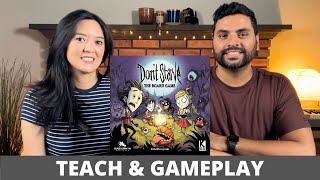
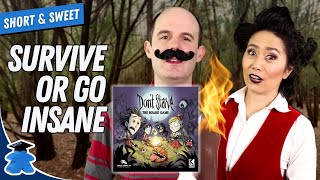
Don't Starve: The Board Game arrives as a faithful translation of the beloved roguelike survival video game, capturing its tense, punishing flavor on the tabletop. The community consensus is mixed but respectful. Reviewers universally praise its thematic commitment and component quality, yet wrestle with a steep learning curve and relentless difficulty that demands patience and repeated plays. Some view this harshness as the game's strength, a feature that mirrors the video game's unforgiving nature and creates memorable table moments. Others find the complexity and pacing barriers that obscure the elegant core beneath layers of rules and bookkeeping. Meeple University celebrates the game's faithful recreation of survival anxiety. Board Game Critique rates it 6.8 out of 10, calling it "a beautiful disaster" that rewards hardcore survivors while frustrating those seeking streamlined cooperation. One Stop Co-op Shop, revisiting the game months after the initial preview, expresses reservation about its punishing tuning, though acknowledges Glass Cannon Unplugged's track record with video game adaptations. The verdict: this is a game for players who embrace difficulty as part of the experience.
Core Mechanics That Define Don't Starve: The Board Game
Resource Management
Every decision in Don't Starve pivots on scarcity. Players must constantly balance hunger, health, and sanity through the acquisition and careful allocation of foraged resources. Wood, stone, food, and specialized crafting materials flow in unpredictably from tile exploration, creating a perpetual tension between gathering what you need today and positioning yourself for tomorrow's threats. The game forces genuine trade-offs: do you spend actions exploring for berries, or dedicate turns to crafting the tools that unlock better resources? This system generates the game's signature anxiety. Players cannot achieve every objective with the resources available, so each action forecloses alternatives. The physical crafting book, passed between players, becomes the literal focus of negotiation and planning, embedding strategy into a shared table object that reviewers consistently highlight as one of the game's finest touches.
Cooperative Game
Don't Starve places all players against the game system itself rather than against each other. Weather events escalate, monster encounters grow more dangerous, and internal stat degradation accelerates across a brutal timeline. Victory requires genuine coordination: one player's desperate search for food cannot happen in isolation, because that absence weakens the group's ability to survive environmental threats. The scenarios establish win conditions (gather specific resources, survive a fixed number of rounds, complete narrative objectives) that demand synchronized effort and honest communication. Characters possess asymmetric abilities (some excel at crafting transmutations, others at survival skills), creating interdependence. Failure cascades. If one player's health reaches zero and the group lacks revival tokens (limited meat effigies), the entire table loses. This stakes-raising mechanic transforms cooperation from a social nicety into mechanical necessity.
The Don't Starve: The Board Game Experience
Tense and Punishing
Don't Starve creates sustained suspense by denying players the security they crave. Each round, stats tick downward relentlessly. Hunger decreases faster as the game progresses. Sanity deteriorates through enemy encounters and ambient dread, spawning shadow creatures that appear on the board. Health vanishes if resources run out. Reviewers emphasize the game's faithfulness to the video game's feeling of narrow escape: "yay, we survived another day" followed immediately by "oh no, we're absolutely going to die." The exploration deck introduces randomness that undermines even careful planning. A promising biome might yield only stones when you needed food. A monster you thought you could ignore turns hostile during interaction. Weather cards introduce global crises that redistribute existing advantages. This design philosophy creates genuine moments of table-wide panic and rare relief when a scenario resolves successfully. The difficulty is not arbitrary cruelty but systemic: players face real constraints, and mastery comes slowly.
Dark and Immersive
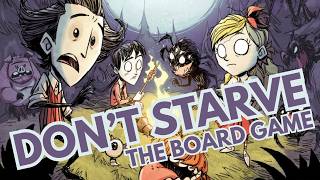
The visual identity supports the survival atmosphere. Art direction emphasizes twisted, unsettling beauty, with component aesthetics that "look like they were pulled from a diary of someone who hasn't slept in 3 weeks," as Board Game Critique describes them. The rotating health, hunger, and sanity dials become tactile reminders of encroaching failure. Shadow creatures appear literally on the board as sanity collapses. Weather cards frame escalating environmental hostility. Characters, drawn directly from the video game, arrive with their own histories and survival quirks. The scenario structure, with each game exploring a specific challenge in the Constant, a world expressly designed to test human endurance, creates narrative momentum despite the largely non-narrative rulebook. This integration of theme and mechanism makes the experience cohesive: you're not playing a mechanically complex game with a pasted-on setting, but a system where components and rules reinforce survival horror.
What Makes Don't Starve: The Board Game Stand Out
Authentic Thematic Translation
The board game doesn't simulate the video game; it translates its essence. Players explore biomes by flipping cards, mirroring the video game's procedural map generation. The crafting book, a physical object passed between players, captures the video game's interface directly on the table. Characters like Wilson, Willow, and Wendy arrive with signature abilities (transmutation, lighter proficiency, spectral allies) that reflect their digital counterparts. Weather events and seasonal cycles structure the experience just as they shape the video game. This fidelity extends beyond flavor to mechanics: the game's reliance on exploration and discovery, its unpredictable monster encounters, its moment-to-moment scarcity feeling all map directly to the video game. Reviewers consistently emphasize that fans of the video game feel the intended franchise resonance.
Scenario Variety and Discovery-Driven Design
Each scenario represents a distinct challenge with randomized board layouts, modular map tiles, and branching narrative paths. "Feast of the Pig King," featured in multiple reviews, differs fundamentally from other scenarios in objective and layout. The modular map tiles ensure that repeating a scenario yields a fresh board configuration. Location cards within each biome are shuffled, so even familiar terrain presents new discoveries. This design philosophy rewards experimentation: players learn optimal patterns through repeated play, but each game surface remains tactically novel. The exploration mechanic (flipping tiles to discover locations, rolling dice on what you find) embeds discovery into the core action economy. Reviewers highlight this as a "discovery-driven" experience where uncertainty about what you're approaching creates momentum and suspense.
Potential Drawbacks
Punishing Learning Curve and Complex Rulebook
The 50-plus-page rulebook scatters important rules across sections, forcing constant reference checks. First-time players will pause repeatedly, and teaching the game demands at least two hours of setup and explanation. Iconography confusion derails actual play: symbols that appear to mean one thing trigger retroactive corrections mid-game. Board Game Critique documents an actual example: misreading an icon that meant "discard after use" led to preserving a torch beyond its lifetime, which unraveled the group's survival strategy. The density of simultaneous systems (weather effects, daily needs, scenario events, health/hunger/sanity tracking, monster combat resolution with multiple dice pools and modifiers) creates cognitive overload. Players without patience for deep ruleset mastery will find initial sessions exhausting rather than engaging. The game does not welcome casual or social table environments where rule arguments derail immersion.
Component Durability and Complexity
Crafted items break frequently and must be rebuilt, creating a constant churn of component management that some reviewers experience as tedious rather than thematic. Items degrade when used for gather actions or combat, tracked through breakage icons on dice rolls. The sheer number of tokens (over 500, by Board Game Critique's count) demands aftermarket storage solutions. Setup and teardown each consume 25 minutes, and the box organization doesn't streamline storage. Item cards have limited hand size constraints, forcing inventory decisions that add friction. During combat, tracking damage, armor effects, and dice results requires active calculation. The game asks players to become component managers, and while some relish this tactile engagement, others experience it as busywork that interrupts narrative flow. One Stop Co-op Shop notes that the crafting system, while core to identity, forces frequent item loss that feels overly punishing rather than strategically interesting.
If You Enjoy Don't Starve: The Board Game
Players drawn to Don't Starve's survival pressure and cooperative urgency will find similar satisfaction in Robinson Crusoe Adventures on the Cursed Island, which Board Game Critique recommends as delivering comparable tension with more elegant balance. Paleo offers streamlined turns and family-friendly accessibility without rulebook migraines. Dead of Winter captures the social vibes and cleaner rules of cooperative chaos. This War of Mine delivers emotional storytelling and tighter rulesets, supporting both solo and cooperative play. For those specifically seeking the roguelike structure and scenario variability, Maximum Apocalypse provides dynamic player interaction, lighter rules, and the survival itch without the component density. Frostpunk: The Board Game, from the same publisher (Glass Cannon Unplugged), carries forward the video game translation philosophy with comparable thematic fidelity and difficulty, though with the same learning curve concerns.
What Reviewers Are Saying
The art is perfectly twisted. The components look like they were pulled from a diary of someone who hasn't slept in 3 weeks. The weather events hit like plot twists. When it snows, you feel it.
— Board Game Critique
For those video game fans, this game nails the feeling of the video game. The mix of yay, we survived another day. Followed immediately by oh no, we are absolutely going to die. It's tense, it's punishing, and it is funny and cruel. But in that good, I can't wait to try again way.
— Meeple University
I only got to see a small amount of the content, a small amount of the craftables, only one of the scenarios. It felt tuned to be very punishing and overly hard in a way that I didn't find that fun. And also the crafting seemed a little too limited and punishing cuz you would lose your items very quickly.
— One Stop Co-op Shop