


















Fearless Deep Dive
What the Community Thinks About Fearless
Friedemann Friese's Fearless arrives as a refreshingly elegant trick-taking game that has earned consistent praise from reviewers. The consensus is clear: this is a clever, unpretentious design that works because it respects both player attention and game time. Reviewers from channels including Dice Tower, Gaming Rules, and Couple of Board Games emphasize that Fearless improves significantly on Friese's previous trick-taking efforts by stripping away unnecessary complexity while preserving surprising strategic depth. The reception centers on how accessible the game is without feeling shallow, making it a rare entry that appeals to both casual players seeking a relaxed experience and strategists who appreciate tight decision-making.
Core Mechanics That Define Fearless
Positive and Negative Scoring
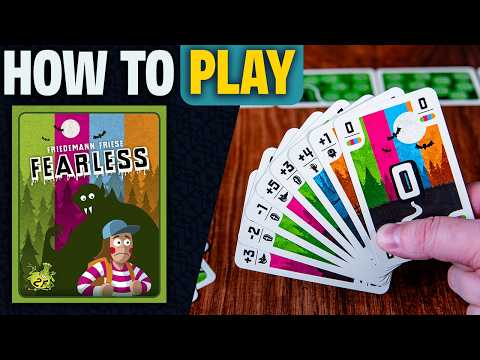
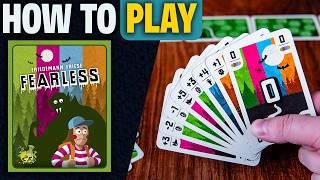
The signature innovation of Fearless lies in its card values. Unlike traditional trick-taking games where cards rank from high to low, Fearless presents a spectrum from positive six to negative six across all four suits. The highest card of the led suit always wins the trick, but the psychological weight of victory becomes complicated: winning a trick with a plus four feels good until an opponent plays a minus five, collapsing the total downward. Reviewers describe this inversion as liberating because it creates moments where you may not want to win a given trick at all. The designer Friedemann Friese has engineered a system where card play requires constant re-evaluation of risk and reward.
Balancing on the Scare Track
After each trick, the winner advances their ghost meeple along a central track by a number of spaces equal to the total value of that trick (positive or negative direction). At round's end, your score is determined by your absolute distance from center. The goal is deceptively simple: stay as close to zero as possible. But the game imposes a cruel twist: if you win no tricks at all during a round, you're penalized with a flat 15 scare points for remaining in the "scary cabin" instead of venturing into the forest. This forced participation mechanic eliminates the strategy of sitting passively while everyone else trades blows. You must win at least one trick to escape the cabin, yet each trick you win pushes you further from your ideal center position. This fundamental tension structures every decision in the game and explains why reviewers call it "clever", it's elegant problem-solving disguised as a simple math game.
The Fearless Experience
A Conversational, Breezy Flow
Multiple reviewers highlight that Fearless occupies a rare category: the relaxed trick-taking game. While many modern trick-takings demand constant calculation and split-second reads of opponent signals, Fearless remains light enough that you can play while chatting about life, catching up with friends, or simply enjoying the shared experience of play. The rules are straightforward enough to teach in minutes, and cards have no special abilities or exceptions to memorize. This clarity means downtime is minimal and brain space is available for connection beyond the table.
Satisfying and Slightly Tense Strategic Play
Despite the casual vibe, Fearless creates genuine aha moments where the mathematics of your position suddenly becomes clear. Reviewers describe recognizing mid-game that they've drifted too far positive and must now risk winning trick that push them negative to rebalance. Conversations turn to collaborative problem-solving: "Did I win that the right way?" and "Should I have played that card?" The game stays light but consistently rewards observation and planning. It feels like a puzzle you're all solving together rather than a competition where one player must dominate, lending it a community-table appeal.
What Makes Fearless Stand Out
Simplicity Paired with Surprising Depth
Friedemann Friese is known for complex trick-taking experiments, yet Fearless strips away bells and whistles, no special card abilities, no complicated phases, no exceptions to standard trick-following rules. Reviewers contrast this favorably with Friese's Fishing, a respected but mechanically heavier game from the previous year. Fearless achieves its strategic complexity purely through the elegance of positive and negative values meeting a center-seeking scoring track. One reviewer observed that the game never forces you to internalize exceptions; instead, the positional puzzle and balancing act provide all the depth you need. It's a masterclass in mechanical economy.
A Clever Penalty System That Forces Engagement
The 15-point penalty for winning zero tricks is deceptively brilliant. It prevents "turtle" strategies where players simply decline to play aggressively. Every player must venture out; the penalty ensures the game stays active and interactive across all four player counts. This mechanic alone forces constant re-evaluation of risk and makes tight games where players genuinely contest every hand. Reviewers praise this as a simple solution to a common trick-taking problem: keeping everyone invested in play rather than watching one or two players dominate the trick count.
Potential Drawbacks
Minimal Strategic Variance Between Plays
Because the game is intentionally streamlined, some reviewers note that tactical flexibility can feel limited at times. Unlike trick-takings with trump suits or variable special abilities, Fearless offers fewer strategic levers to pull each game. If you find yourself in a position where no card solves your dilemma, the game doesn't offer a special rule to change outcomes. This is by design, the designer avoided crutches, but players seeking heavy player-interaction or bluffing may find the decision tree narrower than expected.
Outcome Sensitivity to Card Draw and Early Position
Reviewers acknowledge that while skill matters, the dealt hand shapes your possibilities significantly. If early tricks land you far from center, late-round options shrink. Some players may feel that they're chasing a position created by bad luck rather than mastering strategy. The game is fair and elegant, but it does not insulate unlucky early draws from impacting your round prospects.
If You Enjoy Fearless
Reviewers suggest reaching for Fishing (Friedemann Friese's 2024 trick-taking, which Fearless now surpasses for accessibility), a heavier design offering more card variation and special abilities. If you want a game that also balances players toward a central scoring track but with more physical randomness, Castles of Burgundy offers area majority and tile placement around a vintner's estate. For a trick-taking with a different twist on penalties and rewards, either game pairs well with Fearless as a collection builder. Most importantly, Fearless serves those who want a trick-taking that asks meaningful questions without demanding hours of attention or pages of rules.
What Reviewers Are Saying
"You can definitely have the kind of a relaxed card game flow while still enjoying your experience in Fearless. It is one of those trick-taking games where you can kind of play and also be chatting about other things."
— Mike Delisio
"You'll try your best to stay as close to zero as possible. If you don't win any tricks, you stay in the spooky house, and that's 15 points."
— Couple of Board Games
"When you play out the tricks, you have to kind of strategize as to, 'Is that a trick I want to win? Because is that going to send me further towards the negative track or the positive track?'"
— Board Gaymes James