/pic5894745.jpg)







Meadow: Downstream Deep Dive
What the Community Thinks About Meadow: Downstream
Meadow: Downstream splits its reviewers. Allies or Enemies, whose copy was provided by the publisher, started out unsure that Meadow needed an expansion and finished saying they cannot imagine playing without it. Cardboard Crew put it on a list of sunshine games and called it just another great addition. The Broken Meeple, who calls the base game a comfort food game that has gotten better for him over time, is the dissenting voice: he found Downstream a bit of a let down, gorgeous and with a premise he likes, but not executed that well. Everyone agrees on the look. The split is over whether the extra table space, rules and time are worth it.
Core Mechanics That Define Meadow: Downstream
Tableau Building
Downstream, designed by Klemens Kalicki for Rebel Studio, keeps the card drafting and tableau building at the heart of Meadow. Watch It Played's announcement notes over 80 new cards depicting wildlife living in aquatic environments, and Allies or Enemies describes a whole stack of river and wetlands themed cards. They slot into the same system of building your little ecosystem, stacking cards on top of the ones that support them. Allies or Enemies says the expansion adds another action per turn and a few new icons to fit into your ecosystem, so the tableau puzzle gets wider rather than changing shape.
The Kayak and the River Board
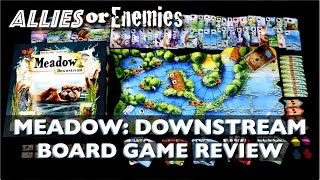
The new piece is a double-sided river board that locks into the campfire board, with a kayak you paddle along it. Allies or Enemies explains the two sides: a lazy float that is a bit easier to reach the end of and has only one real branching choice, between a three-point mini campfire bonus and a beaver card, and a rapids side that is more of a challenge, with bigger choices in its branching paths and bonus tiles. Neither is exactly difficult, they say, but the rapids give you more reason to plan ahead. The real puzzle is balancing your tableau against your progress up the river.
The Meadow: Downstream Experience
A Beautiful, Immersive River Trip
Allies or Enemies says the river board, with its winding waters, gives you a bit of a feeling of floating on a lazy day, and that the icons are clear and easy to read. Cardboard Crew admits the expansion makes Meadow more of a table hog "but that's a good thing because it's beautiful." Even The Broken Meeple has the otter box cover displayed on his expansion wall and says he would love a picture of it on his wall. For Allies or Enemies, the kayaker on the board does more than score points: it puts you into the game and gives context to everything you are collecting.
A Tighter Race at Higher Player Counts
How Downstream feels depends heavily on player count. At two players, Allies or Enemies found you can usually get the cards you want and move up the river at a nice pace. At four, the card slots fill quickly, and the game becomes more about figuring out how to use the cards you end up with than planning for the ones you need. At three or four you also lean on the campfire board more often and worry more about the race on the river board for the best cards and bonus tiles. The solo mode plays much the same as in the base game, with a bot that fills spots and steals cards, which they found more satisfyingly puzzly than many solo modes.
What Makes Meadow: Downstream Stand Out
Attention to Detail
Allies or Enemies singles out the river board, which is double-sided and locks seamlessly into the campfire board whichever way it faces: "the kind of attention to detail that makes board gamers happy." Cardboard Crew is excited by how many new creatures there are to explore, along with fences to build and houses to live in, and calls the whole thing wholesome and lovely.
More Replayability for an Already Replayable Game
Allies or Enemies had played more than a dozen games of Meadow without it going stale, and says there is no denying that Downstream adds even more variability and replayability. The two sides of the river board make that easy: Allies or Enemies says it is nice to change up the game just by flipping the board between the faster rapids and the meandering lazy river.
Potential Drawbacks
Table Space and Length
The Broken Meeple's complaints are practical. Downstream became "a massive table hog on top of what it already is a table hog," it made the game longer, and it made a nice simple affair more complicated than it should be. His conclusion is blunt: you cannot add length and complexity without mitigating it. Even Allies or Enemies puts the cost at about 25 percent more game time and complexity, roughly 10 to 15 minutes per player plus a little for players prone to analysis paralysis, and suggests leaving it out for your first few games with newer players.
It Doesn't Mix With the Adventure Book
The Broken Meeple reviewed Downstream alongside Meadow's second expansion, the Adventure Book, a set of six modules that replace the campfire board. The two are not compatible, so he says that if you have the Adventure Book and like it, you might as well not bother buying Downstream. His own copy is now relegated to never getting played, and he suggests owners separate out all the components and just never look at it again. Anyone planning to buy both should decide which one suits their group.
If You Enjoy Meadow: Downstream
Start with the base game, Meadow. Cardboard Crew's advice is to try Meadow first and pick up the expansion afterward, and Allies or Enemies agrees that newer players are better off learning without the river. If Downstream feels like too much table and too much time, The Broken Meeple's alternative is Meadow: Adventure Book, which adds variety by swapping the campfire board for one of six modules. He calls it a solid, well-produced addition and rates its best modules nine out of ten.
What Reviewers Are Saying
"It became a massive table hog on top of what it already is a table hog, but also it ended up extending the length of the game as well as making it more complicated beyond what it should be, which is a nice simple affair."
— The Broken Meeple
"After playing with it we can't imagine playing without it. It doesn't add too much in the way of complexity, but it certainly expands the decision space just enough, and having your kayaker on the board rowing up the Rapids does a great job of putting you into the game and providing a bit of context for everything."
— Allies or Enemies
"The art in this game is probably one of the most beautiful games out there in the world, different from a lot of other things in my opinion, and I appreciate that it's very welcoming and the Tableau is very fun. The combinations are very fun, the way you choose actions based on where you are and the numbers, there's just a lot of layers in this game that mix together."
— Cardboard Crew