







Iron Forest Deep Dive
What the Community Thinks About Iron Forest
Iron Forest arrives as an ambitious successor to Ice Cool, the wildly popular dexterity game that defined flicking mechanics for a generation. Brain Games took that foundation and attempted to elevate it into something more complex and engaging for a broader gaming audience. The response from reviewers has been decidedly positive about the game's execution, though its market trajectory tells a more complicated story. Reviewers consistently praise Iron Forest as a genuine step forward from Ice Cool, bringing fresh mechanics and clever mission design to the dexterity genre. Yet Tom Vasel from The Dice Tower notes a curious market paradox: despite the game's quality and innovation, it lacks the mass appeal of its predecessor. Players often prefer the simplicity and charm of the original. That said, among those who embrace Iron Forest, the enthusiasm is genuine and passionate, particularly from Board Gaming Ramblings, where it earned recognition as one of 2024's most surprising games.
Core Mechanics That Define Iron Forest
Dexterity and Precision Flicking
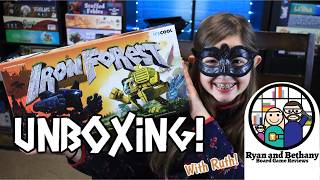
At its heart, Iron Forest is a dexterity game that demands steady hands and tactical thinking. The fundamental mechanic revolves around flicking wooden pieces across a board to accomplish objectives. Brain Games enriched this foundation with a catapult launcher mechanism positioned on a second level, allowing players to shoot pieces upward and across the play space. This two-story design is visually striking and dramatically changes how players approach each turn. The flicking itself is not always reliable, which reviewers note creates both exhilarating successes and frustrating misses. The imprecision is intentional design; missing a flick matters, and the pressure to execute under team scrutiny adds social tension alongside mechanical challenge.
Mission-Based Objectives
Rather than repeating a single goal across the game, Iron Forest features ten different missions that players rotate through. This variety is the game's signature strength. Each mission introduces new win conditions and strategic layers that transform the play experience without requiring rule rewrites. One mission plays like the original Ice Cool, asking players to flick pieces through doorways. Another introduces dice that must be flicked at targets. Yet another includes a football-match objective where players flick a ball toward goals. The designers ensured that despite mechanical overlaps, each mission feels like a distinct puzzle to solve. This mission architecture allows the game to scale from light family fun to a more involved strategic challenge, depending on which set is in play.
The Iron Forest Experience
Excitement and Shared Celebration
Iron Forest generates palpable energy at the table when players succeed. Board Gaming Ramblings described the moment when a flicked piece lands exactly where intended as a moment of genuine celebration, particularly when playing in teams. The two-level board creates a visual spectacle that draws onlookers at conventions; players have reported curious spectators gathering around mid-game simply because the physical setup looks unlike anything else in a board game collection. This spectacle factor amplifies the fun, especially in social settings where the shared experience of watching someone execute a difficult shot becomes memorable.
Frustration and Missed Execution
The flipside of dexterity-based design is inevitable failure. Reviewers acknowledge that frustration emerges when a carefully planned flick misfires or a piece lands millimeters from its target. This is not a flaw in design; it is inherent to the genre. Reviewers described moments of high stakes where a team's strategy hinges on a single flick, and the tension builds as the player attempts execution. When it fails, the disappointment is real but ultimately part of the appeal for players who embrace dexterity gaming.
What Makes Iron Forest Stand Out
Ten Diverse Missions
The mission structure is perhaps Iron Forest's most elegant design choice. Rather than offering cosmetic variety, each mission fundamentally changes how the game plays. The fact that reviewers noted the first mission feels like Ice Cool, while later missions introduce dice flicking and football mechanics, suggests a campaign-like progression that teaches and escalates complexity. This structure ensures the game has legs for repeated play; each session can introduce fresh challenges without feeling like variations on a theme.
The Two-Level Catapult System
Brain Games implemented the physical two-level board and catapult launcher as more than a gimmick. They create a genuine spatial and mechanical puzzle that distinguishes Iron Forest from every other dexterity game. Launching pieces from the top level adds verticality to play and requires players to develop entirely new flicking techniques. The catapult itself introduces timing and aim challenges distinct from standard flicking, giving the game layers of physical challenge that keep experienced players engaged while remaining accessible to newcomers.
Potential Drawbacks
Production Complexity and Reprinting Limitations
Iron Forest's physical ambition came at a steep manufacturing cost. Tom Vasel reported that Brain Games explicitly stated the game was so painful to produce that no reprint is currently planned. This creates genuine scarcity; once copies sell out, availability becomes limited. Reviewers noted the game's retail price is higher than Ice Cool, reflecting the manufacturing complexity. For players concerned about availability or cost, this is a legitimate barrier to entry. The irony is that the game's physical beauty and structural innovation are precisely why production proves challenging.
Market Appeal Narrower Than Ice Cool
Despite positive reviews, Iron Forest has not captured the mainstream audience Ice Cool commands. Part of this may reflect market saturation around dexterity games or the reality that not all gaming audiences prioritize the "next level" experience when the original remains available and simpler. The game ranks 6,987 on BoardGameGeek, a respectable position but far below Ice Cool's dominance. Reviewers suggest that while gamers appreciate the innovation, casual players often prefer Ice Cool's pure simplicity. This narrower appeal may explain why the game appeals strongly to enthusiasts while struggling to achieve breakout success in the broader market.
If You Enjoy Iron Forest
Ice Cool is the obvious starting point, as the two games share DNA. Ice Cool offers the foundational flicking experience in its purest form, ideal for players seeking the same mechanic with lighter complexity. However, if you've already mastered Ice Cool and want its gameplay evolved with meaningful variety and increased strategic depth, Iron Forest delivers exactly that upgrade. The games occupy different niches: Ice Cool is the gateway dexterity experience, while Iron Forest is the advanced exploration of what flicking mechanics can become when layered with design ambition. Fans of physical games who appreciate when publishers take risks on complex production will find Iron Forest rewarding despite its limitations.
What Reviewers Are Saying
"Iron Forest is a flicking game. It's the new game from the people who made Icecool, which is the flicking game with the penguins. They ramped it up one level, literally, because you're playing in two levels and you have like this catapult to shoot yourself on the top level. But it was so fun. And it was so frustrating when you try, you have a plan and you don't do the thing that you're trying to do, but it was very very fun."
— Board Gaming Ramblings
"it is a super good game there is there it's a team versus Team game you could play on free-for-all but we only played a team versus so far and it has launching of things it has flicking has a catapult it has the thing what is really cool is it has like 10 different missions and the ones to play so far even though like they have similarities they feel like you are doing different things and it's not like the first one is ice School basically flicking through uh doors and falling through holes and getting the little Clips but then it gets like more evolved you're trying to rol dice flicking dice launching dice there's even like a football match game."
— Board Gaming Ramblings
"Turns out people did not necessarily want an upgraded Ice Cool. They just like Ice Cool itself. It doesn't have the mass appeal the other one did, even though this is kind of a cool theme."
— Tom Vasel, The Dice Tower