

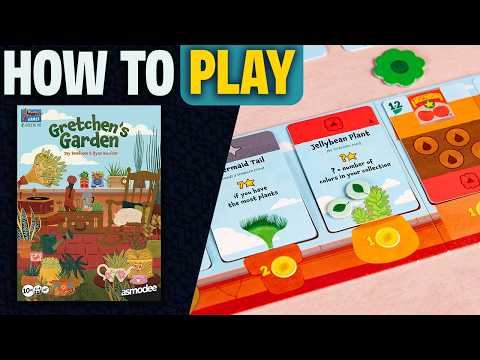








Gretchen's Garden Deep Dive
What the Community Thinks About Gretchen's Garden
Gretchen's Garden has captured attention as a thematic tableau builder with genuine charm, though reviewers consistently note a tension between its appealing exterior and surprisingly intricate ruleset. Lookout Games' release presents itself as an accessible, family-friendly gardening game, but the learning curve reveals mechanics that are noticeably less intuitive than the succulent theme suggests. Reviewers praise the game's distinctive character and interactive gameplay while cautioning new players that the experience is more complex than first appearances indicate. The general consensus leans toward pleasant rather than transcendent, with appreciation for what it does well tempered by acknowledgment of its friction points.
Core Mechanics That Define Gretchen's Garden
Tableau Building with Spatial Constraints
Gretchen's Garden centers on building a personal garden tableau that grows increasingly powerful as the game progresses. Players acquire plant and pot cards from Gretchen's shop, placing them strategically in their collection. What distinguishes this mechanic from traditional tableau games is how the pots themselves become dynamic: when a player acquires a new pot, it can displace the starting pots in the collection, rearranging which plants sit in which containers. This means players cannot simply stack cards; they must manage the spatial arrangement of their garden as it evolves, adding a tangible, thematic element to their decision-making that reviewers found immediately apparent yet mechanically demanding.
Set Collection Through Cultivation
Players score points by assembling and flowering matching succulents and by fulfilling plant-specific objectives. Each plant card contains its own scoring condition, meaning different succulents score differently. The game includes two complete sets of plants, labeled A and B, encouraging replay with different scoring puzzles. Reviewers noted this variability as genuinely valuable, since it prevents the game from becoming predictable, though the abundance of individual rules per plant also contributes to the learning curve. Flowering a plant locks it in place permanently, preventing further movement or watering, which introduces a commitment mechanic that forces players to balance growth against finality.
The Gretchen's Garden Experience
Charming Aesthetics Versus Intricate Rules
Reviewers universally appreciated the game's visual identity and thematic coherence. The Dice Tower described it as having a very charming look that is instantly approachable, noting the appeal of depicting succulents in unconventional containers. However, this aesthetic accessibility creates a false promise: the rules are substantially more finicky than newcomers expect. Players must internalize specific exceptions, such as where water tokens move when a plant is cut by an opponent, which pot placements trigger reordering, and how capacity limits interact with plant growth. These details aren't intuitive from the theme, leading The Dice Tower to describe the rules as tricky, or finicky, and requiring multiple plays before players stop consulting the rulebook.
Quick Turns Disguising Shallow Gameplay Depth
Despite a printed playtime of around half an hour, experienced players reported completing games quickly, with each turn taking only moments since players choose one action from a fixed menu. This brevity is both a strength and a weakness: the game moves at a snappy pace with minimal downtime, making it feel engaging in the moment. However, the overall experience is constrained by a fixed, limited number of meaningful actions across the entire game, leading some reviewers to feel it doesn't deliver enough strategic meat despite its engaging exterior. The game occupies an unusual space where individual turns feel light and quick, but the cumulative experience can feel somewhat thin for players seeking deeper engagement.
What Makes Gretchen's Garden Stand Out
Asymmetric Player Interaction Through Plant Clipping
Rather than direct conflict or punishing player removal, Gretchen's Garden offers a distinctive form of player interaction where one player can cut a leaf from an opponent's plant and propagate it into their own collection, as Banter and Boards highlighted. This mechanic isn't punitive in the traditional sense: when a plant is cut, the opponent gains a water token that may help them later, while the cutter acquires a freshly potted cutting of the same plant type. Reviewers highlighted this as genuinely clever, since it allows players to access succulents unavailable in the shop without ruining their opponent's strategy, creating a gentler form of conflict that fits the game's pastoral theme.
A and B Card Set Variability
The inclusion of two complete plant sets with different scoring conditions provides substantial replayability without requiring expansions. Players can start with the A cards for their first game, then experiment with the B cards or mix them for future plays. Reviewers specifically called out this design choice as thoughtful, since it adds variety while remaining accessible to new players who can stick with the recommended starting configuration. This flexibility respects different player preferences: some enjoy discovering how plant abilities interact, while others appreciate consistent scoring frameworks.
Potential Drawbacks
Steep Learning Curve for a Cozy Game
The most consistent concern across reviews involved the disconnect between Gretchen's Garden's aesthetic promise and its mechanical execution. The box art, theme, and visual design all suggest a relaxed, family-friendly experience, yet the ruleset contains multiple non-obvious interactions and exceptions. The Dice Tower estimated that the game requires several plays before most players stop consulting the rulebook, contradicting the expectation set by its visual presentation. Rules like pot displacement sequencing and water flow mechanics are logical once internalized but feel arbitrary during first exposure, creating friction for casual players expecting a straightforward gardening theme.
Limited Strategic Depth Despite Decision Density
The brevity of the game, with a fixed and relatively short run of actions per player, means that the strategic landscape is constrained. While individual decisions about plant purchases and cutting mechanics carry weight, the overall game offers less room for long-term planning and engine-building than tableau builders with higher action counts. Some reviewers felt the game didn't deliver enough payoff to justify the learning investment, particularly for players expecting a cozy experience that didn't demand extensive rulebook consultation. The game exists in an awkward middle ground: too light to feel strategically rich, but too fiddly to feel relaxingly casual.
If You Enjoy Gretchen's Garden
Players drawn to Gretchen's Garden likely appreciate games that balance charming aesthetics with meaningful interaction. The game's strength lies in combining tableau building with gentle player conflict and thematic coherence. Gretchen's Garden rewards players who value a game that feels like building something real, piece by piece, with physical constraints, over pure puzzle optimization. Anyone who enjoys variable card sets that reward multiple playthroughs, or mechanics that fit their theme without requiring heavy abstraction, may find Gretchen's Garden satisfying once the ruleset clicks. Patience with the learning curve pays dividends; reviewers who persisted through the initial confusion reported enjoying the game's unique character.
What Reviewers Are Saying
"I do think that the rules are tricky, or finicky, I guess I should say. There's a lot of just weird kind of rules that are not very intuitive. Even after multiple plays of this game, when I was teaching a new group, I would pull out the player aid and have to go line by line and pull out the rulebook again. Once you get the game down after a couple plays, it's quick, snappy, really quick decisions and turns. But it does take that full three plays."
— The Dice Tower
"you're kind of like building a tableau, but it's much more thematic than that cuz you're building out your garden. You're building out these succulents in pots."
— Grant Lyon
"I found the game to be very simple and to be a very beginner friendly tableau building game. There was also some player interaction within the game as well, as you can cut different plants from other players pots and copy them into your own tableau."
— Banter and Boards