






Halloween Deep Dive
What the Community Thinks About Halloween
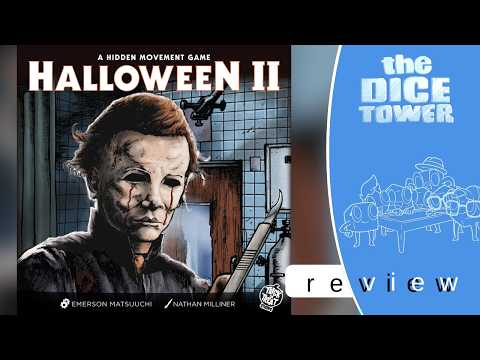
Halloween arrives as a straightforward entry point to hidden movement gaming. Foster the Meeple rates the experience highly for its accessibility and thematic resonance, calling it "very accessible, very straightforward, very enjoyable" and recommending it specifically for fans of horror movies. The design philosophy prioritizes clarity: the ruleset avoids unnecessary complexity while delivering the atmospheric tension of the franchise. Getting Games' Jonathan Cox approached the title with curiosity about its mechanical approach to the killer-versus-victims dynamic, noting it would be worthwhile for their audience to understand how the game inverts certain hidden movement conventions. While the design earned respect from multiple reviewers, personal play collections ultimately moved the game along, suggesting it succeeds as a thematic experience rather than a persistent favorite for dedicated enthusiasts.
Core Mechanics That Define Halloween
Hidden Movement and Line of Sight
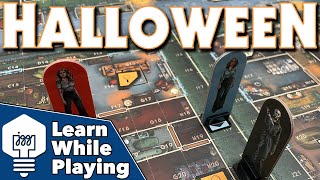
Michael Myers begins the game hidden from all victims on a private tracker, revealed only when someone in his vicinity gains direct line of sight. This asymmetry sits at the game's mechanical core. Victims move orthogonally across a mapped neighborhood, maintaining a facing direction that determines their cone of visibility. Doors block line of sight entirely, but windows permit seeing through them, creating strategic positioning choices. When a victim catches Michael Myers in their line of sight, he appears on the board and remains visible until they lose sight of him again. The hidden player system builds tension through uncertainty: victims never know exactly where Michael Myers lurks, only where he was last spotted.
Asymmetric Roles and Objectives
Trick or Treat Studios designed Halloween around fundamentally opposed win conditions. Michael Myers must either survive to a specific round (round 24 in a two to three-player game, round 18 in a four-player game) or kill a threshold number of victims (four victims in a two to three-player game, three victims in a four-player game). Victims win by finding and equipping a key to one of two cars, locating Tommy and Lindsay (the children in peril), and driving to safety with at least one player holding all three items. Each victim character brings asymmetric abilities: some carry more cards, others gain bonus actions, and certain characters excel at searching. When a victim falls to Michael Myers, they are immediately replaced by a new survivor entering the neighborhood, fresh but without the lost items.
The Halloween Experience
Tension Through Stalking
The act of searching creates palpable dread. Victims must move through quadrants, hunting for items while knowing Michael Myers stalks from an unknown location. The search mechanic itself, flipping location cards from a deck, offers practical tools (weapons, healing, movement aids) alongside story-flavored flavor text. The longer victims linger in one quadrant, the faster they exhaust that area's resources, but moving on means abandoning search progress. This creates a persistent low-level anxiety: should they continue digging or move elsewhere before Michael Myers arrives?
Visceral Horror Movie Moments
The game's true horror arrives when Michael Myers appears. His sudden reveal at a victim's window, after stalking silently through rooms the victims cannot see, captures the movie franchise's signature jump-scare tension. When multiple victims occupy the same space, one careless positioning choice ends in immediate attack rolls. The stagger mechanic, forcing Michael Myers to take reduced action efficiency after taking damage, mirrors the slasher-film trope where the killer limps away after injury, only to recover and resume the hunt moments later. These thematic anchors ground mechanical systems in cinematic moments, reinforcing the franchise's atmosphere through gameplay.
What Makes Halloween Stand Out
Low Rules Barrier for High Thematic Payoff
Jungus Games' comprehensive rules tutorial reveals a game of surprising elegance. The action economy is simple (two actions per turn), movement is intuitive (orthogonal, respecting walls), and line-of-sight rules are straightforward. Yet from these rules emerges complex emergent play: victims must balance searching for victory items against survival pressure, decide when to split up versus cluster, and decipher Michael Myers' likely locations from his movement history. The designers resisted adding mechanical chrome; instead, the theme itself generates tension. Most board gaming systems require heavy rules to achieve asymmetric one-versus-many balance. Halloween achieves it through clean mechanics and spatial constraints, making it genuinely approachable for new players who still feel the pressure mounting.
The Killer Plays by Different Rules
Michael Myers operates from a parallel action set. Instead of searching and moving, he stalks (moving up to five spaces), infiltrates (moving through windows), pursues (moving any distance in a straight line until blocked), or attacks (dealing damage and triggering victim counterattacks). When staggered by damage, his stalking shrinks to three spaces and his pursuit option vanishes entirely, forcing him into weaker tactical choices. This role separation ensures Michael Myers never feels like a fifth player competing for the same resources as victims. He is playing a different game operating under different physics, which reinforces the asymmetry and prevents the hidden movement mechanic from devolving into a simple hunt-the-mouse chase.
Potential Drawbacks
Limited Replayability for Core Audiences
While accessible to newcomers, Halloween showed diminishing returns for dedicated hobby gamers who engage with a title repeatedly. Getting Games' Jonathan Cox, a passionate board game enthusiast who regularly incorporates new titles into their personal collection, ultimately moved Halloween along after creating sponsored content around it. They noted that while the game was "not really bad," it simply didn't earn a permanent slot in their playing rotation. The foundational mechanics, though clean, may not sustain the complex decision trees or narrative arcs that keep experienced players returning. This suggests Halloween positions itself as a party game or introduction to hidden movement rather than a design that deepens with familiarity.
Neighborhood Map Creates Tight Spatial Constraints
The board layout concentrates victims into a relatively confined space. Unlike sprawling hidden movement games, the neighborhood map's internal walls and house layouts reduce maneuvering room, which can feel constraining compared to open-world alternatives. Victims often find themselves in narrow corridors where Michael Myers' presence becomes almost inevitable rather than a matter of clever evasion. This tightness accelerates confrontation and can limit the cat-and-mouse dynamic that some hidden movement fans expect. The consequence: high tension in shorter play windows, but less room for prolonged strategic stalking and escape maneuvers.
If You Enjoy Halloween
Players drawn to Halloween should explore Sniper Elite, a hidden movement game where the roles reverse, one player hunted by all others. Terror Scape offers similar neighborhood-based survival mechanics with cooperative elements. For deeper hidden movement systems, Fury of Dracula delivers extended asymmetric cat-and-mouse play with more rules complexity. Nuns on the Run similarly delivers one-versus-many stealth gameplay, though with a lighter footprint. Each shares Halloween's core appeal: one side hides and hunts while the other searches and evades, but each solves the balance problem in different ways.
What Reviewers Are Saying
One person is playing as Michael Myers and they are essentially trying to kill as many victims as they can. There's a certain threshold they need to meet. The other team of teenagers are running around this map trying to find things, like the keys to the car and the kids, to pull the kids into the car to escape. It is a hidden movement game, very accessible, very straightforward, very enjoyable.
— Foster the Meeple
in it one person is Mike Myers Michael Myers and they are hidden unless somebody could directly see them and they are hunting down everybody else so it's kind of an inversion of that overall system it's my understanding this is a completely different game from Specter Ops
— Getting Games
As soon as they move out of our line of sight, we remove their token from the board and we replace it with a shadow token so we always know the last place where any of the victims had line of sight on Michael Myers.
— Jungus Games