








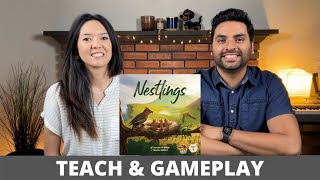
Nestlings Deep Dive
What the Community Thinks About Nestlings
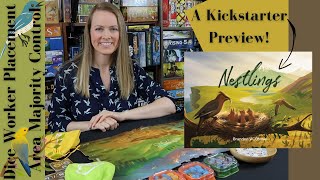
Nestlings has found strong support among board game reviewers who appreciate its blend of familiar mechanics with clever execution. Tabletop Tolson offers particular enthusiasm, describing the game as gorgeous and highlighting its impressive design that manages to be both accessible and engaging. Watch It Played's Matthew Neutzling notes the appeal of the core mechanics for players who enjoy dice placement combined with set collection, positioning Nestlings as a game that satisfies multiple design interests simultaneously. The game has earned recognition from multiple YouTube reviewers as a solid family-weight strategy title that avoids talking down to players while remaining genuinely approachable.
However, not all perspectives align perfectly. Board Gaymes James offers a more measured take, particularly regarding the solo and AI components, suggesting that while the game itself flows well once players understand the rules, the rulebook could be clearer. The complexity of teaching and explaining remains a point of friction for some reviewers, particularly those engaging with the solo mode or attempting to learn without guided instruction. Despite this, the consensus trend favors Nestlings as a worthwhile design that delivers on its core promise of engaging competition across beautiful biome boards.
Core Mechanics That Define Nestlings
Dice Placement
Nestlings centers on dice placement as its primary decision engine, but with a significant twist that distinguishes it from traditional worker placement games. Players roll custom biome dice and assign them to action spaces on the board in order to claim resources from different biome locations. The elegance lies in how the die face value determines eligibility: a player can only place a die in a space matching its symbol, and they build competing claims within each biome simultaneously. Tabletop Tolson describes this as a delightful twist on dice worker placement, calling it both intuitive and engaging. The mechanic creates constant negotiation between players: someone wants to secure priority in a biome for valuable resources, but committing multiple dice to one location risks leaving them vulnerable elsewhere. The first player to place dice in any biome gains important leverage, yet the leftmost position determines tiebreakers, rewarding those who move decisively early.
Set Collection and Resource Management
Resource gathering and set completion form the second pillar of Nestlings' design. Players collect diverse food tokens from the biomes they win, working toward two overlapping goals: feeding their individual nestlings and completing public Gathering objectives. The game introduces a biome ring on each player board that rewards diversity, encouraging players to collect resources across multiple biome types rather than hoarding a single resource. This mechanism ensures that strategies remain varied and that no single approach dominates the table. Reviewers highlight the elegance of this system: resource scarcity on the board changes every round as the bag-drawing mechanism refreshes supplies unpredictably. Because players draw resources directly from bags, duplicates stack on the board naturally, and the distribution shifts with each turn. This randomness combines with the deterministic dice results to create a satisfying balance where planning matters but luck never obliterates strategy entirely.
The Nestlings Experience
Tension Through Competition
Watching reviewers engage with Nestlings reveals a game that generates genuine table tension through shared resources. Because every biome contains only as many resource stacks as there are players plus one, every choice feels consequential. The first player to resolve a biome picks first, but then gets to discard one resource stack that other players cannot access, ensuring that winning priority carries meaningful strategic weight. Tabletop Tolson captures this dynamic perfectly when describing how players desperately want particular resources but face uncertainty about whether they will successfully claim them. The feeling builds across the round: players commit their dice, hoping their numbers in each biome prove sufficient, then watch as the resolution unfolds and they scramble to claim the pieces they need.
Accessibility Without Sacrifice
Multiple reviewers emphasize how Nestlings achieves accessibility without sacrificing strategic depth. The game has light to medium complexity, plays one to four players across approximately 45 minutes, and communicates its rules through intuitive components. The asymmetric bird characters provide special powers that add flavor without creating overwhelming exceptions. Tabletop Tolson notes the game appeals to players interested in Wingspan or Discovery, positioning it within a design tradition that values thematic coherence and elegant mechanics. The bird theme and biome diversity create immediate visual interest, and the game invites engagement from younger players while remaining interesting for serious hobbyists.
What Makes Nestlings Stand Out
Beautiful Production and Thoughtful Components
The physical presentation impressed reviewers repeatedly. Tabletop Tolson describes the board as beautiful with genuine biome variety, and multiple reviewers praise the component quality in the deluxe version. The custom dice featuring biome symbols reduce confusion compared to traditional numbered or symbol-heavy dice in other placement games. The bag-drawing mechanism adds tactile satisfaction to resource gathering, transforming a random distribution system into an engaging physical interaction. Board Gaymes James notes that the deluxe components with plastic replacements for cardboard tokens significantly enhance the experience, suggesting that component quality meaningfully impacts player enjoyment.
Balanced Opportunity Across Player Counts
Reviewers acknowledge that Nestlings scales well from solo play through four players, though different counts require different approach systems. The base game mechanics remain unchanged, but two-player games incorporate an AI system to maintain the scarcity pressure that defines the experience. The ability to play the same core game across multiple player counts without dramatic rule changes represents elegant design. Tabletop Tolson mentions playing across two, three, and four player counts and consistently finding engaging games, crediting the tight balance that exists regardless of table size.
Potential Drawbacks
Rules Clarity and Solo Mode Complexity
Board Gaymes James raises substantive criticism regarding the rulebook and solo mode implementation. The reviewer notes that the rulebook has confusing passages, particularly surrounding the AI player behaviors and two-player setup. Board Gaymes James states that mastering these rules requires effort and that the solo experience, while playable, does not shine as brightly as the multiplayer game. The complexity of teaching the AI system and remembering its specific decision trees creates friction that might discourage some solo players, even though the core game itself flows smoothly once learned.
Player Count Optimization
While the game supports one to four players, reviewers suggest the experience peaks in multiplayer configurations. The resource competition that drives tension becomes less interesting against an AI system than between human opponents. The game is mechanically designed around interaction: watching other players commit to biomes and racing to secure priority before they do. With fewer real players at the table, this dynamic diminishes. Board Gaymes James mentions that even with the advanced AI system available for two-player games, the experience loses some of its charm compared to full four-player rounds.
If You Enjoy Nestlings
Tabletop Tolson points bird lovers toward Wingspan, praising both games for birds that behave the way real birds do, even though the two play very differently. For the dice itself, Tolson's own touchstone is Discoveries, another game built on rolling dice and placing them as workers, and a natural next step for anyone who enjoys that one-die-per-turn tension in Nestlings.
What Reviewers Are Saying
"I enjoyed the game though. I want to play it again without the AI player because I agree, I think with the real people it'd be good, but I enjoyed it. I thought it was good."
— UndeadVikingVideos
"I love dice worker placement now it's not necessarily going to be the traditional this has kind of like a spin or a twist on it and I really really like it."
— Tabletop Tolson
"I love dice placement and set collection so this one will have my attention because after a successful Kickstarter by Tangerine games Lucky Duck will be making it available at retail in April."
— Watch It Played