




Valheim: The Board Game Deep Dive
What the Community Thinks About Valheim: The Board Game
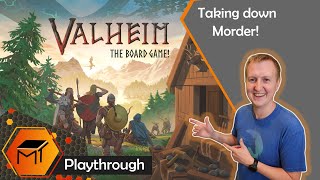
Valheim: The Board Game arrives as a faithful, earnest adaptation of the beloved survival video game. Reviewers broadly acknowledge its success in capturing the spirit of exploration, resource gathering, and base-building that defines the original. However, reception reveals a clear divide: some found it a satisfying cooperative survival experience worthy of repeated plays, while others discovered its appeal fades quickly after the first handful of scenarios. The game has genuine admirers who appreciate its streamlined design and thematic execution, but it also has vocal critics who felt the core loop grew repetitive and the boss encounters felt insufficiently developed.
Core Mechanics That Define Valheim: The Board Game
Resource Management
The heartbeat of Valheim: The Board Game is its resource management system. Players must scavenge wood, stone, hides, and metal across procedurally laid-out hexagonal maps, then convert those raw materials into weapons, armor, and home furnishings. Every action competes for limited stamina and turn structure. When players gather resources, they flow into a communal house supply, forcing the group to coordinate what gets built when. This constraint ensures that choosing to craft a fire table means forgoing an armor upgrade, creating genuine strategic tension. The mechanic mirrors the video game's survival loop without requiring the months-long campaign, condensing years of progression into a 90-minute session.
Boss Battler
Once players feel adequately equipped, they summon a boss and transition to a dedicated arena battle. The map morphs into a circular arena where the boss occupies the center and players circle around it, attacking from different facings. Each boss has unique arena effects and special ability cards. The mechanic works thematically, offering a clear endgame and a distinct phase break from the exploration phase. However, reviewers consistently noted that the boss encounters lack the tactical depth found in larger boss-battler games like Oathsworn or Vagrant Song. The arena is smaller and less elaborate, and the combat often hinges heavily on die rolls rather than meaningful positioning choices.
The Valheim: The Board Game Experience
Survival Tension and the Threat of Raids
Reviewers describe a pervasive survival tension throughout the early game. Each explored hex might spawn enemies or valuable resources. The event deck serves as a merciless timer, threatening to end the game if players dawdle too long. Raids, in particular, struck multiple reviewers as a clever mechanical parallel to the video game: a card from the event deck builds up enemies in a nearby hex over several turns, and when the timer runs out, they rush the base, forcing players to abandon exploration and scramble home to defend it together. Reviewers who know the source material were impressed the raid mechanic made the jump to the tabletop at all, noting it captures the danger of wandering too far from an unattended base and the camaraderie of regrouping to fend off a wave of enemies.
Front-Loaded Crafting Satisfaction
The crafting satisfaction is real but front-loaded. Players enjoy the early scenarios when each resource feels precious and every new weapon feels like a genuine upgrade. That same mechanic, however, begins to feel rote by the fourth or fifth scenario. Building a crafting table, a bed, and upgraded armor follows the same sequence each time; the narrative and resource-driven tension that made early plays engaging doesn't regenerate in later ones.
What Makes Valheim: The Board Game Stand Out
Faithful IP Translation
The game's most consistent strength is its faithful IP adaptation. Reviewers noted that Valheim: The Board Game does not simply slap the license onto a generic survival game. It translates specific mechanics from the video game: building a beehive because honey is as valuable in the board game as it is in Valheim. The miniatures and artwork are bright and colorful, recognizable to fans and inviting to newcomers. Mood Publishing invested effort in respectful translation rather than cynical cash-in.
Scenario Variety and Replayability
The scenario variety is substantial on paper. Fourteen different scenarios with different map layouts, boss encounters, and optional islands offer enough variety to justify multiple sessions. The rulebook even includes guidance for creating custom scenarios, allowing groups to tailor difficulty. The production quality is solid; components feel good in hand, and the retail version strikes a balance between component upgrades and playability.
Potential Drawbacks
Repetitive Scenario Structure
Despite different maps and bosses, the core sequence remains unchanged: move, gather, build, fight monsters, advance the event deck. Reviewers observed that whether you are facing the Elder or Bone Mass, you perform the same sequence of actions with marginally different weapons. The terrain might be swamp instead of meadow, but the gameplay loop does not fundamentally shift. One reviewer noted they were "doing the same stuff over and over again" despite varied scenarios, and that after four or five plays the game lost its appeal entirely. Boss-specific arena mechanics are not distinct enough to make each encounter feel like a fundamentally different challenge.
The 3D House Gimmick
The deluxe edition includes a three-dimensional cardboard house structure that players assemble and modify as they build furniture. Reviewers unanimously panned this component. It requires assembly before every game, which is tedious and unintuitive. More critically, it obscures the furniture cards placed inside it, forcing players to peer into the structure to see what they own. As one reviewer put it, the house "doesn't do anything to add to the game" and only "obscures your tokens and your furniture." It is a cosmetic upgrade that actively harms playability. The retail version, which uses flat board representation, is the better choice.
If You Enjoy Valheim: The Board Game
Deep Rock Galactic: The Board Game, also by Mood Publishing, is the natural recommendation. It shares the same video-game adaptation DNA and cooperative survival structure, but Reviewers found it executed more successfully, with greater scenario variety and tighter pacing. If you crave more boss-focused cooperative gameplay, Oathsworn and Vagrant Song offer richer tactical boss encounters, though at greater complexity and length. For the survival loop without boss emphasis, Stardew Valley: The Board Game captures the satisfying progression of building and gathering, though with less combat.
What Reviewers Are Saying
"This is definitely paying homage to the theme. It's not just using it for the sake of using it. No, it actually is trying to be Valheim. I like the little arena battle setup as well."
— The Broken Meeple
"My family and I got bored with this one as well. This one actually was pretty exciting at first. My kids really liked it. Why wouldn't they? It's fun to craft stuff and build your house, get cool armor, get cool weapons. But the game just in my opinion barely changes in different scenarios. You're doing the same stuff over and over again."
— One Stop Co-op Shop
"It's entirely useless because it doesn't do anything to add to the game. It just gives you a 3D structure that you put here for your house. The problem is is that from depending what angle you're looking at or even if you've just got stuff inside it, it obscures your tokens and your furniture and stuff."
— The Broken Meeple