






Gettysburg: A Time for Heroes Deep Dive
What the Community Thinks About Gettysburg: A Time for Heroes
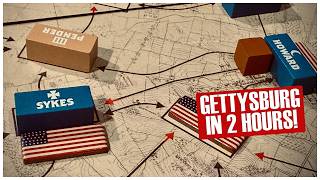
Gettysburg: A Time for Heroes has earned consistent praise from the board gaming community as a gateway wargame that delivers far more strategic depth than its accessible ruleset might suggest. Reviewers from Zilla Blitz and The Discriminating Gamer agree on the game's core appeal: it teaches quickly, plays in under two hours, and generates memorable tactical encounters without demanding the intimidating complexity of traditional conflict simulations. The consensus centers on a single revelation that separates this game from other Civil War treatments. Multiple reviewers emphasize that the game excels at capturing the dramatic feel of the Battle of Gettysburg through mechanical elegance rather than historical simulation. The semi-random activation of leaders means no two games play identically, even though the scenario remains fixed to July 1863. This design choice receives universal appreciation because it creates genuine replayability and alternate history moments while still honoring the battle's shape and flow. Reviewers describe walking away from the table with strong memories, tight finishes, and stories worth replaying, hallmarks of a game that succeeds on both mechanical and thematic levels.
Core Mechanics That Define Gettysburg: A Time for Heroes
Card-Driven Unit Activation
The heart of Gettysburg: A Time for Heroes rests in its card-driven activation system. Instead of each player moving all their units in turn, players alternate playing formation cards that specify which units activate and how many actions they may take. A major activation grants two actions (move and attack, two attacks, two moves, or any combination), while minor activations grant one action. The semi-random order in which these cards appear throughout the game, combined with the fact that different leader personalities can emerge in various sequences, creates a dynamic pace that feels unpredictable without becoming chaotic. Reviewers highlight how this system naturally teaches the game's core concepts while maintaining tension. Players cannot simply execute a perfect plan; they must adapt to which units are available each round. This feeds directly into replayability, since the game plays differently depending on whether aggressive commanders arrive early or late.
Cohesion and Combat Through Dice
Gettysburg: A Time for Heroes measures unit strength not through numerical hit points but through cohesion, a mechanic that tracks both a unit's readiness and its capacity to remain on the battlefield. Each unit has a cohesion tracker marked on the map, and cohesion is spent in two ways: activation costs (paid when a unit takes an action) and combat losses (suffered when attacked). When a unit's cohesion drops into the yellow zone, it must pass a cohesion check by rolling equal to or under its current cohesion on a die, or the unit is eliminated entirely. Combat itself uses a dice-chucking system where only the attacker rolls. The number of dice depends on the attacking unit's strength, modified by terrain arrows (black for no effect, red for minus one die, green for plus two dice). The combat results table creates memorable moments: doubles of ones or twos hurt the attacker, doubles of three grant momentum cubes (a resource used to purchase tactic cards), and doubles of four, five, or six inflict defender casualties. This elegant system means combat feels swingy and dramatic: casualties are frequent, but a strong position or clever tactic card can shift outcomes.
The Gettysburg: A Time for Heroes Experience
Tension and Narrative Flow
Reviewers consistently describe playing Gettysburg: A Time for Heroes as a tight, dramatic experience that generates stories. The game's design creates natural narrative arcs. The Union player begins with victory points under control and must hold them against Confederate pressure. The Confederates can win as early as the first day by capturing three points, placing immediate time pressure on both sides. Units wear down through activation and combat, forcing difficult decisions about when to push a weakened formation and when to pull it back. Late in a game, control of a single victory point location becomes desperate, with both players deploying depleted units hoping to hold long enough or break just long enough to shift control. Reviewers report games decided in the final activation by a single failed cohesion check, with the tension building throughout because both players always know the rules and can calculate when victory is within reach. This mechanical clarity combined with uncertainty (opponent hand cards, tactics card availability, die rolls) creates an atmosphere of mounting tension that players find engaging and memorable.
Accessibility and Learning Curve
A prominent theme in reviewer discussions is how quickly Gettysburg teaches and flows once the initial learning phase ends. The rulebook is only 18 pages and clearly written, yet executing the rules requires understanding several interconnected systems. Reviewers report that a first play takes longer (up to four hours with teaching) as players look up interactions, but subsequent plays run much faster and smoother. The card-driven structure, once grasped, becomes intuitive. One reviewer notes that once someone understands how to play, they can teach others efficiently, making it an attractive gateway game. This combination of brief rules text and quick mastery once playing makes Gettysburg: A Time for Heroes suitable for both casual board gamers and committed wargamers seeking a lighter evening experience.
What Makes Gettysburg: A Time for Heroes Stand Out
Beautiful Production and Map Design
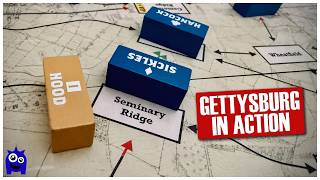
Reviewers praise the physical components throughout. The mounted map (22 by 34 inches) features excellent graphic design with clear point-to-point connections between locations. The two identical rulebooks (a touch reviewers appreciate) reduce table friction. Unit blocks have clean printing with no stickers needed. The cohesion trackers are printed directly on the map's borders, eliminating fiddly separate sheets. The tactics cards are printed on high-quality vinyl and come in two sets (one for Confederate, one for Union), adding durability. The overall presentation reads as professional and accessible without sacrificing durability or clarity. Reviewers emphasize that this production quality matters because the game sees repeated play and the mechanics demand quick visual reference. The map's design in particular earns praise because terrain modifiers (arrow directions and colors) and location names are legible from across a table.
Exceptional Replayability and Solitaire Mode
The game contains only one scenario (the full Battle of Gettysburg across three days), yet multiple reviewers list it high on their solitaire and 2025 best-of lists, suggesting unexpected depth. The semi-random leader activation system means the same scenario never plays the same way twice. Which side gets commanding generals early, which tactics cards appear and in what order, and pure die rolls ensure that strategic decisions matter without determining outcomes. Additionally, after initial release, the designer published official solitaire rules that players initially didn't know existed. These rules allow play against an AI opponent using the same core mechanics but with a personality-driven decision tree (generals categorized as impetuous, prudent, or opportunistic, affecting aggression levels). The solitaire bot uses simplified but potent combat, rolling fewer dice but needing only singles instead of doubles to hit. Reviewers who tried the solo mode report that it provides a challenging, engaging experience on par with the two-player game.
Potential Drawbacks
Rulebook Ambiguities Require Consultation
While reviewers universally praise the game once learned, the path to proficiency has friction points. Early interactions around activation cards, readout mechanics, and edge cases occasionally require consulting Board Game Geek or re-reading specific sections. One specific example involves the penalty for not attacking during the first day activation. The rule creates a scenario where the Confederate player is penalized for not attacking, yet no Union forces are present to attack. This logical impossibility caused confusion and required cross-referencing to clarify. Reviewers note that a rulebook refinement addressing such edge cases would smooth the teaching experience. The ambiguities do not break the game, all reviewers eventually resolved them, but they do add friction during a learning game and warrant mentioning alongside the game's many strengths.
Hidden Information Can Challenge Solo Play
The game features intentional fog of war: opponent hand cards remain hidden, and unit strength can be masked by reinforcement mechanics. This design enriches two-player games by preventing perfect information abuse but creates challenges for solo players attempting to play two-handed without accidentally influencing decisions through knowledge of hidden cards. Reviewers note that while the solitaire mode mitigates this concern through official bot rules, playing both sides simultaneously without the official variant requires discipline. This limitation is minor given the existence of the official solo mode, but it bears mention for players interested in purely two-handed play.
If You Enjoy Gettysburg: A Time for Heroes
The Discriminating Gamer places this game in a family of designs, noting that it builds on the system of Freeman's Farm 1777 and Chancellorsville 1863, and that in a lot of ways it is the better game. Players who enjoy the double-rolling combat, cohesion and point-to-point movement here will find the same core system applied to other battles in those titles.
What Reviewers Are Saying
"This plays deeper and it plays deeper than its rule set which to me is the mark of a really good game. It's pretty easy to learn once you get it down there's a lot of depth to play."
— Zilla Blitz
"There's a lot of kind of fun things here. I love trying to make the dice work for you in this game and trying to roll those doubles. It's an excellent game and it's an excellent dice mechanic, dice rolling mechanic here in Gettysburg: A Time for Heroes."
— The Discriminating Gamer
"It spins great narratives. It's got beautiful components. Every time I've touched this game, I've had fun playing it. Additionally, it's got a very strong solo mode. It plays a strong game, so you can enjoy this game either as a two-player experience or as a solo experience."
— Zilla Blitz