






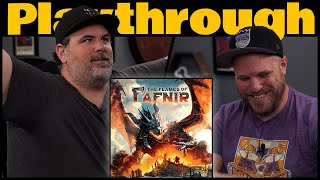
The Flames of Fafnir Deep Dive
What the Community Thinks About The Flames of Fafnir
The Flames of Fafnir presents an interesting paradox: reviewers consistently praise the core concept and the signature marble-flinging dragon mechanic, but struggle with how the execution delivers on that promise. The consensus leans mixed to skeptical. The game's central gimmick captures attention in reviews, yet several experienced players describe the overall experience as forgettable and somewhat unbalanced, especially in solo play. The verdict across multiple review channels is cautiously interested rather than enthusiastically recommended.
Core Mechanics That Define The Flames of Fafnir
Resource Gathering and Building Deployment
The game centers on a classic worker placement loop: heroes move around the board collecting three types of resources (troops, materials, and treasure), then invest those resources to deploy defensive buildings. The four building types each serve distinct purposes. Walls provide discounts on quest completion. Embankments increase movement and resource storage. Watchtowers amplify resource gathering on future turns. Barricades grant artifact cards, which are the game's most powerful upgrade path. This economic engine creates genuine decision-making around what to build and when, with real trade-offs between immediate benefits and long-term positioning.
The Physical Dragon Fire Mechanic
Every round, the dragon loads marbles into its physical body and launches them down toward the village. Players' heroes and buildings sit in the marble's path, and destruction is determined by actual physics. When a marble topples a building or hero, the owner gains benefits (glory points, ability to peek at quests, or the ability to reposition). This creates a counterintuitive incentive: players benefit when their own structures are destroyed. The marble mechanic is undeniably eye-catching and generates the kind of tactile, unpredictable moments that stick in memory, but reviewers note the actual gameplay impact can feel disconnected from the rest of the turn structure.
The Flames of Fafnir Experience
A Gimmick Stronger Than Its Execution
Multiple reviewers describe the core experience in the same terms: the concept is cooler than the execution. The marble-flinging dragon is a visually striking and mechanically unique selling point, but once that novelty settles, the strategic depth underneath feels shallow. Resource management is straightforward, the Euro-style elements (engine building, quest chains) remain fairly light, and the turn structure does not layer meaningfully enough to sustain deep replay. Reviewers who played multiple times reported that the game did not meaningfully evolve across sessions.
An Identity Crisis
The game appears caught between two design goals. It could be a silly, dexterity-forward experience in the vein of Fireball Island, where the marble mechanic is the primary focus and strategy takes a back seat. Or it could lean fully into the Euro-style resource management, quest completion, and artifact combo chains, with the marble mechanic as flavor. Instead, reviewers felt the game landed "a little bit in each category, which means you're sort of nowhere." The result is a game that is neither silly enough to be a pure fun-focused experience nor strategic enough to satisfy players looking for meaningful economic depth.
What Makes The Flames of Fafnir Stand Out
The Physical Dragon Fire Gimmick
The marble mechanic is genuinely novel. Reviewers consistently called it the game's strongest asset. Watching the dragon breathe fire and marbles roll unpredictably down the board creates memorable moments that tabletop games rarely achieve. The tension of not knowing exactly where the marbles will land, and the chance of getting hit yourself (for glory points), introduces an element of tactile uncertainty that digital games cannot replicate.
Interesting Incentive Structures Around Destruction
Unlike most tower defense games, where destruction is pure loss, The Flames of Fafnir rewards players whose buildings get destroyed. This creates genuine tension: you want to build defensively to protect the village, but you also benefit personally when the marble destroys what you built. The destroyed-building effects (gaining glory, peeking at quests, repositioning) are often valuable enough to make destruction tempting. This inversion of typical defense-game incentives is one of the few strategic elements that keeps the game from feeling entirely predictable.
Potential Drawbacks
A Forgettable Overall Experience
One experienced solo reviewer described the game directly as "forgettable." After playing with the prototype multiple times, this reviewer struggled to recall what they actually felt about the game, only that it did not leave a strong impression. The marble mechanic is memorable, but the turn-to-turn gameplay (gather resources, build a building, move closer to the dragon) does not layer into anything surprising. Reviewers noted they would need multiple plays to be confident in their full assessment, but most did not feel compelled to return to the table.
Solo Mode Unbalance and Accessibility Concerns
Multiple reviewers cited the solo mode as "a little unbalanced" and tuned to be overly punishing. One described it as unreasonably hard, with an unclear path to victory even for experienced players. For a game that prominently features solo play, this represents a significant design challenge. In multiplayer, the game's lighter structure does not require deep strategy, which works fine. In solo, without the emergent chaos of other players' decisions, the game's systems felt thin and frustrating, with difficulty spikes that seemed arbitrary rather than earned.
If You Enjoy The Flames of Fafnir
If you are drawn to The Flames of Fafnir, you likely appreciate games that prioritize memorable moments over tight strategy. Fireball Island is the natural recommendation; it leans fully into dexterity, surprise, and tactile fun without pretending to offer strategic depth. If you prefer the resource management and building elements, games like King of Tokyo or even lighter Euros offer more satisfying economic loops without the identity confusion. The Flames of Fafnir occupies an awkward middle ground that few reviewers found fully satisfying, but players who enjoy both dexterity and light engine building might find moments to appreciate here.
What Reviewers Are Saying
"Oh man, maybe this is a cooler idea than execution. Uh, but I do think it'll probably better at three or four players. So we have to for sure have to try that before we can make like our definitive ruling."
— The Brothers Murph
"It's like a thing that's... I don't know if the game could decide like is this like a kids silly like Fireball Island thing or is it like a Euro? And they sort of landed a little bit in each category, which means you're sort of nowhere."
— The Brothers Murph
"This one was a little bit forgettable, honestly. It didn't make a strong impression on me."
— One Stop Co-op Shop