








Catan: Cities & Knights Deep Dive
What the Community Thinks About Catan: Cities & Knights
Catan: Cities & Knights stands as one of the most transformative expansions in modern board gaming. Board Game Critique describes it bluntly: this expansion "basically becomes the real version of the game," a sentiment echoed by many experienced players who find the base game feels fundamentally incomplete by comparison. The expansion addresses what many see as structural flaws in vanilla Catan, particularly the runaway leader problem where players who establish early dominance face little effective resistance. Where opinions diverge most sharply is on whether solving this problem justifies the dramatic increase in complexity. Nights Around a Table praises it as "a rewarding game experience," while Shelfside takes a more measured view: it is more player interactive, but anyone who gets ticked off by a Monopoly card in base Catan will find the take-that progress cards are not up their alley.
Core Mechanics That Define Catan: Cities & Knights
Knights and the Barbarian Invasion
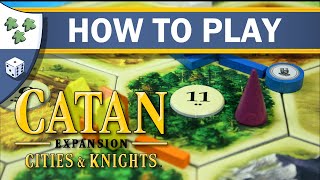
The expansion introduces a persistent external threat: barbarians approaching the island on a ship. Every turn, players roll an event die that has a fifty percent chance of moving the barbarians one step closer. The barbarians' attack strength scales directly with the total number of cities on the board, creating a clever feedback mechanism. Board Game Critique identifies this as "the master stroke," explaining that it "moves toward the island, and its attack strength scales with the total number of cities and metropolises on the board. So the player who's winning, the one with the most cities, is also the one contributing most to the threat level." Players must build and activate knights to defend collectively; failure to contribute enough strength means the player with the weakest defense loses a city, downgraded to a settlement. This mechanic creates what Shelfside describes as "a forced alliance between the players leaves us some pretty cool deal making potential in catan." It transforms the game from purely competitive into something with cooperative undertones, where the leader must invest resources in defense rather than running away with points.
City Improvements and Commodities
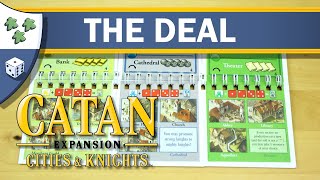
Cities can no longer produce two basic resources of a single type. Instead, they generate one basic resource plus a new commodity: paper from forests, cloth from pastures, coins from mountains. These commodities fuel three separate city improvement tracks: trade, politics, and science. Players spend commodities to advance on these tracks, unlocking special abilities and competing for three metropolis gates worth bonus victory points. The first player to reach the fourth level on any track claims a golden gate, converting that city into a metropolis worth four points instead of two. If another player later reaches level five on that same track, they steal the gate away. This creates multiple simultaneous victory races rather than a single sprint to 10 points. Board Game Critique notes that "the commodities layer, where cities produce these new resources that go into city improvement tracks" combines with "progress card decks, trade, politics, and science" to create "way more specific, way more interesting" gameplay than the base game's single development deck.
The Catan: Cities & Knights Experience
Strategic Depth and Player Interaction
The expansion significantly amplifies player interaction beyond the base game's relatively limited tool set. Shelfside observes that cities and knights introduces "more to do with wackier source of income" and "more player interactive" mechanics. The three progress card decks replace the base game's development cards with specialized options tailored to each track. A diplomat can remove roads. A deserter forces an opponent to sacrifice a knight, replaced by one of your own. These interactions feel targeted and contextual rather than generic. The deal-making potential intensifies as players negotiate who should contribute most knights to the defense, trade resources to fund armies, or deliberately undermine a leader by failing to help defend the barbarians when that leader has the most to lose. The shift from simple robber placement to complex knight positioning, activation costs, and strength calculations adds layers of tactical consideration.
Complexity as Double-Edged Sword
The increased depth comes with a steep cognitive load. Shelfside highlights a critical usability issue: "the knights which are one of the most important parts here are insanely hard to see if you don't play under studio lights yeah the active side is light tan and the inactive is black and white like from far away who knows the difference." Beyond visual clarity, the sheer number of systems creates what Shelfside describes as making "card handling fiddly. Commodities just sit in your hand for a long time being saved up as it can only be spent for one thing which is upgrading your flip sheet." Game length consistently exceeds published estimates, often stretching to two to three hours on initial plays as players learn to manage knights, commodities, and the advancement tracks simultaneously. For groups accustomed to the 45-to-60 minute rhythm of base Catan, this expansion feels bloated.
What Makes Catan: Cities & Knights Stand Out
Fixing the Runaway Leader Problem
Board Game Critique articulates the core design achievement: "Vanilla Catan has a runaway leader problem that the elegant simplicity of the base just cannot handle. Once someone builds a strong network in a high production hex, there's almost nothing the table can do about it." The barbarian mechanic inverts this dynamic. The player with the most cities contributes most to the threat level and risks losing a city if the collective defense fails. This creates what Board Game Critique calls "a persistent cooperative pressure underneath the competitive game, and the leader feels it more than anyone." It transforms the leader from untouchable to vulnerable in a fundamentally different way than base Catan's robber, which the community recognizes as "anti-fun in its base form" because it "almost always punishes whoever's in the lead, which the table eventually agrees on, so it just becomes the consensus targeting tool."
Structural Redesign, Not Just Content Addition
Board Game Critique emphasizes the depth of the redesign: "What Cities and Knights does is so much more than tweak. It overhauls the strategic core while keeping the bones familiar." This distinction matters. Most expansions add modules or components that coexist with the base game. Cities & Knights replaces core systems: the development deck becomes three specialized progress decks, the largest army tile disappears, cities now produce commodities alongside resources, and the turn structure expands to accommodate barbarian checks, progress card resolution, and improvement track purchases. The result feels less like an optional module and more like a different game with the same setting and basic rules. Board Game Critique captures this permanence in gameplay preference: "When we go back to vanilla Catan now, it feels skeletal."
Potential Drawbacks
Rules Complexity and Setup Burden
The rules introduce genuinely difficult edge cases that even experienced players find confusing. Knights have activation and movement mechanics that require tracking state across multiple turns. The interaction between activated and inactive knights, the strength calculations for defense, and the promotion costs create opportunities for mistakes. Shelfside notes the expansion "really needs a player aid for all the new mechanics it's introducing where knight activation and movement really needs to be clarified on a separate sheet." The setup process expands significantly: distributing advancement booklets, commodity cards, progress card decks, knight tokens, metropolis gates, and the barbarian ship. Games intended to last 90 minutes routinely exceed two hours, particularly on early plays. For casual players seeking Catan's accessibility, this expansion breaks the game's strongest asset: ease of teaching and quick play.
Component Quality and Visual Organization
Nights Around a Table raises component concerns: the distinction between active and inactive knights relies on a subtle color difference (slightly yellow versus grey) that becomes problematic in normal lighting. Shelfside's verdict is harsh: "this causes so much confusion with the round around invaders oh i flipped it over uh wait is it active okay with the lights back on." The commodity cards share visual similarity with base resources, creating hand management confusion. City walls as a mechanic feel underdeveloped; they increase hand capacity by two per wall but don't actually protect cities from barbarian attacks. The overall effect is a game where visual information doesn't clearly communicate mechanical state, and several systems feel half-baked relative to the barbarian invasion's elegant simplicity.
If You Enjoy Catan: Cities & Knights
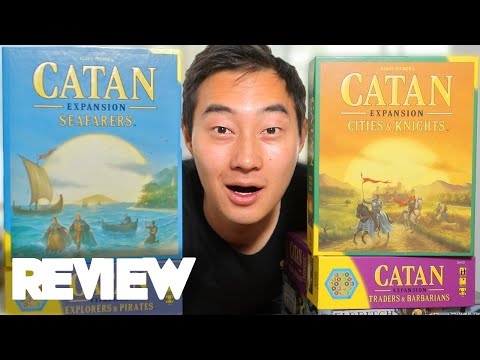
Shelfside reviewed every Catan expansion side by side, and its comparison is the most useful guide here. Catan: Seafarers is the easiest expansion to learn: ships work like roads on water, and scenarios send you out to colonize new islands. Shelfside names it one of the two expansions it recommends as a first step up from the base game,.
For a lighter touch, Shelfside describes Catan: Traders & Barbarians as a set of five easily digestible modules that can be mixed into any Catan game, including one with Cities & Knights. It suits groups who want to change the base game a little at a time.
What Reviewers Are Saying
"This is the expansion that in our minds basically becomes the real version of the game."
— Board Game Critique
"This injects a lot of novelty into catan with these new development cards where you take out the old deck and introduce three new decks."
— Shelfside
"You do not want to lose your last city in this game. It can be incredibly hard to bounce back from that."
— Nights Around a Table