


Posthuman Saga Deep Dive
What the Community Thinks About Posthuman Saga
Reviewers see Posthuman Saga as a clear step up from its original release. Designed by Gordon Calleja and published by Mighty Boards, it is a competitive post-apocalyptic adventure in which players cross a modular tile map, complete objectives, and resolve story encounters. Board Games UnLocked recalled the first edition's dice-based combat as a convoluted mess, and its hosts said the story layer and the Journey Home expansion make the current version far more engaging. The two hosts scored the game seven and eight out of ten.
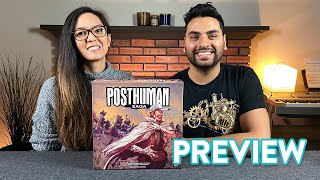
Before You Play previewed the game from a deluxe production copy and framed it as an exploration game in which players move across terrain and place mission tokens to score points. That preview also warned that the Journey Home expansion was a prototype whose rules could change.
The main point of disagreement is length. Reviewers praise the content and the theme, yet they question whether the 16-round structure earns its runtime. Reviewers also agree that the game is strongest with two players, and they describe the competition between players as more of a race than a conversation.
Core Mechanics That Define Posthuman Saga
Simultaneous Actions
Each round's day phase starts with every player holding four identical action cards. Players secretly choose one card, reveal them together, and then resolve the actions in turn order. The four actions are Forage, Camp, Map, and Track. Board Games UnLocked admitted that its own table rarely used the simultaneous timing, since a player choosing Camp left the other player with nothing to do. The rulebook suggests resolving Camp and Forage together to speed up play, and the reviewer wondered how much that would really help.
Resource Management
Food, ammo, boost tokens, broadcast tokens, and recovery points drive nearly every decision. Each morning a character eats one food or takes fatigue, and the round tracker sets the pace of that cycle. Camp lets players spend up to four recovery points on health, morale, fatigue relief, boost cubes, broadcast tokens, or challenge cards. Board Games UnLocked said that fights drain ammo quickly, so players must forage steadily to keep up. One of its hosts found it odd that ammo is scarce in a post-apocalyptic setting, since the reviewer thought it was easy to make yourself. Broadcast rounds add a bidding layer where the highest bidder picks first from the terrain and scavenger pairings.
The Posthuman Saga Experience
A Race Against the Round Tracker
The game is built around a clock of 16 rounds, and the sense of pressure builds as the tile supply shrinks. Board Games UnLocked observed that the round tracker is interesting mainly because players look forward to the next story event. Late-game tile flipping can feel like going through the motions when few meaningful choices remain. In that playthrough both players were racing for the same scavenger bonuses, which kept every choice tense. The result is a race that rewards careful route planning, though the final rounds sometimes reduce to pushing out the last blank tokens.
Wry, Story-Driven Humor
The tone is lighter than many post-apocalyptic games. Board Games UnLocked said the writing is solid rather than remarkable, and it contrasted the game's mood with the grim atmosphere of War of Mine. Characters who pick up croquet mallets to go mutant hunting, and a morning event built around a figure peering moronically out of a window, give the setting a self-aware bounce. That mix of tongue-in-cheek moments and real danger gives the game much of its personality.
What Makes Posthuman Saga Stand Out
Story Events That Shape the Route
Board Games UnLocked was enthusiastic about the story layer. Before You Play noted that the companion booklet contains 70 stories, and the reviewer explained that many choices depend on visible mutations, specific followers, or character traits, so the same encounter can play out differently from game to game. Events are random without feeling cruel, because players can often plan around them. For example, a player can choose Forage instead of Trek to dodge a fatigue penalty. The reviewer credited these elements with keeping the game fresh across a long session.
Character Decks and Upgrades
Each character has a personal deck, and Board Games UnLocked called this the biggest upgrade over the first edition. Players improve those decks with XP, weapon mods, and skill cards that are spent during the night phase, which lets two players with different characters develop different approaches. Journey Home adds two new characters, and the reviewer said the cast offers enough variety to support several distinct builds. The reviewer also liked that scavenged weapons usually feel worth using.
Potential Drawbacks
Length and Late-Game Momentum
Length is the criticism that reviewers return to repeatedly. Board Games UnLocked timed a two-player session at nearly three hours and felt that it dragged past its welcome. The late game can lose its tension once the tokens run out, and one host suggested removing four blank tokens so the game finishes in 12 rounds rather than 16. The same host said the game would earn an eight out of ten with four fewer rounds, because the story and puzzle elements would stand out more.
Limited Interaction and Combat Stakes
Board Games UnLocked described the two-player experience as a multiplayer solitaire race. Players can see each other's progress and compete for tiles, but there is little direct contact, and the reviewers wished for a way to trade or cross paths. Combat also drew mixed reactions. One host said combat rarely felt challenging once a character was prepared, while a second Board Games UnLocked playthrough showed how quickly a fight can go wrong when a player goes in unprepared. Before You Play's preview also noted that the expansion's rules were still a prototype.
If You Enjoy Posthuman Saga
Players who enjoy Posthuman Saga's tile-based route planning and its thematic, Euro-leaning structure will find similar satisfaction in Vindication. Board Games UnLocked drew that comparison directly, describing the Posthuman Saga design as very Euro in its structure while remaining genuinely thematic, a balance that also defines Vindication.
What Reviewers Are Saying
"The way that it works is you're going to just choose one of these per round to play and this is going to be done simultaneously and secretly. So Naveen and I would both decide on a card, put it face down, and once we're both ready we reveal them at the same time."
— Before You Play
"I think that this one does a really good job of throwing in some humor. It's not like this brooding Like Woe Is Me post-apocalypse."
— Board Games UnLocked
"What's interesting is it's not the easiest or it's not the hardest thing to kill these enemies. But man if you don't kill them or mainly if you go into a combat unprepared it it kind of hurts."
— Board Games UnLocked