

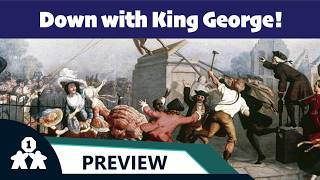

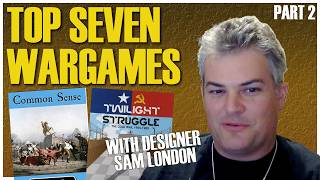

Common Sense: An American Revolution 1775-1783 Deep Dive
What the Community Thinks About Common Sense: An American Revolution 1775-1783
Common Sense emerges as a standout design from wargame channels exploring recent releases. Reviewers consistently praise it as an accessible yet strategically dense experience that leaves players immediately wanting to replay it with new approaches. The consensus is clear: Sam London has created something fresh that manages to feel both historically grounded and open-ended. Zilla Blitz described the game as possessing remarkable replay value, noting that immediately after playing, the desire to try different strategies overwhelms any fatigue from learning rules. One Stop Co-op Shop's Mike emphasized the coherence of its solo mode, a particular challenge for trick-taking games. The broader take from the community is that Common Sense succeeds where many historical wargames fall short: it teaches meaningful decisions without crushing players under complexity, and it rewards creative play rather than punishing deviation from historical orthodoxy.
Core Mechanics That Define Common Sense: An American Revolution 1775-1783
Trick-Taking Card Play
Common Sense inverts the traditional trick-taking experience by coupling it to historical warfare. Each player controls a unique 36-card deck where every card represents a historical figure, battle, or concept from the American Revolution. Cards belong to four suits corresponding to core actions: green for movement, yellow for special asymmetric abilities, blue for recruitment, and red for combat. Players lead a card and opponents must follow suit if able, with the highest card of the led suit, or of a trump suit, winning the trick. What distinguishes Common Sense from standard trick-takers is that the card a player wins with determines what action they then resolve. This creates a constant tension: lower-value cards are mechanically stronger, rewarding difficult choices about when to spend weak cards to secure high-value actions. Sam London designed the asymmetry intentionally so that higher-value cards carry weaker events. A nine-value card might grant a single action, whereas a zero-value card unleashes a powerful historical event. This inverted value hierarchy means victory goes not to whoever can muster the highest cards, but to whoever reads the shifting card landscape and executes timely plays.
Asymmetric Card-Driven Wargame Design
The game separates itself through radical asymmetry. The British and Colonial forces operate under fundamentally different mechanics and face different victory paths, anchored in a shared will-to-fight system. Both sides track their willingness to continue the conflict, but the mechanics eroding that willingness are entirely separate. The British player worries about maintaining forces back in Europe while keeping Parliament convinced the war is winnable; losing too many regulars or failing to win battles crumbles British public support. The Colonial player, by contrast, loses resolve when they surrender territory: losing Pennsylvania, for instance, tanks their morale dramatically. This asymmetry extends to recruitment. The Colonials simply spawn militia in uncontrolled spaces, while the British must navigate a supply network anchored to coastal ports, recruit Hessian mercenaries at steep cost, and manage Tory recruits and native raiding forces. Sam London explained that they wanted these two factions to feel like they are genuinely fighting different wars, using different levers, within the same game. The result is a design where no two games play out alike because the tools each side brings and the pressures they face are fundamentally distinct.
The Common Sense Experience
Sandbox Exploration of Alternative History
Reviewers consistently describe Common Sense as a sandbox, and the word carries weight. The game gives both sides numerous strategic levers to pull. The British can focus on a Northern strategy, attacking down through New York and Canada, or shift to a Southern strategy, relocating their forces to pursue a different campaign. They can lean heavily on native allies, training them into formidable forces, or ignore that axis entirely. The Colonials can prioritize French entry into the conflict, accelerate militia training into Continental regulars, or focus on territorial defense. Because card-driven events populate historical scenarios, such as Benedict Arnold, French alliance negotiations, and harsh winters, the same cards played in different sequences tell radically different stories. Zilla Blitz played a game where the British won by capturing Philadelphia and surrounding the Continental Congress with native forces, forcing surrender, an outcome the designer had worked toward for years but only recently achieved in testing. That level of alternative history play is the entire point: players are not following a historical simulation but playing through a branching space of what-if scenarios, grounded in the period but never beholden to it.
Tense Strategic Depth
Despite its accessible rules for a wargame of this weight, Common Sense generates constant tension through decision density. Reviewers noted that every card play feels meaningful. Mike from One Stop Co-op Shop described working through the bot's decision-making in solo mode and found it sophisticated without becoming impenetrable. The trick-taking frame creates information asymmetry: when a player leads a card, they do not know what their opponent holds, so every bid is a bluff. But a player can read the discard pile, track which suits are depleting, and infer what the opponent likely still has in hand. This layer of deduction creates what Sam London called the head game. Once a player has played twice and learned the cards, they notice that both decks contain a Benedict Arnold card, and the British version shuts down the American one. Suddenly the second game becomes about timing: burn a valuable card early to stop an opponent's Benedict Arnold, or save the hand for other priorities. Zilla Blitz described this experience repeatedly: the desire to play again was driven not by random variation but by recognizing new decision branches not yet explored.
What Makes Common Sense: An American Revolution 1775-1783 Stand Out
Sam London's Design Excellence
The broader wargame community views Sam London as an ascendant designer bringing genuine innovation to the field. Zilla Blitz stated that London would be recognized as one of the most creative and ingenious historical board game designers of their generation within five years. What separates London's work is not novelty for its own sake but novelty in service of historical exploration and emergent play. London's previous work, including Firefight Tactical, a tactical-level companion to Common Sense's strategic scope, and London's upcoming Microverse, a 4X game designed to play in under 15 minutes per player, both demonstrate a design philosophy grounded in replayability and mechanical clarity. For Common Sense, London constructed each card to carry historical weight, representing actual figures and events, while remaining mechanically interchangeable, allowing players to explore counterfactual scenarios without the game becoming academic or dry. Every design choice serves the dual goal of authenticity and openness.
The Will to Fight System as Victory Condition
Rather than pursuing territorial conquest or military annihilation, both sides lose when their will to fight erodes to zero. This system, Sam London noted, was inspired by the elegant macro-economic systems of Imperial Struggle, where actions taken in peacetime set up the modifiers that resolve conflicts. In Common Sense, players spend the game accumulating advantages, territory, and momentum, but victory is determined by whether the opponent's commitment to the war has collapsed. The British might control half the colonies militarily but still lose if Parliament decides the war is unwinnable and their will to fight evaporates. The Colonials might face overwhelming force but hang on if they maintain resolve. This creates a system where military success and political sustainability are distinct challenges: players cannot simply dominate on the map, they must also manage their side's fatigue, supply lines for Britain, and morale for the Colonials. The design elegance lies in making these two victory paths feel integral to the war, not like separate minigames.
Potential Drawbacks
Weight and Learning Curve
Common Sense is unabashedly a heavy wargame. Mike's teaching notes from One Stop Co-op Shop run to great length, and Mike still warned that the prototype rules continued evolving during the preview period. The solo mode, while praised, requires careful tracking of card availability, trump relationships, and the bot's decision priorities across multiple tables of reference material. Players learning the game should expect their first play to run longer than the advertised 90 to 150 minutes as they consult rules and work through the decision trees, particularly around the asymmetric special actions available to each faction. Reviewers all recommended playing through at least one scenario before attempting the longer campaigns.
Two-Player Only
Common Sense is designed as a two-player head-to-head game. The asymmetric factions and direct conflict mean that multiplayer variants are not straightforward. While a solo mode exists, guided by detailed bot tables and priorities, solo play transforms the experience into playing against a predetermined system rather than against another human's decision-making. Zilla Blitz emphasized that the game is very much a two-player game, and solo play, while functional, shifts the experience toward procedural puzzle-solving rather than psychological warfare and bluffing.
If You Enjoy Common Sense: An American Revolution 1775-1783
Reviewers explicitly mentioned Twilight Struggle as the spiritual predecessor, citing its card-driven event system and the head game of knowing when an opponent might hold specific cards. Common Sense takes Twilight Struggle's principle, that knowing what cards exist in the decks creates strategic depth even with random events, and applies it to asymmetric wargaming. Arcs, another asymmetric game, shares Common Sense's commitment to letting both players play fundamentally different games within the same ruleset. Readers who gravitate toward Twilight Struggle and appreciate both historical grounding and strategic variety will find Common Sense immediately accessible. Those who have enjoyed other Sam London designs, such as Firefight Tactical, should also prioritize this one. For players seeking alternative history games at the strategic level, Common Sense delivers what few designs attempt: a game where the historical outcome is truly uncertain and divergent play styles lead to genuinely different wars.
What Reviewers Are Saying
"It is an odd duck. So this was this was the answer to okay if I was going to design a tactical game what would it look like and the answer was Firefight Tactical. This was if I was going to design a strategic game what would it look like? And the answer was Common Sense."
— Sam London, Zilla Blitz Interview
"As soon as I'm done with them, I want to play it again. And that's why this game is here. It's like, of all the games that I've played in the past month, if you said you could play any game again that you could play you don't have right now, which game would it be? Be Common Sense. Really want to play that one again because I feel like I have a lot of ideas on how I can do a lot better the next time."
— Zilla Blitz, December 2025 Game of the Month
"People who enjoy games that ask them to think, people who enjoy games that let you experience history in a in a divergent way, you know, alternative history path lines and and that trip of sandbox feel, I think are really going to enjoy it, too."
— Zilla Blitz, Sam London Interview