










Cross the Line Deep Dive
What the Community Thinks About Cross the Line
Cross the Line has struck a strong chord with reviewers who play it as a centerpiece for social moments. Grant Lyon, who contributed to the game's card writing, calls it "a hit" and primes it as the kind of game you bring to family gatherings and friend nights. Other channels consistently describe it as a fresh take on personal revelation games, most often drawing comparisons to Wavelength while emphasizing that Cross the Line leans harder into getting to know the people around the table. The game generates the kind of moments reviewers highlight as unforgettable: learning something surprising about a friend and feeling the satisfaction of reading them correctly, or the delight of being caught off guard by their answer.
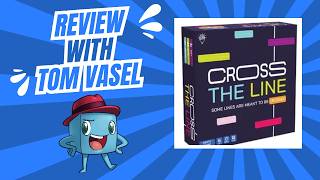
Tom Vasel from The Dice Tower rates the game a 6 out of 10, acknowledging its solid design while flagging production and question quality concerns that hold it back from being excellent. Reviewers across channels are united that this is a party game first and foremost, designed for laughter and connection rather than strategic depth.
Core Mechanics That Define Cross the Line
Spectrum Positioning and Secret Guessing
At Cross the Line's heart is a deceptively simple idea: one player reads a spectrum question (ranging from one extreme to another), secretly positions a line where they fall on that spectrum, and hides their choice behind a sliding shield. Everyone else then places tokens on the board to guess where that line is. The spectrum questions are deeply personal. Grant Lyon gives an example from their own experience: "How much do I like my fan setting, from I don't have a fan to keep it blasting on me all the time?" These are the kinds of preferences and feelings that reveal character and spark conversation. The straightforward mechanic makes the game teachable in 10 to 20 seconds, which reviewers praise as essential for a party game.
Risk and Reward Through Token Sizing
Each player has three tokens of different sizes. The largest token is easiest to place and scores one point if it crosses the line; the smallest is harder to place but awards three points. This push-your-luck element adds a light strategic layer. Reviewers note that the tension between a conservative choice and a risky one mirrors the social tension of the game itself, you know whether to play it safe with your guess or risk a bold prediction about someone's preference. The different token sizes ensure the game accommodates both cautious and confident players at the same table.
The Cross the Line Experience
Surprising Discovery and Connection
What reviewers consistently highlight is the emotional core of Cross the Line: the moments of genuine surprise and recognition. Grant Lyon captures this: "I've played this multiple times where it always leads to those memorable moments where you're like, 'What? I did not know that about you.' Really? And so there's there is an aspect of like getting to know your friends better, getting to know your family members better." These moments aren't manufactured by the game's rules, they emerge from the questions and the people answering them. A room of comedians on Good Time Society's playthrough generated waves of laughter and riffing as players reacted to answers. The game becomes a catalyst for stories and small revelations.
Easy Social Friction and Trash Talk
The game thrives on playful conflict. Because you are explicitly trying to read another player's mind, you are constantly making micro-bets on how well you know them. When you guess correctly, you feel the satisfaction. When you miss wildly, the table laughs at how wrong you were. There is a natural flow to trash talk and light roasting as players defend their guesses or mock a friend's unexpected answer. Reviewers describe this as "super fun," capturing the easy, consequence-free ribbing that party games thrive on.
What Makes Cross the Line Stand Out
Personal Storytelling Over Generic Clue-Giving
The most distinctive feature reviewers notice is that Cross the Line does not ask players to guess a word or concept; it asks them to guess where a friend falls on a spectrum of personal preference. Grant Lyon notes it is "kind of like Wavelength, but for personal storytelling and facts." This reorientation is crucial. You are not decoding a codeword, you are making an educated guess about someone's taste, comfort level, or habit. That difference compounds over a game: each question reveals something true about the people playing, rather than testing how well you can give abstract clues.
Immediate Teachability and Zero Downtime
Reviewers repeatedly praise how fast you can get Cross the Line to the table and how smoothly it plays. Grant Lyon emphasizes it as a game you "can teach in, you know, 10 seconds, 20 seconds" and that "it just looks really good on the table." The physical board with the sliding line mechanism is visually clear, the turn structure is transparent, and there are no ambiguous rules to negotiate. For a party game, this is a massive advantage: you spend more time playing and laughing, less time explaining.
Potential Drawbacks
Production Quality and Physical Reliability
Tom Vasel flags a real issue: "The production of it kind of hems keeps it from being great. It's easy for things to slide around." The sliding mechanism that hides the player's line guess is the game's defining physical feature, and if it does not function smoothly, the secrecy that drives the game is compromised. This is not a game-breaking flaw, but it is a quality-of-life problem that nags at otherwise smooth gameplay. Reviewers who value tactile, reliable components may find this frustrating.
Uneven Question Quality and Low Ambiguity
Not all spectrum questions are created equal. Tom Vasel points out that some questions offer no real spectrum at all: "How afraid am I of spiders? Everyone's like, well obviously he hates spiders. There's not a Some of the questions is not very much ambiguity." When the answer feels obvious, there is no mystery to solve and no learning moment. The game relies on a wide variety of genuinely interesting questions to sustain engagement across multiple plays. Quality curation of the question deck makes the difference between a game that keeps revealing new sides of your friends and one where the novelty fades.
If You Enjoy Cross the Line
If Cross the Line resonates with you, Wavelength is the natural next step, though reviewers note it operates on a different axis. Wavelength asks you to understand a category and give abstract clues; Cross the Line lets you read a person. Both are party games built on knowing the people at your table. If you want more personal-storytelling-based games that create memorable moments and laughter, look for games with similar DNA: hidden-information party games where the social interaction is the point rather than the strategic outcome.
What Reviewers Are Saying
"I've played this multiple times where it always leads to those memorable moments where you're like, ‘What? I did not know that about you.’ Really? And so there's there is an aspect of like getting to know your friends better, getting to know your family members better, where you're like, ‘Oh, I know this about you.’ And then you feel good when you're right, or you get surprised when you're wrong."
— Grant Lyon
"Cross the Line is a great new party game. It's kind of like Wavelength, but for personal storytelling and facts. One player will read a spectrum and then set a line, and then everybody else is guessing where that line is, and then you get to know your friends better."
— Grant Lyon
"It just looks really good on the table. This is a game also you can teach in, you know, 10 seconds, 20 seconds. So, it's going to be uh easy to get uh get to the table with various different groups of people."
— Grant Lyon