









Clash of Corgis Deep Dive
What the Community Thinks About Clash of Corgis
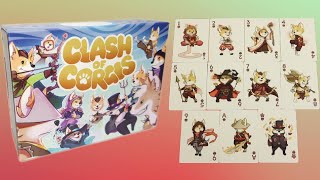
Clash of Corgis is a pocket-sized card game from designer Deric Drazich that packs three separate games into one deck of corgi cards: the Original shedding game, a push-your-luck questing mode called Treasure Island, and a two-player memory duel called Capture the Illusionist. Reviewers broadly like what the deck does. Brains On Games, which received a copy from the designer, found the second and third rule sets a big hit with its group because nobody had played anything like them before. Chairman of the Board, also sent a copy by the design team, ranked it fourth of five new-to-me games and called it tightly designed and cleverly thought out. Let's Table It found all three games relatively easy to learn and play.
The praise comes with one criticism that nearly every hands-on reviewer repeats: the card abilities are not printed on the cards. Much of the remaining coverage is promotional. The Brothers Murph and Foster the Meeple both featured the game in segments sponsored by Clash of Corgis, and TheGameBoyGeek previewed a prototype for the crowdfunding campaign, so those videos describe the game rather than judge it.
Core Mechanics That Define Clash of Corgis
Climbing and Shedding With Card Powers
The Original mode is what Brains On Games calls a climber and shedder. Each player starts with 12 cards and tries to be first to empty their hand. The round leader plays a single, a pair, or up to five of a kind, and every following player must match that number of cards at a higher rank or pass. There are no runs. Each suit holds ranks one through nine, an ace that beats a nine, and a wild illusionist that beats any rank.
The twist is that every rank carries a power, and playing a combo triggers one of them. Foster the Meeple reads out examples from the reference card: the bard lets a player take another turn, as long as the next play matches the bard's suit; the assassin skips the next player; the mage discards a matching-suit card from hand. The fighter forces the next player to expose a card from their hand. Chairman of the Board singles out the number one card, which reveals the top card of the deck and wins the round instantly if the suits match, and calls it a shoot-the-moon mechanism. Brains On Games notes that the ace works like a nope card that cancels another player's ability. Exposed cards cannot be combined with cards in hand, which Brains On Games calls the unique wrinkle of the Original mode.
Push Your Luck in Treasure Island
Treasure Island reuses the same cards for a different goal: first to 10 loot. Players build a party of at most two cards, triggering each card's ability as it is played, then may choose to fight one, two, or three face-down foes from the deck. If the party's total beats the foes, they become loot; a tie goes to the foes. Aces and illusionists count as 10, and Brains On Games explains that two party cards of the same suit add a bonus of 10. Deciding how many foes to draw is the push-your-luck heart of the mode. Let's Table It describes Treasure Island as a variation of War, made more strategic by the card effects and suit pairings.
The Clash of Corgis Experience
Light, Quick, and Portable
Reviewers frame Clash of Corgis as a light game. Brains On Games says games take 10 to 20 minutes and that the small box could fit in a pocket for a trip to a restaurant. The box lists age 13 and up, but both Brains On Games and Let's Table It think much younger players can handle the Original mode; Let's Table It suggests seven or eight year olds could play. Brains On Games also enjoyed the take-that side of Treasure Island, where players steal loot from the leader, and stresses that it never felt malicious.
A Memory Duel Unlike Anything Else
Capture the Illusionist is the mode reviewers found most surprising. Each player takes all 11 cards of one suit and deals eight face down in two rows of four, keeping three in hand. Neither player knows where their own illusionist sits. Each turn begins with a peek at one hidden card; then a card is activated and turned sideways to rest. The goal is to reveal the opponent's illusionist twice. A revealed illusionist can be saved once by discarding the ace, if its owner can find it. Brains On Games describes the illusionist's own power, shuffling itself with two hidden cards, as a shell game. It notes that the mode trains spatial memory, because players must remember not just which card is where but when it was there. Brains On Games reports that the teenager it played with named it a favorite card game.
What Makes Clash of Corgis Stand Out
Three Genuinely Different Games in One Deck
The core selling point is that one deck supports three distinct games, each with its own set of card powers. TheGameBoyGeek sums it up as three separate games from a pocket-size box. Brains On Games calls Capture the Illusionist a completely different beast from the other rules, and the reviewer's own favorite was Treasure Island, for its push-your-luck fights and loot stealing. Groups that want a shedding game, a light push-your-luck game, and a two-player memory game can get all three from the same cards.
Small Powers That Add Real Decisions
Chairman of the Board argues that the shedding structure is as simple as it gets, but that the rank powers are where the cleverness lies. Even low cards that are normally hard to shed become useful for their abilities. Forcing opponents to expose cards adds guile, especially against a player down to their last few cards. Reviewers also enjoy the corgi art, with the dogs dressed as warriors, wizards, and musicians.
Potential Drawbacks
Abilities Live on a Reference Card
The most repeated complaint is that nothing on a card reminds players of its power. Brains On Games says it came up multiple times during play: each of the three modes gives the 11 ranks different abilities, so players kept passing the rules around the table. Its group found the powers easier to remember in Capture the Illusionist, where the same abilities recur. Chairman of the Board calls this a fatal error that kept the game out of the top spots, describing a tiny reference card that forces players to squint. Let's Table It also wishes the abilities appeared on the cards, even in three separate sections.
Light Games, and One Mode Might Be Enough
Chairman of the Board had no interest in the memory and questing modes and would rather have seen one shedding game done to the highest possible standard, with its powers printed on the cards. Players looking for depth should note that Brains On Games describes all three games as light. Board Gaymes James, who received an unsolicited copy through what that channel called a mass marketing campaign, never played it and eventually got rid of it.
If You Enjoy Clash of Corgis
Chairman of the Board points to Ship It from Amigo as a shedding game that works in a similar manner, with players matching the number of cards played, but with chips that raise card values at the cost of a wasted turn later. For Treasure Island, Let's Table It's comparison to War is a reminder of how simple the core comparison is, with card effects and suit pairings adding the strategy.
What Reviewers Are Saying
"Lovely artwork, really nicely produced, tiny little box, nice clean rules, good clever gameplay, but sadly a missed opportunity by not putting those keywords on the cards."
— Chairman of the Board
"The three games are relatively easy to learn and play. They might remind you of some of the classic card games out there, but they also each have special card abilities to change those games up."
— Brody, Let's Table It
"The second two rule sets were a big hit with our group because we hadn't played anything like that before."
— Dr. Brian McDonald, Brains On Games